

An affiliate network is an intermediary technology and operations layer connecting advertisers with publishers, aggregating partner recruitment, tracking, attribution, commission calculation, payment, and compliance workflows. It turns separate merchant and publisher relationships into a managed system where referrals can be recorded, evaluated, paid, and audited.
But what is an affiliate network really controlling when the headline commission rate looks attractive? The difficult part isn't finding a tracking link. It's understanding who receives credit, which conversions get approved, how reversals work, and when money reaches the publisher.
For marketers researching programs, platforms, agencies, and technology providers, that distinction matters. A network can simplify recruitment and administration, yet its rules can also shape effective earnings, reporting quality, and the commercial relationship between a merchant and a publisher.
Table of Contents
- Understanding What an Affiliate Network Is
- How Affiliate Tracking and Attribution Work Technically
- The Hidden Economic Trade-Offs Networks Control
- Different Types of Affiliate Networks and Pricing Models
- How to Choose the Right Affiliate Network
- Setting Up Merchant and Publisher Accounts
- Why AffiliateLandscape Simplifies Network Discovery
Understanding What an Affiliate Network Is
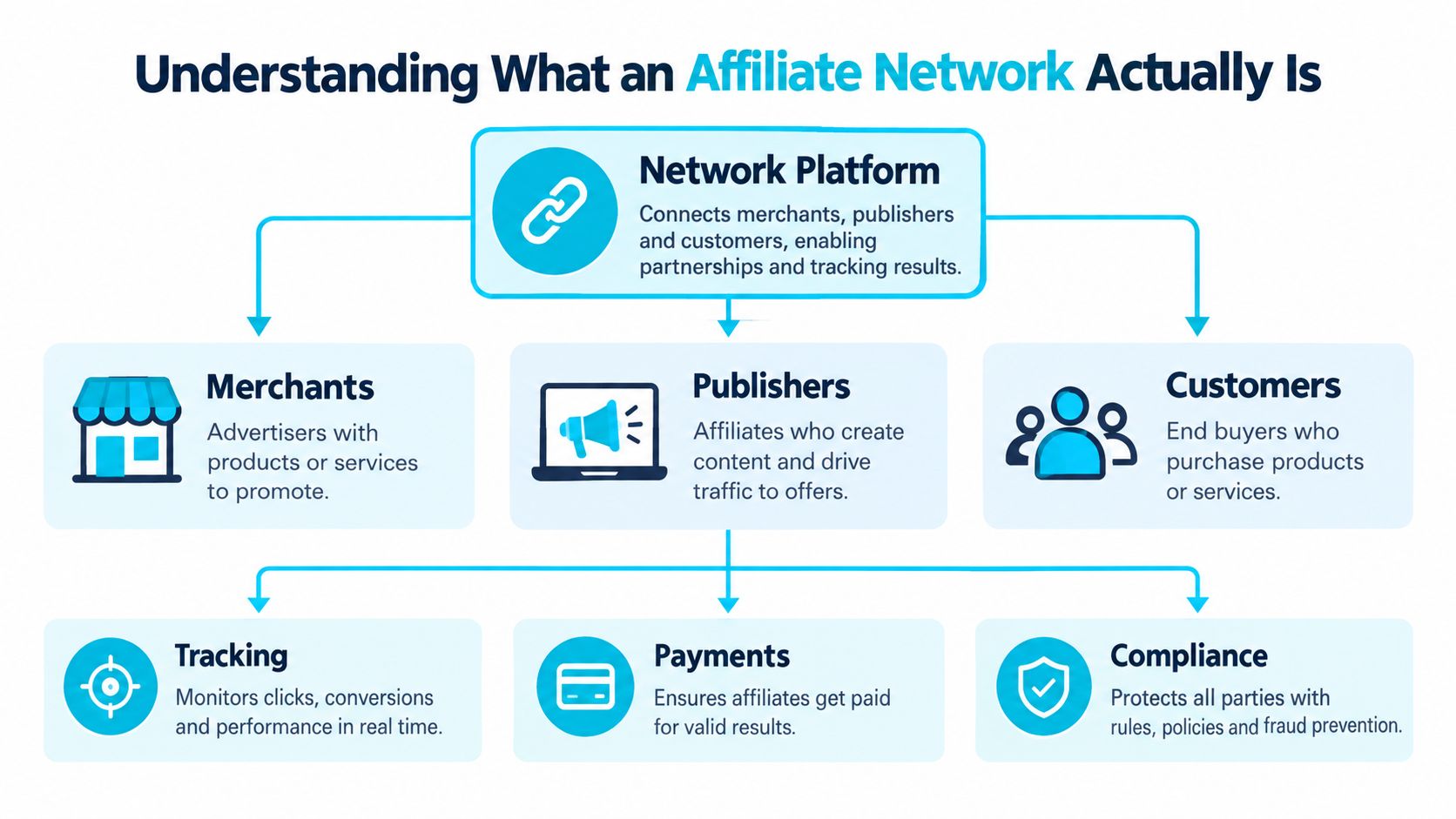
What happens between a customer's click and a publisher's commission? An affiliate network provides the commercial and technical layer that connects merchants or advertisers with affiliates or publishers, then manages the work required to turn referred activity into a payable transaction.
Its responsibilities commonly include partner onboarding, trackable-link creation, click and conversion records, commission calculation, reporting, payments, compliance support, and suspicious-activity reviews. These functions matter because a commission rate has little meaning if conversions are rejected, attribution rules are restrictive, or payment arrives long after the sale.
The main participants have separate roles:
- Merchants: Brands or businesses selling products, services, subscriptions, or other offers. They define the qualifying conversion and fund approved commissions.
- Publishers: Content creators, comparison sites, loyalty platforms, media companies, and other partners that generate traffic or influence customer action.
- Customers: People who click, browse, and complete the action that may qualify for commission.
- Networks: Infrastructure providers that coordinate relationships, standardize tracking, apply attribution rules, and handle operational administration.
Agencies and OPMs occupy a different position. An agency or outsourced program manager may recruit partners, develop strategy, negotiate placements, and operate a merchant's program. The network provides the underlying infrastructure. One organization can hold several roles through separate products or services, so identify whether a provider is supplying technology, program management, or both.
Why networks emerged
Dedicated affiliate-network companies entered the market in 1996, when LinkShare and Be Free appeared during the rapid expansion of merchant affiliate programs. Before then, merchants and publishers could form direct relationships, but each relationship required its own tracking, reporting, payment, and administrative work. A network let one platform serve many advertisers while publishers accessed multiple programs through a shared interface. Online Marketing Essentials explains the development of affiliate marketing networks
Amazon's Associates program launched in July 1996 and helped popularize a public model in which websites placed product links and earned commissions when referred visitors purchased products. Amazon was not necessarily the first online affiliate program. PC Flowers & Gifts launched one in October 1994, followed by other early programs. Amazon's public approach became an important industry template.
The practical lesson is that networks solve coordination problems. Merchants need a reliable way to identify referring partners and validate actions. Publishers need offer access, usable links, conversion information, and payment. Customers need a working path from recommendation to purchase.
For a broader explanation of the channel and its infrastructure, read AffiliateLandscape's guide to affiliate marketing.
Practical rule: Treat a network as an operating layer, not a marketplace of offers.
The network's value appears in the handoffs. It creates publisher accounts, issues unique tracking URLs, receives conversion data, applies eligibility rules, records approved and reversed transactions, and sends reporting and payments to the relevant parties. Evaluate those rules and timelines alongside the headline commission rate, because they determine effective earnings.
How Affiliate Tracking and Attribution Work Technically
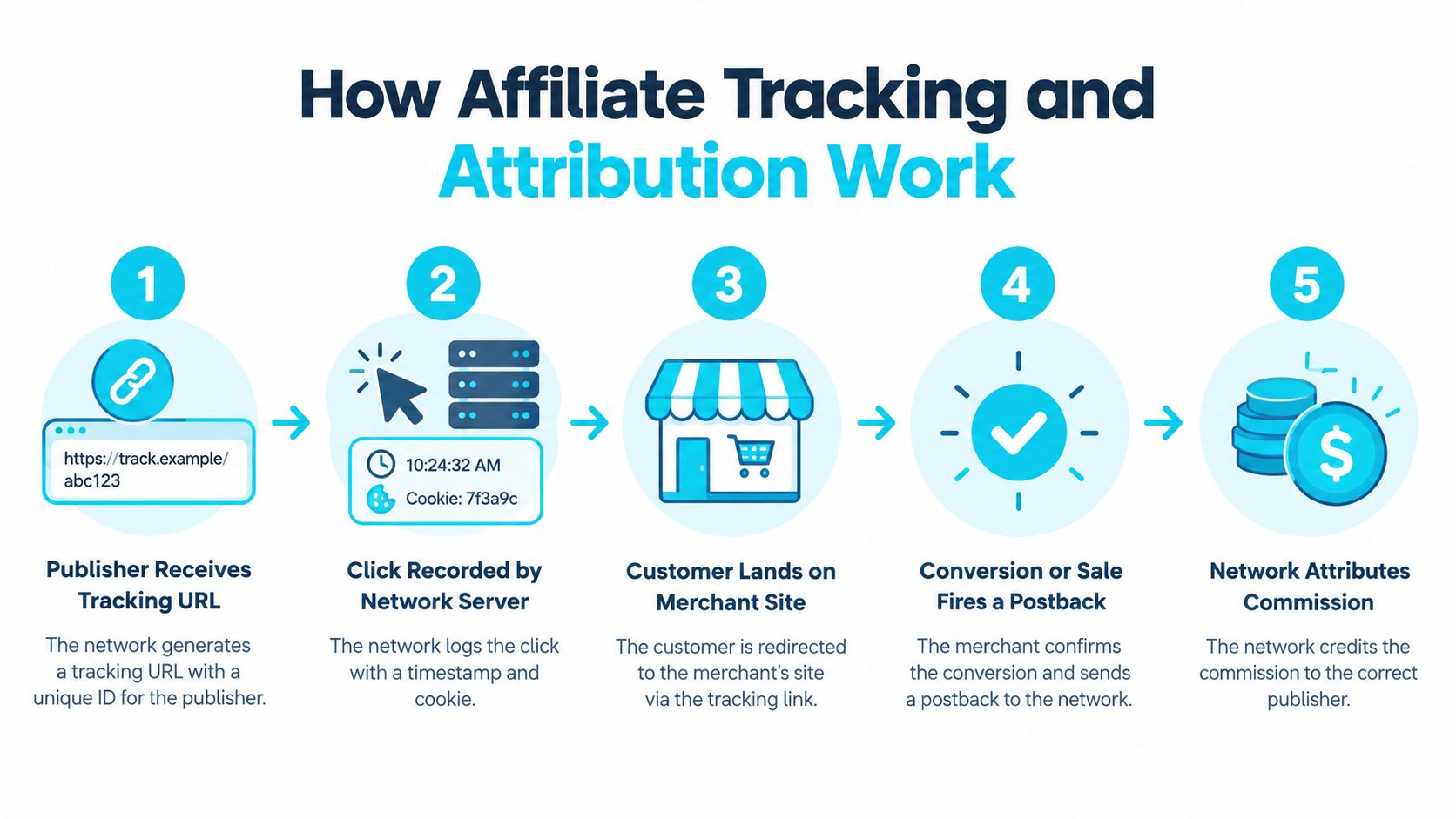
How can a network connect one publisher's click with a later purchase? A network tracking link usually contains a unique affiliate identifier, along with optional campaign, creative, sub-ID, or click-token fields. These parameters identify the referral and help publishers compare placements.
The process generally follows five stages:
- Link generation: The publisher selects an offer and receives a network tracking URL.
- Click capture: The customer clicks, and the network records referral details such as time, placement, browser information, and an event token.
- Merchant visit: The customer reaches the advertiser's website, application, or landing page.
- Conversion transmission: The advertiser or network sends a pixel event, API transaction, or server-side postback. It may include the order ID, revenue, product, and commissionable status.
- Attribution and reconciliation: The network matches the conversion with an eligible referral, then records the commission, adjustments, refunds, and payout status.
Why attribution rules matter
A network records more than a click. It applies rules that decide whether the referral receives credit. These may include last-click attribution, lookback windows, coupon-code overrides, and deduplication logic.
Under a last-click rule, the most recent eligible click may receive the conversion. A coupon-code rule may assign credit to the publisher linked to the code, even when another partner introduced the customer earlier. Deduplication prevents one order from creating multiple payable conversions. The result is an attribution ledger, not a neutral list of links.
The ledger must reconcile clicks, conversions, refunds, chargebacks, and publisher payouts. If the advertiser's order system conflicts with the network's records, validation and reversal procedures determine the commercial result. Publishers should understand these mechanics before judging a program by its stated commission rate. For a deeper walkthrough, see AffiliateLandscape's step-by-step technical guide to affiliate tracking.
The risk of attribution corruption
Broken links are only one technical risk. Research from the University of California, San Diego characterizes cookie stuffing as an abuse technique that injects affiliate cookies without a genuine qualifying referral, which can create fraudulent commission claims. (The UC San Diego research on cookie stuffing describes how fraudulent affiliate attribution can occur)
Merchants can reduce exposure through several controls:
- Server-to-server validation: Confirm conversion data independently instead of relying only on browser-side events.
- Order-ID deduplication: Reject repeated submissions for the same transaction.
- Anomaly monitoring: Compare click-to-conversion latency, conversion concentration, device patterns, and placement behavior.
- Delayed approval: Hold commissions until returns, refunds, and chargebacks have cleared.
- Audit trails: Preserve enough event data to explain why a conversion was accepted, rejected, or reversed.
Publishers face the same uncertainty from the other side. A reported conversion can remain pending, change status, or be reversed after the initial event. The tracking interface records an operational decision, not unquestionable proof that the publisher caused the sale. That distinction affects effective earnings and should shape how publishers compare networks.
The Hidden Economic Trade-Offs Networks Control
A network is often described as a neutral broker. Operationally, it can control approval rules, attribution windows, conversion validation, reversal policies, payment timing, and access to advertiser data. Those choices affect the publisher's real economics even when the advertised commission rate stays unchanged.
Publishers should ask four questions before investing heavily in a program:
- Are commissions calculated on gross sales or net sales?
- Are returns and chargebacks deducted?
- Can approved conversions be reversed later?
- How long does the network hold funds before payment?
Typical programs use attribution windows ranging from 24 hours to 90 days, while payouts may be delayed 30 to 60 days to allow for returns and chargebacks. (The analysis of affiliate program economics discusses attribution windows and payout delays) These are not minor administrative details. They determine how quickly revenue becomes usable cash and how much of the reported commission survives validation.

Nominal commission versus effective earnings
Suppose two networks promote the same merchant with the same stated commission. Their results can still differ because one network approves more transactions, reverses fewer orders, pays sooner, or charges less for currency conversion. A publisher evaluating only the headline rate misses the terms that determine the amount eventually received.
A more useful comparison includes:
| Metric | Why it matters |
|---|---|
| Approval rate | Shows how many reported conversions become payable |
| Reversal rate | Reveals the effect of returns, chargebacks, and validation decisions |
| Payment latency | Indicates how long approved revenue remains unavailable |
| Minimum payout threshold | Determines whether small balances are paid or carried forward |
| Currency-conversion costs | Affects the value of cross-border payments |
| Attribution share | Shows how much activity qualifies under the network's rules |
Global publishers also need to review tax documentation, supported payment methods, settlement currencies, and market-specific compliance requirements. A commission that looks strong in a dashboard may be less valuable after conversion charges, withholding requirements, or delayed settlement.
Network economics also matter to merchants. The advertiser generally funds the commission for the defined event, while the network retains a platform fee or margin. The network's price therefore needs to be evaluated against recruitment reach, operational support, validation quality, reporting, and payment administration rather than against the fee alone.
For teams comparing network costs with broader partner-management expenses, Capstacker's overview of agency compensation and revenue-share agreements provides useful context on how performance-based commercial arrangements can distribute value between brands and service providers. The comparison is relevant because a network and an agency may both influence program economics, but they do so through different roles and contracts.
Merchants should also examine how the network handles data access. If publishers can't see meaningful status changes, reversal reasons, or attribution details, they may struggle to diagnose underperformance. If merchants can't inspect placement-level patterns or suspicious activity, they may pay for demand that another channel created.
A lower stated commission can produce better net economics when approvals are more reliable, reversals are less frequent, and payments arrive with lower friction. The right question isn't “Which network advertises the highest rate?” It is “Which network produces the most dependable value under its actual rules?” Readers researching the economics of a particular network can also consult AffiliateLandscape's analysis of Commission Junction cost.
Different Types of Affiliate Networks and Pricing Models
Affiliate networks share a basic performance logic: advertisers generally pay after a defined event, such as a sale, qualified lead, or app install. The network then retains a platform fee or margin from the advertiser-funded commission. This arrangement shifts media-buying risk away from the advertiser, but it makes attribution integrity and incremental demand central to program management. (The discussion of affiliate fraud and performance pricing examines these commercial risks)
Generalist and vertical-focused networks
A generalist network can offer breadth across industries and partner types. That may suit a publisher seeking multiple categories or a merchant that wants access to a broad recruitment pool. The trade-off can be a less specialized operating model, especially where a merchant needs deep knowledge of a regulated or technically complex vertical.
A vertical-focused network concentrates on a narrower market. Its value may come from relevant publisher relationships, specialized compliance knowledge, more suitable conversion events, or reporting adapted to the category. A merchant should choose this structure when expertise and partner fit matter more than a large general catalog.
Common performance models
- Cost per sale: The publisher earns when a customer completes a qualifying purchase. This model aligns payment with revenue but requires careful handling of cancellations and returns.
- Cost per lead: The advertiser pays for a qualified action, such as a completed application or validated inquiry. The contract must define what makes a lead eligible.
- Cost per install: The payment event is an approved application or software installation. Validation needs to distinguish genuine installs from duplicated or incentivized activity that violates program terms.
- Cost per click: The advertiser pays for traffic rather than a completed downstream action. This can simplify conversion measurement, but traffic quality and invalid-click controls become especially important.
Publishers researching this last model can review AffiliateLandscape's guide to cost-per-click affiliate programs, particularly when comparing traffic monetization with sale or lead-based programs.
Comparing operating structures
| Structure | Recruitment scope | Tracking needs | Fraud exposure | Best fit |
|---|---|---|---|---|
| Generalist network | Broad partner and advertiser access | Standardized multi-program tracking | Requires broad monitoring | Publishers and merchants needing range |
| Vertical network | Specialized partner pool | Category-specific validation | Often depends on vertical risks | Businesses requiring domain expertise |
| In-house program | Direct merchant-to-publisher recruitment | Merchant-owned implementation | Merchant owns controls | Teams with internal technical and operational capacity |
| Hybrid approach | Network reach plus direct strategic relationships | Combined reporting and governance | Requires clear channel precedence | Mature programs balancing scale and control |
Platform choice should reflect the party making the decision. A merchant seeking recruitment scale may prioritize partner access and fraud controls. A publisher may care more about application approval, reporting detail, payment reliability, and the ability to promote programs across markets.
The channel also extends beyond conventional websites. Social commerce and creator-led distribution may require clear rules for discount codes, product demonstrations, and platform-specific disclosures. Merchants evaluating creator routes can use resources such as Chern & Co's practical guide to selling on TikTok to understand the broader operational context, then verify how a selected network records and attributes those transactions.
A controlled attribution contract should define eligible events, lookback windows, exclusions, reversal rules, channel precedence, and audit access before partner recruitment scales. Without those terms, a network can produce a high volume of reported conversions without giving the merchant a dependable view of incremental demand.
How to Choose the Right Affiliate Network
The right network depends on the economics and controls required by the program, not on the size of a marketplace screenshot. A merchant and a publisher may assess the same network differently because they carry different risks.
Start with the conversion definition. A merchant should document whether the payable event is a sale, approved lead, install, subscription, or another action. The definition should also specify exclusions, validation timing, refund treatment, and the conditions under which a conversion can be reversed.
Questions for merchants
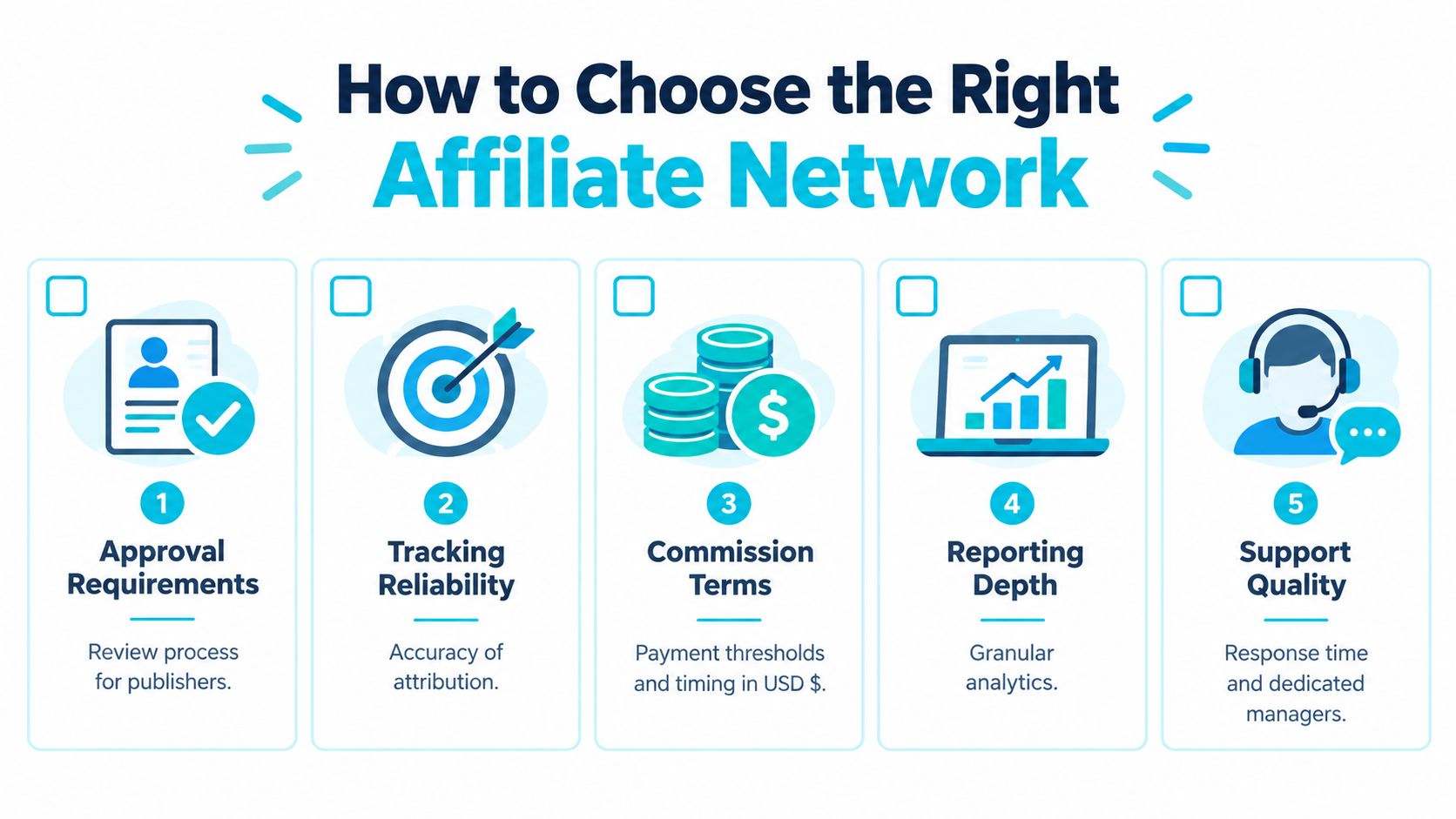
- Tracking reliability: Can the network support first-party identifiers, server-to-server postbacks, APIs, or code-based attribution where browser tracking is incomplete?
- Fraud controls: Does the reporting expose duplicate identifiers, unusual click-to-conversion timing, forced clicks, coupon interception, or branded-search overlap?
- Reporting depth: Can teams segment performance by partner, placement, device, product, market, and transaction status?
- Payment administration: Does the network handle publisher payments, tax documentation, currencies, and settlement records in the markets the program serves?
- Data access: Can the merchant export event-level information and reconcile network records with order and finance systems?
Questions for publishers
Publishers should inspect the application process, program terms, conversion status definitions, reversal policy, payment schedule, minimum threshold, and supported payment methods. They should also check whether the network explains why an application or conversion was rejected.
A network's attribution methodology deserves special attention. Click-based attribution can over-credit coupon, loyalty, cashback, or retargeting partners that appear immediately before checkout. It can under-credit creators, reviewers, and discovery publishers that influenced earlier research. (The discussion of affiliate attribution and incrementality explains why a tracked conversion is not always an affiliate-caused conversion)
Test incrementality instead of assuming causation
A network-reported conversion confirms that its rules matched an event to a referral. It doesn't automatically prove that the referral created new demand. Merchants should ask whether the network supports holdout tests, new-customer analysis, assisted-conversion review, and post-purchase surveys.
Privacy regulation, browser restrictions, ad blockers, and cookie changes make deterministic tracking less reliable. First-party tracking, server-side transmission, and code-based attribution can improve the evidence, but every method still requires transparent consent treatment and clear deduplication logic.
Decision test: A network earns confidence when its data can explain not only who received credit, but also why the credit was valid and what happened afterward.
For a practical evaluation, score each candidate against tracking, attribution, fraud prevention, reporting, payment, compliance, and support. Then compare those scores with the program's real operating priorities. A network with fewer headline features may be the better choice if its records reconcile cleanly and its terms are understandable.
Setting Up Merchant and Publisher Accounts
A merchant should begin with the commercial event, not with a tracking pixel. The program owner needs a written definition of the action that earns commission, the value used for calculation, exclusions, approval conditions, reversal rules, and payment timing.
Merchant onboarding sequence
- Set the program objective: Decide whether the program supports sales, qualified leads, installs, new customers, or another measurable outcome.
- Define commission terms: Specify the calculation base, eligible products or actions, exclusions, and treatment of returns or cancellations.
- Write attribution rules: Document the lookback window, coupon treatment, channel precedence, deduplication logic, and any prohibited promotional methods.
- Configure technical events: Implement the approved tracking method, then test clicks, conversions, order IDs, revenue fields, status changes, refunds, and reversals.
- Prepare partner terms: Explain permitted traffic sources, brand bidding, coupon use, disclosure expectations, creative rules, and data handling.
- Recruit and review publishers: Approve partners whose audiences and methods match the offer, then monitor activity after launch rather than treating approval as a one-time decision.
A direct merchant program may give the brand more control over relationships and data, while a network can provide standardized infrastructure and access to multiple partners. The right arrangement depends on the merchant's operational capacity, recruitment needs, and willingness to maintain tracking, reporting, payments, and compliance internally.
Publisher onboarding sequence
Publishers generally create a network account, provide business and payment information, describe their traffic sources, apply to relevant programs, and generate approved tracking links. A complete profile helps a merchant understand the publisher's audience, content model, promotional methods, and markets.
Before publishing a link, the publisher should test the destination, confirm the program's restrictions, label the placement internally, and verify how the network reports clicks and conversions. Sub-IDs or equivalent tracking fields can help connect a conversion to a particular article, campaign, video, or placement where the network supports them.
Compliance belongs in setup, not as an afterthought. In the United States, the Federal Trade Commission says affiliates should disclose their relationship with a retailer clearly and conspicuously when an endorsement may earn a commission. The disclosure should appear near the affiliate links so readers understand the financial relationship before assessing the recommendation. The FTC gives language that states the publisher receives commissions for purchases made through links. (The FTC explains clear and conspicuous disclosure for affiliate relationships)
Common launch failures include vague commission terms, untested conversion events, overly restrictive attribution rules, weak reversal documentation, and partner approval without traffic-source review. A short operational checklist shared with merchants, publishers, agencies, and network contacts can prevent those issues from becoming payment disputes.
Why AffiliateLandscape Simplifies Network Discovery
Affiliate networks make the ecosystem function, but professionals still need to find and compare the right providers. AffiliateLandscape organizes merchants and brands, affiliates and publishers, networks and platforms, technology and tools, agencies and services, communities, and events within a searchable industry directory.
The platform helps users move from an abstract definition to practical research. A marketer can compare network profiles, review relevant categories, inspect company capabilities, and investigate providers involved in tracking, attribution, fraud prevention, payment, or program management. Its structured ecosystem view is useful when a buying decision involves more than one participant, such as a merchant evaluating a network alongside an agency or technology provider.
AffiliateLandscape also separates directory visibility from independent editorial conclusions. Commercial or Featured placements can be presented transparently, while research and comparisons should remain distinct from paid positioning. That separation gives professionals a clearer basis for evaluating recruitment scope, technical depth, payment operations, and market coverage.
The most useful discovery process starts with the operating problem. A publisher may need reliable approval and payment information. A merchant may need fraud controls and event-level reporting. An agency may need network compatibility across several client programs. Search and comparison tools become valuable when they help each audience investigate those specific requirements rather than merely browse company names.
Affiliate Landscape offers a structured directory for discovering affiliate networks, publishers, merchants, agencies, platforms, and supporting technologies across the performance marketing ecosystem. Visit Affiliate Landscape to compare relevant companies and identify potential partners for the tracking, attribution, recruitment, and payment requirements of a program.
Ready to explore the affiliate landscape?
Discover networks, tools, and opportunities in our directory.
Explore Directory