

Let’s get right to it. At its heart, affiliate marketing is a partnership. You promote a company’s product or service, and when someone buys it through your unique link, you get paid a commission. It’s that simple.
Think of it as being a trusted digital salesperson who only gets paid for delivering results—whether that's a sale, a new customer lead, or even just a click. This is how countless creators, bloggers, and publishers turn their passion and content into a real income stream.
What Is Affiliate Marketing in Simple Terms
Imagine you tell a friend about an amazing new coffee shop you found. They go try it, love it, and mention your name. As a thank you, the owner hands you a free coffee the next time you visit. That's a perfect real-world analogy for affiliate marketing.
Instead of a free coffee, though, brands reward you (the affiliate) with actual cash for sending new customers their way.
This entire ecosystem is built on a straightforward relationship between three parties:
- The Merchant (or Brand): The business with a product or service to sell. Their goal is to reach more people and grow their sales.
- The Affiliate (or Publisher): That’s you. The blogger, influencer, or website owner who promotes the merchant's products to a dedicated audience.
- The Customer: The person who sees your recommendation, clicks your link, and ultimately makes a purchase.
When you sign up for a brand's affiliate program, they give you a special, trackable link. Every time someone clicks that link and completes an action (like buying something), the system gives you credit, and you earn your commission. It's a win-win-win: the brand makes a sale, you earn money, and the customer discovers a product they'll love.
The Core Players and Their Roles
To really understand how it all works, you need to know who’s involved and what they do. Grasping these roles is the first step to seeing how powerful and efficient this business model truly is.
Affiliate marketing isn't just another sales channel; it's a relationship-building engine. It works because it's built on the trust between an affiliate and their audience, turning genuine recommendations into a reliable revenue stream.
The numbers back this up. Over 80% of brands now run affiliate programs, and for good reason—they see an average of $6.50 in revenue for every $1 spent. It’s a proven model across e-commerce, software, finance, and countless other industries. You can dive deeper into these trends with these recent industry statistics on Firstpromoter.com.
Let's quickly summarize the key players and their primary goals.
Key Players in the Affiliate Marketing Ecosystem
This table breaks down who does what in a typical affiliate relationship, making it easy to see how all the pieces fit together.
| Player | Role | Primary Goal |
|---|---|---|
| Merchant | The brand or company selling a product. | Drive sales and acquire new customers cost-effectively. |
| Affiliate | The publisher or content creator. | Monetize their audience with authentic recommendations. |
| Customer | The end-user making a purchase. | Find reliable products based on trusted advice. |
Each player has a clear objective that keeps the system in balance. The merchant wants efficient sales, the affiliate wants to earn income without losing their audience's trust, and the customer just wants to find great stuff.
You can see this model in action by exploring the diverse range of successful affiliates and publishers on AffiliateLandscape. This simple, performance-based structure is exactly why affiliate marketing has become such a vital part of modern business.
How the Affiliate Marketing Ecosystem Really Works
While the relationship between a brand, its partner, and the customer is the heart of affiliate marketing, there’s a whole operational engine running behind the scenes. This ecosystem is what makes sure every click gets tracked, every sale is credited properly, and every partner gets paid on time.
Imagine affiliate marketing is a global shipping business. The brands are the factories making the products, and the affiliates are the local couriers getting them to the customer's door. But what about the massive logistical hubs, the package tracking systems, and the international payment processors that connect everything? That’s where the rest of the ecosystem comes in.
The Central Hubs: Affiliate Networks and SaaS Platforms
At the center of most affiliate programs, you'll find affiliate networks and SaaS platforms. These are the bustling marketplaces and tech toolkits that connect thousands of brands with countless publishers.
An affiliate network like CJ or Rakuten Advertising acts as a giant intermediary. It's a central hub where merchants can list their affiliate programs, and publishers can browse thousands of partnership opportunities all in one spot.
- For Brands: Networks offer a shortcut to a huge, pre-vetted pool of potential partners, saving them the monumental task of finding affiliates one by one.
- For Affiliates: These platforms give you a single dashboard to join multiple programs, grab your links, check performance reports, and get all your payments in one consolidated deposit.
On the other hand, SaaS platforms (often called Partner Relationship Management or PRM software) offer a more direct, in-house approach. Brands use this software to build and manage their own affiliate program, giving them total control over branding, partner communication, and commission rules.
Think of it this way: an affiliate network is like a sprawling public market where anyone can set up a stall. A SaaS platform is like building your own flagship store. Both get your products in front of customers, but they offer very different levels of control and scale.
The Tech That Makes It Work: Tracking Links and Cookies
This entire system hangs on one simple but vital piece of technology: the unique tracking link. When an affiliate joins a program, they get a special URL that has their unique partner ID baked right in.
When a customer clicks this link, a tiny file called a cookie is dropped onto their web browser. This cookie is like a digital nametag that tells the brand's website, "Hey, this visitor was sent by Partner #123." It has an expiration date, called the cookie duration, which can last anywhere from 24 hours to 90 days or more. If the customer buys something within that timeframe, the affiliate gets credit for the sale.
This simple process is what makes the whole thing tick.
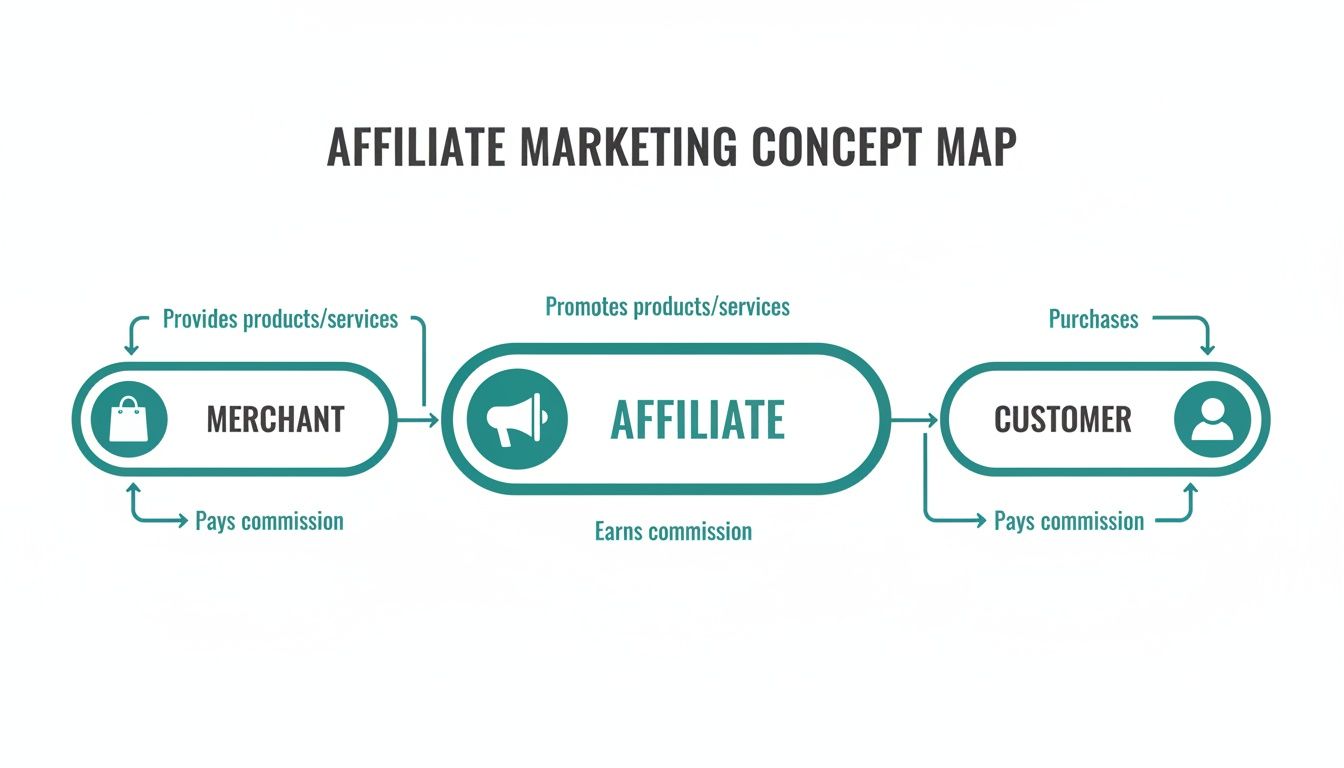
As you can see, it’s a straightforward path from the affiliate's promotion to the customer's purchase, with the tracking link connecting the dots.
Finding Partners in a Crowded World
With tens of thousands of affiliate programs scattered across dozens of networks and platforms, just finding the right partners can feel like searching for a needle in a haystack. This is where discovery tools become absolutely essential.
Platforms like AffiliateLandscape exist to map this complex world. They act as a comprehensive directory, helping brands and affiliates find each other, perform their due diligence, and ultimately connect with the perfect partners for their goals.
These tools cut down on countless hours of research and dramatically improve the quality of the partnerships you form. Whether you’re a brand looking for high-quality publishers or an affiliate searching for top-tier programs, a discovery platform brings much-needed clarity. You can explore a huge list of affiliate networks and platforms on AffiliateLandscape to see just how deep the rabbit hole goes.
Understanding Affiliate Payment Models
In the world of affiliate marketing, one size definitely does not fit all—especially when it comes to getting paid. A simple click on a link isn't the same as a completed sale, and the way brands pay their partners reflects that. Getting a handle on these payment structures is the first step to figuring out how you’ll actually make money.
Think of it like being a freelance salesperson. You might get a small finder's fee just for introducing a potential customer. Or, you could get a bigger reward if they sign up for a demo, and the real prize—a healthy commission—if they pull out their credit card and buy something. Affiliate marketing operates on the very same principles, using different models to reward different results.
For brands, picking the right model means their marketing budget is tied directly to real business goals. For affiliates, it shapes their entire strategy, from the content they create to how they promote it.

Cost Per Sale (CPS) or Pay Per Sale (PPS)
This is the bread and butter of affiliate marketing. With Cost Per Sale (CPS), also known as Pay Per Sale (PPS), you earn a commission only when someone you referred actually buys something. It’s that simple. The payout is usually a percentage of the sale or sometimes a flat fee.
You'll see this model everywhere in e-commerce. A tech blogger who reviews a new gadget gets a cut every time a reader clicks their affiliate link and purchases it. For the brand, it's a dream come true—they only pay for actual revenue. For the affiliate, the potential is huge. A 10% commission on a $2,000 laptop is a lot more motivating than one on a $20 t-shirt.
Cost Per Lead (CPL) or Pay Per Lead (PPL)
Not every business is trying to make an immediate sale. The Cost Per Lead (CPL) model is all about generating interest. Here, affiliates get paid for driving a specific action that turns a visitor into a qualified lead—like filling out a form, signing up for a free trial, or subscribing to a newsletter.
This is a go-to for industries with longer sales cycles, like insurance, real estate, or B2B software. A financial advice blogger might promote a "free mortgage pre-approval" form. They could earn a flat $25 for every person who fills it out, whether or not that person ever closes on a loan.
For affiliates, CPL models are incredibly appealing. It’s often much easier to convince your audience to sign up for a free webinar or download an ebook than it is to get them to make a purchase on the spot.
Cost Per Click (CPC) or Pay Per Click (PPC)
Last but not least is the Cost Per Click (CPC) model. This is the most straightforward of all: an affiliate earns a small fee every time someone clicks their link. What happens after the click doesn't matter.
Frankly, this model has become less common because it can be an easy target for fraud (think bots generating thousands of fake clicks). But it’s not extinct. It can still work for massive publishers or influencers who can send a firehose of traffic to a site. For instance, a major news outlet might use CPC links, earning a few cents for each of the thousands of clicks an article generates.
The main draw for affiliates is the low bar—you get paid for engagement, not for a sale. The catch? The payout per click is usually tiny. To see how these models plug into the bigger ecosystem, you can learn more about how to choose an affiliate network on AffiliateLandscape.
Comparing Affiliate Payment Models
So, which structure is best? It really depends on what's being sold, how it's being promoted, and what the end goal is. This table breaks down the key differences to help you see where you might fit in.
| Model | What Is Measured | Best For Merchants | Best For Affiliates |
|---|---|---|---|
| CPS | A completed purchase or sale. | Low-risk, as they only pay for actual revenue generated. Ideal for e-commerce. | High earning potential, especially with high-ticket items and strong conversion rates. |
| CPL | A lead form submission or free sign-up. | Building a customer database or sales pipeline with qualified leads. | Easier conversions, as no purchase is required from the audience. Predictable income. |
| CPC | A single click on an affiliate link. | Driving large volumes of traffic and increasing brand awareness quickly. | Earning from audience engagement alone, without needing sales or leads. |
At the end of the day, truly understanding affiliate marketing means getting comfortable with these financial nuts and bolts. When you align the payment model with your content and your audience, you create a partnership where everyone—the brand, the affiliate, and the customer—wins.
Building Trust and Staying Compliant
Great affiliate marketing is built on trust, not tricks. While the potential to earn is exciting, long-term success really comes down to operating with integrity. This means being transparent with your audience and sticking to the legal guidelines that govern the space.
Think of it like this: you'd rather take a product recommendation from a trusted friend than from a pushy salesperson trying to hit a quota. Your audience follows you for your authentic voice and genuine insights. If you betray that trust for a quick commission, you risk losing the very community you worked so hard to build.
The moment your recommendations start to feel forced or transactional, you break that valuable connection. The best, most sustainable partnerships happen when you put your audience's interests first, making sure every promotion is something you can genuinely stand behind. This isn't just good practice—it's a legal requirement.
Disclosures and FTC Guidelines
One of the most important parts of staying compliant is simple transparency. In the U.S., the Federal Trade Commission (FTC) has crystal-clear rules about endorsements. Put simply, if you stand to earn money from a recommendation, you must disclose that relationship to your audience.
And we're not talking about a tiny disclaimer buried in your website's footer. The FTC requires disclosures to be "clear and conspicuous," which is just a formal way of saying they need to be hard to miss.
Here are some common ways to get this right:
- Placement: The disclosure should be close to the affiliate link itself—ideally right before someone might click it.
- Wording: Keep it simple. Phrases like "(paid link)," "#ad," or "As an Amazon Associate, I earn from qualifying purchases" work perfectly.
- Visibility: Don't bury your disclosure in a huge block of text or use confusing jargon. The goal is to make it obvious.
The guiding principle is straightforward: An average reader should be able to easily see and understand that you have a financial connection to the brands you promote. This isn’t just about avoiding fines; it's about respecting your audience enough to be honest with them.
Imagine a popular food blogger who suddenly starts raving about a new line of cookware without mentioning it's a paid partnership. Once followers find out, that trust vanishes. Every past and future review is suddenly called into question, damaging a reputation that took years to build.
Avoiding Deceptive Practices
Beyond clear disclosures, the affiliate world unfortunately has a dark side with fraudulent activities that hurt everyone involved. Knowing what these schemes are is the first step in protecting yourself and the integrity of your partnerships.
Two of the most common and damaging practices are:
- Click Fraud: This is when someone uses automated bots to generate tons of fake clicks on an affiliate link. It inflates performance data, wastes the merchant's ad spend, and can get honest affiliates booted from programs.
- Cookie Stuffing: This is a sneaky tactic where a third-party script secretly drops an affiliate cookie onto a user's browser without them ever knowing. If that person eventually makes a purchase, the fraudster gets the commission, effectively stealing it from the affiliate who actually earned it.
These shady tactics don't just violate program rules; they corrode the trust that holds the entire system together. Whether you're an affiliate or a brand, your best defense is working with reputable partners and using platforms with solid fraud detection. By operating with total transparency and avoiding unethical shortcuts, you ensure your reputation remains your most valuable asset.
How to Get Started in Affiliate Marketing
Alright, so you understand the moving parts of affiliate marketing. But knowing how it works and actually making it work for you are two different things. Whether you're a brand looking to add a powerful new sales channel or a creator wanting to monetize your audience, the first step is always the same: a solid plan.
Let's walk through the roadmap for both sides of this coin.
The numbers don't lie. Brands typically see a $6.50 return for every dollar spent on affiliate marketing, which is exactly why 57% of them are planning to increase their affiliate budgets. With 81% of brands already running programs, it's clear this isn't just a trend—it's a core growth strategy. You can dig deeper into these numbers with these affiliate marketing statistics on MarketingLTB.com.
This isn't just about finding people to promote your stuff; it's about building a sustainable, performance-driven business model from the ground up.

A Roadmap for Aspiring Merchants
For any brand, launching an affiliate program is like building a sales team that only gets paid when they deliver results. The key is creating a program that top-tier affiliates actually want to join.
1. Define What Success Looks Like (Goals and KPIs)
Before you even think about platforms or partners, you need to define your finish line. What does a "win" look like for you? Is it a certain number of sales each month? A specific customer acquisition cost (CAC)? Hitting a revenue target? Your goals will shape every other decision you make.
- Key Performance Indicators (KPIs): Get comfortable tracking metrics like conversion rates, average order value (AOV), and overall affiliate-driven revenue.
- Budgeting: Figure out what you can realistically spend on commissions, platform fees, and any creative assets (like banners or ad copy) you'll need to provide.
2. Create a Commission Structure That’s Fair and Competitive
Your commission structure is your #1 recruitment tool. It has to be compelling enough to attract great partners but still profitable for your business. A good first step is to see what your direct competitors are offering.
A smart program rewards performance. Think about setting up a tiered model where commission rates increase as affiliates hit sales milestones. This gives your top performers a reason to keep pushing and motivates everyone else to level up.
3. Choose Your Tech and Find Your Partners
You'll need a system to handle tracking, reporting, and, most importantly, payments. You have two main paths: join an established affiliate network like ShareASale or CJ to access their built-in pool of affiliates, or use a SaaS platform like PartnerStack to run your program in-house.
Once your foundation is set, you can use partner discovery tools like AffiliateLandscape to find and vet potential affiliates who are a perfect fit for your brand.
A Step-by-Step Guide for Aspiring Affiliates
If you're a content creator, affiliate marketing is about turning the trust you've built with your audience into a real income stream. This isn't a get-rich-quick scheme; it requires patience, authenticity, and knowing your audience inside and out.
1. Pick a Niche You Actually Care About
This is the most important decision you'll make. Don't just chase the niches with the highest commissions. Choose a topic you're genuinely passionate about, whether it's sustainable fashion, homebrewing coffee, or optimizing WordPress sites.
Your enthusiasm (or lack thereof) will shine through in your content. Real passion builds a loyal community that trusts what you have to say, and without that trust, you'll never convert clicks into sales.
2. Build Your Platform and Find Your People
Your platform is your home base. While you can definitely start on social media platforms like YouTube or TikTok, having your own blog or website gives you ultimate control and long-term stability.
- Start a Blog: Use a simple platform like WordPress with a clean, fast theme. Your primary focus should be creating incredibly helpful content that solves real problems for your readers.
- Grow a Following: Learn the basics of SEO to get organic traffic from Google. At the same time, become an active member of online communities and social media groups where your audience hangs out.
3. Find and Join Quality Affiliate Programs
Once you have a steady stream of traffic, it's time to find programs that align with your niche. The best place to start? Look at the products and services you already use and love. See if they have an affiliate program—it's the most authentic way to begin.
You can also browse affiliate networks to discover new brands. When you're looking at a program, ask yourself:
- Is it relevant? Will these products genuinely help my audience?
- Is the commission fair? Are the payout rates competitive for my industry?
- Is the brand reputable? Does the company have a good reputation and positive reviews?
For creators in the tech and online business space, we put together a list of the top 10 affiliate programs for content creators to give you some great starting points.
4. Create Authentic Content That Actually Helps
Now, you just need to weave your affiliate links into your content in a way that feels natural, not forced. The key is to stop selling and start helping.
- Product Reviews: Go deep. Write honest reviews that cover the good, the bad, and the ugly.
- Tutorials and How-To Guides: Create content that shows your audience exactly how to use a product to achieve a specific outcome.
- Comparison Posts: Help your readers make a decision by clearly comparing the features and benefits of different options.
Remember, your job isn't to be a salesperson; it's to be a trusted guide. When you focus on helping your audience make smart choices, the sales will come as a natural result of the trust you've built.
Your Top Affiliate Marketing Questions Answered
When you first dip your toes into affiliate marketing, a bunch of questions always bubble up. It's totally normal. How much money can I actually make? Do I really need a website? What's the deal with networks versus programs?
Let's cut through the confusion. Here are some straight answers to the most common questions we hear, designed to give you the clarity you need to move forward, whether you're a brand or a creator.
How Much Can You Realistically Earn?
This is the big one, isn't it? The honest answer is that there's no single number. Your earnings can range from a little extra coffee money to a full-blown, life-changing income. It all comes down to your niche, how well you connect with your audience, and the products you choose to stand behind.
A beginner putting in the work might start seeing a few hundred dollars a month, which is a huge win. At the other end of the scale, you have super-affiliates who pull in consistent five or even six-figure incomes every single month. They didn't get there overnight. They got there by building trust and consistently delivering value.
Your income is a direct reflection of the value you provide. If you focus on genuinely helping your audience, the money will follow. It's a natural byproduct of trust.
Think about it: promoting high-ticket items, like a $100/month SaaS tool, will earn you a much bigger commission per sale than a $15 t-shirt. But you might sell a lot more t-shirts. The sweet spot is finding that perfect balance between commission size and conversion rate that makes sense for your audience.
Do I Need a Website to Start?
While a website is the ultimate long-term asset, you absolutely do not need one to get started. Many affiliates build incredibly successful businesses without ever owning a traditional site.
If you have an audience somewhere, you can be an affiliate. It's that simple.
- Social Media: Platforms like YouTube, TikTok, and Instagram are affiliate powerhouses. A creator can use a simple "link in bio" page to send followers to a curated list of their favorite gear or software.
- Email Newsletters: Got an email list? You're sitting on a goldmine. You can share helpful tips and weave in affiliate links to products you genuinely recommend to a super-engaged group of people.
- Podcasts: Mentioning a product on your show and dropping a custom link in the show notes is a classic, highly effective strategy.
That said, building your own website is about playing the long game. It gives you total control—over your content, your brand, and how you make money. By focusing on search engine optimization (SEO), you build an asset that isn't at the mercy of some social media algorithm change. For serious, sustainable growth, a website is the way to go.
What Is an Affiliate Network Versus a Program?
This is a really common point of confusion, but the distinction is pretty simple once you get it.
An affiliate program is run directly by one company. Think of the famous Amazon Associates program. You sign up directly with Amazon to promote products sold on Amazon. It's a one-to-one relationship.
An affiliate network, on the other hand, is a massive marketplace that brings thousands of individual company programs together under one roof. Big names like ShareASale, CJ (formerly Commission Junction), and Rakuten Advertising are intermediaries that connect brands with affiliates.
Here’s a good analogy: An individual affiliate program is like a single boutique shop. An affiliate network is the giant shopping mall that houses hundreds of those boutiques.
By joining the mall (the network), you get a single login to find and apply to tons of different brands. More importantly, you can manage all your different partnerships—your links, your performance data, and your payments—from one central dashboard. For most people, that convenience is a game-changer.
Ready to cut through the noise and find the perfect partners? AffiliateLandscape is the definitive directory for the affiliate marketing ecosystem. Whether you're a merchant looking for high-performing publishers or a creator searching for the best programs, our platform makes discovery and due diligence faster and easier. Explore the landscape and build better partnerships today.
Ready to explore the affiliate landscape?
Discover networks, tools, and opportunities in our directory.
Explore Directory