
In most affiliate marketing models, you only get paid when someone buys something. But what if you could earn money just for sending people to a merchant’s website?
That’s exactly where Cost Per Click (CPC) affiliate programs come in.
What Are Cost Per Click Affiliate Programs
Think of it this way: imagine you own a popular blog that gets tons of visitors every day. A new company wants to get their name out there, so they agree to pay you a small fee every time one of your readers clicks on their ad or link. They aren't paying for a sale or a signup—just for the click that gets a potential customer to their site.
That’s the core of cost per click affiliate programs. The merchant pays you, the publisher, a predetermined rate for every single valid click you generate through your affiliate link.
The payment trigger here is what sets this model apart. It's the click itself, not what happens afterward.
The entire focus is on generating traffic. Merchants are essentially paying for eyeballs, and affiliates earn revenue by successfully directing their audience to a merchant’s digital doorstep.
This makes CPC a totally different ballgame compared to models like Cost Per Action (CPA) or Revenue Share, where your commission is tied directly to a sale. With CPC, you're rewarded for sparking that initial interest. If you're new to this world, our guide on what affiliate marketing is provides a great overview of the different models.
The 'Digital Real Estate' Analogy
Your blog, social media profile, or YouTube channel is your piece of digital real estate. When you join a CPC program, you're effectively renting out tiny "billboard" spaces on your property. Your great content brings in the crowd, and merchants pay you to get their message in front of them.
This model is a fantastic fit in a few specific scenarios:
- New Brands: A company launching a new product can use CPC to flood their site with initial traffic and build brand recognition fast.
- High-Traffic Publishers: If you run a site with a massive audience, you can create a reliable income stream, even if your readers aren't always in a buying mood.
- Educational Niches: In some industries, the main goal is simply to educate potential customers. CPC aligns perfectly with that awareness-first approach.
To help clarify, the table below breaks down the defining characteristics of the CPC affiliate model.
Key Characteristics of CPC Affiliate Programs
Here's a quick summary of the fundamental attributes that define the Cost Per Click affiliate model.
| Attribute | Description |
|---|---|
| Payment Trigger | A unique, valid click on an affiliate tracking link. |
| Primary Goal | To drive traffic and increase brand visibility for the merchant. |
| Affiliate Focus | Maximizing qualified clicks from a relevant audience. |
| Risk Distribution | Higher risk for the merchant (paying for traffic that may not convert). |
| Ideal For | High-traffic publishers and merchants focused on awareness campaigns. |
As you can see, the focus is squarely on traffic generation, which creates a unique set of opportunities and challenges for both merchants and publishers.
How CPC Affiliate Marketing Works From Click to Commission
Ever wondered what actually happens when someone clicks one of your affiliate links? It might seem like a simple redirect, but behind the scenes, a well-oiled machine is working to make sure you get paid for that referral. The entire process hinges on a single, powerful tool: your unique affiliate tracking link.
When you join a CPC program, the merchant doesn't just hand you a generic URL. They give you a special link tagged with your personal affiliate ID. Think of it as your digital signature. Every time a visitor clicks it, that signature tells the merchant’s system, "Hey, this person came from me!"
This link does two jobs instantly. First, it sends the user straight to the merchant's website. At the exact same moment, it drops a small tracking file, called a cookie, onto the user’s browser. This cookie contains your affiliate ID, officially marking that visitor as your referral for a set period.
This simple flow chart breaks down the three main steps.
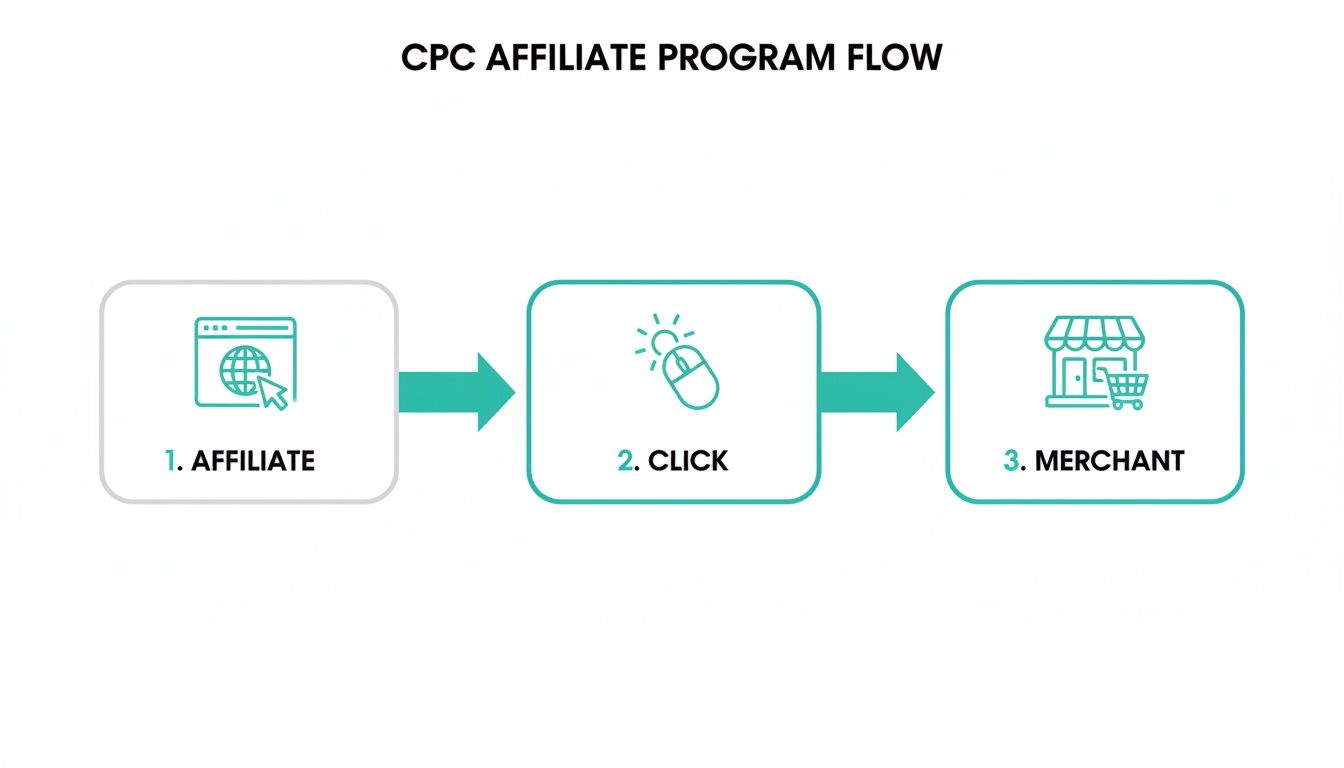
As you can see, the click is the trigger that connects your hard work to the merchant's website traffic.
The Role of Tracking and Validation
Just because a click happened doesn't mean you automatically get paid. This is where the merchant's affiliate software steps in to perform a crucial quality check known as click validation. It’s not about short-changing affiliates; it’s about making sure the traffic is real.
The system sifts through every click, looking for red flags that suggest it isn't from a genuine, interested human.
Here are a few common reasons a click might get tossed out:
- Duplicate Clicks: Someone repeatedly clicking your link in a few seconds usually only counts as one valid click.
- Bot Traffic: Automated scripts crawling the web generate tons of clicks, but they aren't potential customers and are always filtered out.
- Fraudulent Activity: This nips things like click farms and other shady tactics in the bud.
- Geo-restrictions: If a program only wants traffic from a specific country, clicks from outside that region won't count.
By weeding out junk traffic, merchants protect their budgets and ensure they're paying for real potential customers. This keeps the program healthy and allows for better payouts to honest affiliates.
From Valid Click to Commission Payout
Once a click sails through the validation process, it’s marked as a "payable click" and credited to your account. Cha-ching.
Each of these valid clicks adds a set amount—your CPC rate—to your earnings. So, if the rate is $0.25, every approved click nets you a quarter. These small amounts can add up quickly with good traffic.
Most affiliate programs have a payment threshold you need to hit before you can cash out, often around $50 or $100. Once your balance crosses that line, you'll get paid on the program’s schedule, which is usually once a month.
The whole operation is powered by sophisticated affiliate tracking software. If you're curious to learn more about the technology behind it, you can dive deeper in our guide to the best affiliate tracking software solutions. Understanding how it all works is the first step to making CPC programs work for you.
Comparing CPC with Other Affiliate Commission Models
While cost per click affiliate programs offer a clear-cut way to earn, they're just one tool in the affiliate marketing toolbox. To figure out if CPC is the right move for you, you have to see how it stacks up against the other big players. Each commission model serves a different purpose and represents a unique trade-off between risk and reward for both brands and their affiliate partners.
Think of it this way: a CPC model is like getting paid by the hour. You put in the work to drive traffic, and you get paid for that effort, regardless of the outcome. Other models are more like getting paid on commission for a big sale—the potential payout is much higher, but so is the risk.
Cost Per Action and Cost Per Lead
The most common alternative you'll encounter is Cost Per Action (CPA). With CPA, you only earn your commission when a visitor you referred completes a specific, valuable action. Most of the time, that "action" is a sale.
A popular variation on this is Cost Per Lead (CPL). In this setup, the goal isn't a sale but simply generating a new lead. This might mean getting someone to fill out a contact form, sign up for a free trial, or join an email newsletter. The user doesn't have to spend a dime; your job is to deliver a qualified prospect.
With both CPA and CPL, the performance risk shifts almost entirely to you, the affiliate. You could send thousands of clicks, but if nobody buys or signs up, your commission is zero.
The market has spoken loud and clear on this. A staggering 99% of all affiliate programs now use some form of CPA, making it the industry standard. This shows a massive shift where brands want to pay for tangible results, not just website traffic. As affiliate marketing spending continues to grow, CPA gives brands confidence that their marketing dollars are tied directly to performance.
Revenue Share
On the other end of the spectrum, especially for subscription businesses or high-ticket items, is Revenue Share (RevShare). Here, you earn a percentage of the actual revenue generated by the customers you refer. This could be a one-time cut of a big purchase or, even better, a recurring slice of a customer's monthly subscription.
Revenue Share is the ultimate long-term play. It creates a true partnership where your success as an affiliate is directly and continuously tied to the lifetime value of the customer you brought in. A single referral can become a passive income stream for months, or even years.
For instance, if you're promoting a SaaS product with a 20% recurring RevShare, you get 20% of that user's payment every single month they stay subscribed. It’s a powerful incentive to refer high-quality, loyal customers.
CPC vs CPA vs CPL vs RevShare: A Head-to-Head Comparison
To make the strategic differences crystal clear, it helps to see these models side-by-side. The "best" one really depends on your business goals, your audience, and how much risk you're willing to take on.
This table breaks down the core differences to help you decide which structure fits your strategy.
| Model | Payment Trigger | Merchant Risk | Affiliate Risk | Best For |
|---|---|---|---|---|
| CPC | A valid click | High | Low | Brand awareness campaigns and driving top-of-funnel traffic. |
| CPL | A qualified lead (e.g., free trial sign-up) | Medium | Medium | Service-based businesses and companies with longer sales cycles. |
| CPA | A completed sale | Low | High | E-commerce stores and businesses focused on immediate ROI. |
| RevShare | A percentage of ongoing revenue | Low | High | Subscription services and products with high customer lifetime value. |
As you can see, it's all about trade-offs. Cost per click affiliate programs are fantastic for publishers who want a low-risk way to monetize traffic, especially for content that's more informational than commercial. The merchant, however, shoulders all the risk by paying for clicks that might not convert.
CPA and RevShare flip that script completely. They protect the merchant’s budget by guaranteeing they only pay for results, which is exactly why most brands prefer them. For affiliates, these models offer much higher earning potential per referral, but they demand a sharp understanding of your audience and how to drive traffic that’s ready to take action.
The Pros and Cons of CPC Affiliate Programs
Like any tool in the marketing shed, cost per click affiliate programs have their place, but they aren't a one-size-fits-all solution. There’s a unique balance of opportunity and risk, and what looks like a great deal from one side of the table can look like a major gamble from the other.
To really know if CPC makes sense for you, you have to understand these trade-offs, whether you're the merchant paying for traffic or the affiliate sending it.
Advantages for Merchants
So, why would a brand choose to pay for every single click? For companies that need to build momentum fast, CPC can be a powerful engine for growth and brand building. The upside really comes down to speed, control, and reach.
Rapid Brand Visibility: When you need to go from zero to sixty on brand awareness, CPC is your gas pedal. It allows you to flood your site with new visitors almost overnight, which is a huge advantage for a new product launch or for breaking into a crowded market where you’re the new kid on the block.
Predictable Ad Spend: From a CFO's perspective, CPC can be a dream. You agree on a fixed price per click, so you know exactly what each visitor will cost you. This makes forecasting your marketing budget incredibly straightforward, unlike CPA models where your costs are tied to conversion rates that can fluctuate wildly.
Access to Top-of-Funnel Audiences: CPC is perfect for getting in front of people who are just starting to explore a topic or problem. You can introduce your brand to a massive audience that isn't quite ready to pull out a credit card today but might remember you when they are.
Disadvantages for Merchants
The very thing that makes CPC appealing—paying for traffic—is also its biggest pitfall. The merchant assumes all the financial risk for clicks that don't convert, and that can be a tough pill to swallow.
The core challenge for any merchant using a CPC model is ensuring traffic quality. Paying for thousands of clicks that never lead to a single lead or sale is a fast way to burn through a marketing budget with nothing to show for it.
Here are the main headaches for merchants:
Risk of Low-Quality Traffic: Let's be honest: not all traffic is created equal. An affiliate can send you thousands of visitors, but if none of them have any genuine interest in your product, you're just paying for high bounce rates and getting zero return on your investment.
Vulnerability to Click Fraud: Since every click costs you money, the model is a prime target for fraud. This can be anything from simple automated bots to sophisticated click farms, all designed with one purpose: to generate fake clicks and drain your ad budget.
Potentially Lower ROI: When you pay for results with a CPA or RevShare model, your ROI is much more direct. With CPC, you're paying for the chance of a conversion, not the conversion itself. This can easily lead to a much lower overall return on investment if the traffic quality isn't there.
Advantages for Affiliates
Now, let's flip the coin. For a publisher or content creator, CPC offers one of the most direct paths to making money. The barrier to entry is often lower, and you see the reward for your efforts much faster.
The main benefit is refreshingly simple: you get paid for generating clicks, not sales. This is a game-changer for publishers whose content is more about education or entertainment than direct sales pitches. If your audience loves what you do but isn't always in a "buy now" mode, CPC lets you monetize that engagement without pushing them to make a purchase. Your income isn't held hostage by the merchant's website design, pricing, or ability to close a sale.
Disadvantages for Affiliates
While the simplicity is nice, it’s not exactly easy money. Affiliates working with CPC programs face a different kind of pressure.
The most glaring downside is the typically lower payout rates. A single click might only earn you a few cents. To make any real money, you need to be able to drive a massive amount of traffic. A site with just a few hundred visitors a day will find it nearly impossible to build a substantial income from CPC alone.
On top of that, there's constant pressure to prove your traffic is the real deal. Merchants are always watching their analytics. If they see that the clicks you're sending are bouncing immediately or never converting, they won't hesitate to cut you from the program. You have to consistently show that your audience is legitimate and engaged, or you could lose that income stream in a flash.
Best Practices for Success with CPC Programs
Winning with cost per click affiliate programs is a whole different ballgame compared to other models. The focus shifts away from closing a sale and squarely onto delivering quality traffic while maintaining trust on both sides of the partnership.
Whether you're a merchant paying for those clicks or a publisher driving them, your success boils down to a few specific, actionable strategies. Let's get practical and look at what it really takes to make CPC work for you.
Merchant Playbook: Driving Value from Clicks
As a merchant, your main objective is simple: make sure the traffic you're paying for is actually valuable. This means setting clear standards from the get-go, attracting the right people, and protecting your budget from being wasted.
It all starts when you establish crystal-clear traffic standards. Think of your terms of service as your first line of defense. Be explicit about what counts as a "valid click" and what doesn't.
- Geographic Targeting: If you only operate in the United States, make it known that clicks from other countries won't be paid for.
- Traffic Sources: You might forbid traffic from pop-up ads, certain social media sites, or other sources to protect your brand's reputation.
- Click Cadence: Set rules against rapid-fire clicks from the same IP address to automatically filter out bots and suspicious activity.
With those rules in place, your next job is to craft creatives that attract the right audience. Your banners, ad copy, and landing pages need to pre-qualify visitors before they even click. For instance, a banner that says "Compare Luxury Car Leases" is going to attract a far more qualified prospect than one that screams "Free Car Giveaway."
By being specific, you ensure the clicks you buy come from people with a genuine, even if early, interest in what you offer. This one step can dramatically improve the quality of traffic you pay for.
The ultimate challenge for a merchant in a CPC program is turning traffic into tangible value. It begins with defining what "valuable traffic" looks like for your business and then building a system to attract and validate it, while ruthlessly filtering out everything else.
The Elephant in the Room: Tackling Click Fraud
Click fraud is the single biggest risk for merchants in any CPC model. It’s any click generated with phony or deceptive intent, designed to do nothing but drain your ad budget without ever delivering a real potential customer.
The good news is that modern affiliate platforms and networks have gotten incredibly sophisticated at sniffing out fraudulent activity. They use a combination of automated tools and clever techniques to spot suspicious patterns.
Common Anti-Fraud Measures:
- IP Address Monitoring: This flags an unusually high volume of clicks coming from a single IP address or a range of IPs known to be associated with data centers or VPNs.
- Click Timing Analysis: The system looks for unnatural patterns, like clicks happening at perfectly timed intervals—a dead giveaway for bot activity.
- Behavioral Analysis: This involves looking at what happens after the click. If thousands of clicks from a single affiliate all result in a 100% immediate bounce rate, that's a massive red flag.
- Honeypot Traps: This is a clever tactic where networks set up invisible links that only automated bots would ever find and click, instantly identifying and blocking them.
Partnering with a reputable affiliate network that has robust fraud detection is one of the best ways to protect your investment and ensure you're paying for real human interest.
Affiliate Playbook: Maximizing Earnings and Trust
As an affiliate, your mission is twofold: drive a healthy volume of clicks, but also make sure those clicks are high-quality. This dual approach is what builds a sustainable income stream and a stellar reputation with merchant partners.
Your top priority should always be driving relevant, high-quality traffic. A merchant would much rather get 100 clicks from an audience that is genuinely interested in their niche than 1,000 random clicks that bounce immediately. It’s all about alignment. If you run a blog about vegan cooking, partnering with a CPC program for a local butcher shop simply makes no sense for anyone involved.
Next, you have to maintain audience trust through total transparency. Your readers are savvy; they know when they're being sold something. Always disclose your affiliate relationships clearly and openly. This isn't just an FTC rule; it's a core part of building a loyal community that trusts what you have to say.
Finally, you must continuously optimize your campaigns. Don't just slap a banner on your site and hope for the best.
- Track which pages and articles generate the most clicks.
- Test different ad placements. You might find that in-content text links far outperform those sidebar banners.
- Dive into your analytics to see which topics resonate most with both your audience and the merchant's offerings.
By putting these fundamental principles into practice, you can turn your website traffic into a reliable source of revenue. For a more in-depth look at this, be sure to check out these essential affiliate marketing best practices.
Finding and Evaluating High-Quality CPC Affiliate Programs
Alright, you get the theory behind cost per click affiliate programs. Now for the fun part: finding great programs and actually making some money. CPC offers are definitely the road less traveled in affiliate marketing, but for publishers with big traffic—especially in niches built around awareness—they can be a perfect fit.
So, where do you even begin your search? You could type "CPC affiliate programs" into a search engine, but that’s like looking for a needle in a haystack. A much smarter, more efficient approach is to use a dedicated affiliate marketing directory.
Tools like AffiliateLandscape are built for this. They let you filter program listings by commission type, which means you can instantly isolate the CPC offers from the sea of CPA and RevShare programs. It’s a massive time-saver. You can also work backward by checking out lists of the best affiliate networks to see which ones are known for hosting CPC-style partnerships.
Your Program Evaluation Checklist
Finding a program is just step one. Vetting it properly is what separates a profitable partnership from a frustrating waste of your traffic. Trust me, not all CPC programs are created equal. Before you send a single visitor their way, run every potential partner through this quick reality check.
First, do some digging on the program's reputation. What are other affiliates saying? Do they pay on time? Is their tracking software reliable? A history of late payments or ghosting affiliates is a huge red flag you can't afford to ignore.
Next, it’s time to read the fine print. And I mean really read it. Pay special attention to these three things:
- What Counts as a "Valid Click"? Get crystal clear on what the merchant considers a payable action. Are clicks from certain countries excluded? What about from specific traffic sources? Know the rules.
- Traffic Restrictions: Most CPC programs are picky about traffic. They often ban clicks from pop-up ads, certain email lists, or incentivized sources. Make sure your promotional methods are compliant, or you risk getting your commissions voided.
- Commission Rates vs. EPC: A high pay-per-click rate looks tempting, but it’s often a vanity metric. What good is a high rate if the merchant's validation process is so strict that it disqualifies most of your clicks? Instead, the gold standard is Earnings Per Click (EPC). This number shows the average earnings per 100 clicks for all affiliates in the program, giving you a much truer sense of its earning potential.
A program with a modest CPC rate but a high-converting landing page and loose validation will almost always make you more money than a program with a sky-high rate that rarely approves a click. Always look at the bigger picture with EPC.
A Quick Word on the Affiliate Landscape
It’s important to keep your expectations in check. While CPC programs have their place, the affiliate industry has largely shifted toward pure performance models. Cost-per-sale (CPS) is king because merchants love only paying when they make a sale. This trend is a major reason why 81% of brands now have affiliate programs, as they prefer these scalable, performance-based partnerships. To get a better handle on the latest affiliate industry statistics, you can explore these key insights on New Media.
This doesn't mean CPC is dead—far from it. It's just become a more specialized tool. Think of it as the right option for a specific job, usually for brands laser-focused on massive awareness campaigns. By using this evaluation framework, you can cut through the noise and find quality cost per click affiliate programs that are a perfect match for your audience and your goals.
Frequently Asked Questions About CPC Affiliate Programs
When you're digging into cost per click affiliate programs, a few common questions always pop up. Let's tackle some of the most frequent ones we hear from publishers trying to make sense of it all.
Is CPC Affiliate Marketing Still Profitable?
It definitely can be, but your strategy has to be smart. While CPA has become the dominant model in affiliate marketing, CPC hasn't disappeared—it’s just found its niche. Think of it as a volume game.
CPC works best for high-traffic sites where the main goal isn't an immediate sale. News aggregators, viral content sites, or entertainment blogs are perfect examples. If you have a massive, engaged audience, you can absolutely build a reliable income stream one click at a time.
How Do Programs Prevent Click Fraud?
Merchants and networks are fiercely protective of their ad budgets, so they invest heavily in preventing click fraud. They use some pretty sophisticated systems to make sure every click they pay for is from a real, interested person.
Think of it like a security system for clicks. These tools constantly scan for red flags by analyzing data points like IP addresses, the timing between clicks, and the source of the traffic. If a pattern looks robotic or comes from a known bad actor, the system automatically invalidates the click.
This way, affiliates get rewarded for sending genuine traffic, and merchants aren't paying for bots.
What Is a Good CPC Rate for an Affiliate?
That’s the million-dollar question, and the honest answer is: it depends. A "good" rate can be anything from a few pennies to well over a dollar. It changes dramatically based on the industry, the country your traffic comes from, and how valuable that audience is to the advertiser.
Instead of getting hung up on the CPC rate alone, a much smarter move is to look at a program's Earnings Per Click (EPC). This metric tells you the average amount earned per 100 clicks sent by all affiliates in the program. EPC gives you a far more realistic snapshot of how much you can actually expect to make.
Finding the right affiliate programs is the first step to success. AffiliateLandscape provides the most comprehensive directory to discover, compare, and connect with affiliate networks and programs that fit your needs. Start exploring your next partnership at https://affiliatelandscape.com.
Ready to explore the affiliate landscape?
Discover networks, tools, and opportunities in our directory.
Explore Directory