

So, you want to join an affiliate program. The process seems simple enough: find a product you like, get a special link, and share it. But the reality is, getting approved and actually earning money takes a bit more groundwork. Your success hinges on creating high-quality, trustworthy content that genuinely helps your audience and makes your recommendations feel like a natural fit.
First Things First: Build a Platform That Gets You Approved

Before you even start looking at affiliate programs, you need a home base. This is where you'll build an audience and earn their trust. Think of it as your digital storefront. It could be a blog, a YouTube channel, or even a super-active social media profile.
What really matters is that your platform is dedicated to a specific niche and has a real, breathing audience that listens to what you have to say. Affiliate managers aren't just looking for clicks; they're looking for partners who can authentically represent their brand.
What Program Managers Really Look For
Having reviewed thousands of affiliate applications myself, I can tell you what separates an instant approval from a quick rejection. It’s not about follower counts. It’s about proving you're a serious partner.
Here’s what makes an application stand out:
- A Well-Defined Niche: A blog about "everything" is really a blog about nothing. Affiliate managers want to see a clear focus. A site about WordPress speed optimization or a YouTube channel on budget-friendly family travel immediately tells them who your audience is and if it’s a match for their product.
- High-Quality Content: Your content is your resume. We absolutely will check out your latest posts or videos. We’re looking for well-researched, helpful, and professional content that shows you care about your audience. Thin, sloppy articles are an immediate deal-breaker.
- An Engaged Audience: Honestly, a small, engaged audience is far more valuable than a huge, silent one. Comments, questions, and shares are gold. They prove you have actual influence and that people trust your advice.
Key Takeaway: Affiliate marketing is built on trust. You have to provide value long before you ever ask for a sale. Your number one job is to help your audience solve a problem or reach a goal.
Aligning Your Content with Your Products
The real magic happens when your content seamlessly aligns with products your audience genuinely needs. This is about more than just getting accepted into a program; it's about setting yourself up to actually earn commissions.
Before you go any further, it’s worth understanding how to start an affiliate website that’s built for the long haul. And if you’re brand new to this world, getting a handle on the basics is essential. Our guide on what is affiliate marketing breaks down the entire model. Putting in this foundational work now will make every other step so much easier.
Finding Affiliate Programs That Actually Fit Your Brand
With your website or channel ready to go, the real hunt begins: finding affiliate programs that make sense for your audience. This isn't just about Googling "top affiliate programs" and signing up for the first one you see. You need a strategy to find partners that feel authentic to your voice and, just as importantly, can actually make you money.
I generally bucket affiliate opportunities into three main types: the big networks, in-house programs, and direct partnerships. Most successful affiliates I know have a healthy mix of all three.
Start Your Search on Major Affiliate Networks
If you're new to the game, affiliate networks are the perfect place to start. Think of them as massive marketplaces where thousands of brands are actively looking for affiliates just like you. They handle all the messy stuff—discovery, link tracking, and payments—all under one roof.
Here are a few of the big players you should check out:
- ShareASale: This is a goldmine for physical products, especially in niches like fashion, home goods, and lifestyle. With over 15,000 merchants, you'll find tons of unique small and medium-sized businesses here.
- CJ Affiliate (formerly Commission Junction): A true industry giant with more than 3,800 brands. CJ is a powerhouse for software, travel, and major retail names. Their reporting tools are also top-notch for digging into what's driving sales.
- Impact: A more modern platform that has become the go-to for SaaS, tech companies, and many of the direct-to-consumer brands you see on social media.
A quick word of advice: don't just sort the list by the highest commission rate. It's a classic rookie mistake. A 20% commission on a product your audience genuinely wants will always outperform a 50% commission on a random product nobody clicks on.
Uncover Lucrative In-House Affiliate Programs
Many brands, especially established ones, prefer to run their own show by managing an in-house program. You won’t find these on a network. Instead, you'll need to do a little digging. Scroll down to the footer of a brand's website and look for a link that says "Affiliates," "Partners," or "Refer a Friend."
The real beauty of in-house programs is the direct line of communication. You get to talk to the brand’s actual affiliate manager, which can open doors to better support, custom commission deals, and even unique content collaborations.
For instance, popular hosting companies like Kinsta and WP Engine run their own programs, offering hefty payouts that can go up to $200 or more for a single referral. Juggling a few different dashboards is more work, but the payoff is often much higher. To really get a handle on this, you can dig deeper with our guide on how to find affiliate programs, which breaks these methods down even further.
Go Direct With the Brands You Already Use and Trust
Honestly, this is where the magic happens. The most powerful recommendations are the ones that are 100% genuine. Think about the products and tools you already use every single day—the software, the gear, the services that are non-negotiable for you.
Make a list of them.
Then, visit their websites and look for an affiliate program. If you don't see one publicly listed, don't be shy! Send a professional email introducing yourself, explaining why you love their product, and outlining how you'd want to promote it. You'd be surprised how often this works. These are the partnerships that feel less like a sales pitch and more like a trusted friend giving advice, and they almost always convert the best.
2. Vet the Program’s Terms and Commission Structure
So, you’ve found a handful of promising affiliate programs. The temptation is to jump on the one with the highest commission rate, but that's a classic rookie mistake. A big, flashy number can easily mask terms that will actually sabotage your earnings in the long run.
Before you even think about applying, you need to become a detective and dig into the affiliate agreement. This is where you find out how, when, and if you'll get paid. Getting this right is what separates affiliates who build a sustainable business from those who burn out chasing empty promises.
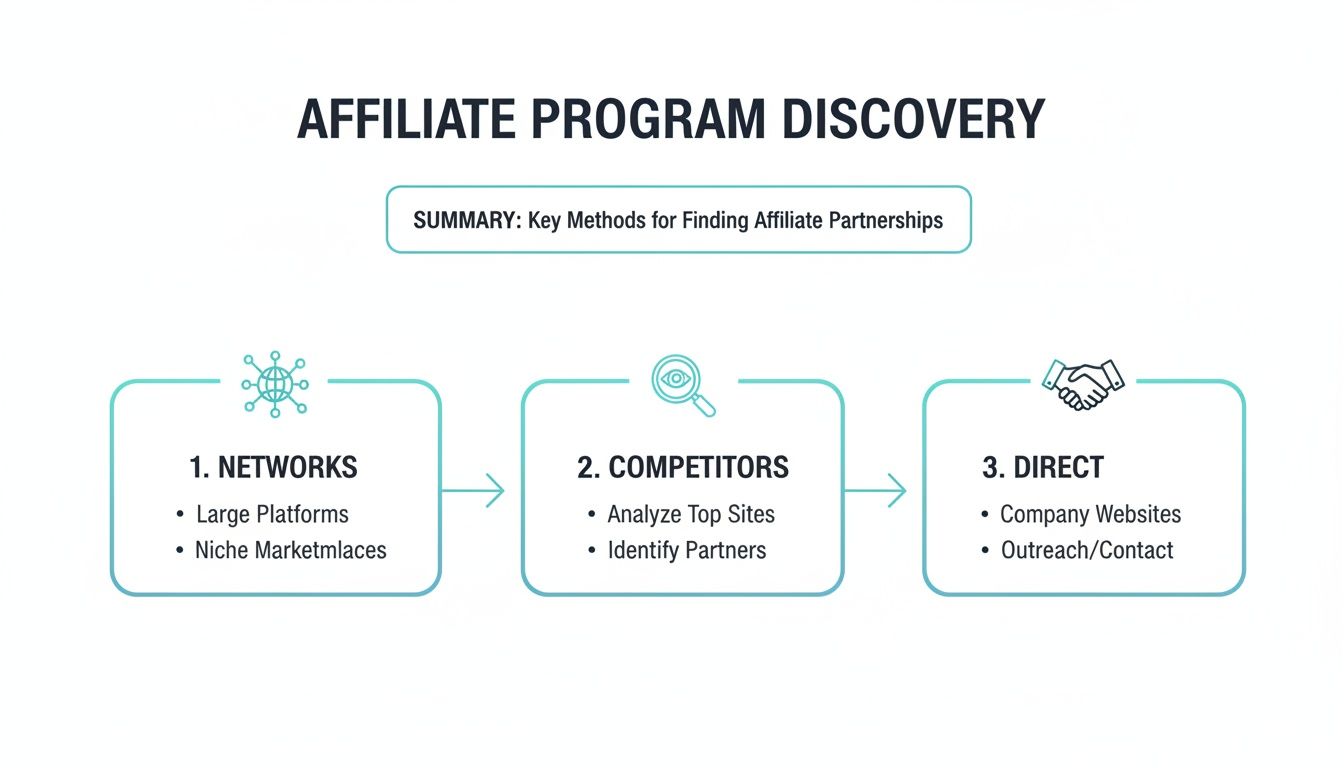
While the discovery phase is about casting a wide net, this evaluation stage is about carefully checking what you've caught. Let's break down the critical terms you need to scrutinize.
Decode the Commission Model
First things first: how are they paying you? Most programs fall into two buckets: a percentage of the sale or a flat-rate fee. Neither is inherently better—it all depends on what you're promoting.
For high-ticket products, a percentage model is usually the winner. A 20% commission on a $500 piece of software feels a lot better than a fixed payout. On the other hand, if you're promoting a subscription service or a lower-cost item, a predictable $50 flat fee for every new sign-up can add up quickly and make forecasting your income much easier.
Keep an eye out for recurring commissions, too. This is the holy grail for many affiliates. You get paid every single month for as long as your referral stays a customer. It might start small, but it's how you build a truly passive and reliable income stream over time.
Understand Cookie Duration (And Why It’s a Big Deal)
Next up is the cookie duration, sometimes called the attribution window. This is the length of time after someone clicks your affiliate link that you can still earn a commission from their purchase. A standard window is anywhere from 30 to 90 days.
A longer cookie duration is your best friend. Think about it: someone clicks your link for a new camera, reads your review, but needs to think it over. They do more research, wait for payday, and finally buy it six weeks later. With a 90-day cookie, that commission is yours. With a 7-day cookie, you get nothing for your hard work.
This is especially vital for products with a long consideration phase, like electronics, furniture, or expensive courses. I’ve seen programs with a lower commission but a generous 90-day cookie consistently outperform those offering huge commissions with a 24-hour cookie (looking at you, Amazon). Don't underestimate this.
Review Payment Thresholds and Payout Schedules
Finally, get practical and check the payment terms. The payment threshold is the minimum you need to earn before they’ll send you the money. Some programs are great, with thresholds as low as $25. Others might make you wait until you’ve racked up $100 or more. A high threshold isn't a deal-breaker, but it’s something to be aware of if you’re just starting out.
Also, look for the payout schedule and any clauses about payment reversals. Most programs have a holding period, often 30-60 days, to account for customer refunds or credit card chargebacks. This is standard practice, but knowing the timeline helps you manage your cash flow expectations and avoid nasty surprises when you check your bank account.
Getting a handle on these financial details is a core part of building a profitable partnership. For a deeper look at managing your affiliate finances, check out these affiliate marketing best practices that top earners rely on.
Craft an Application That Gets You Approved
Your affiliate application is your one shot to make a great first impression. I've seen countless aspiring affiliates get this wrong, sending a sloppy, two-sentence request that gets an instant "no." From an affiliate manager's perspective, a lazy application screams "lazy partner."
Remember, you're asking a business to trust you with its brand. A thoughtful application immediately sets you apart, showing you're a serious professional, not just another person hoping for a quick buck. This is your chance to stand out before you even land your first link.
Describe Your Platform Professionally
The first thing any affiliate manager wants to know is where you'll be promoting their products. Be specific. "I have a blog" isn't going to cut it.
Give them a clear, confident summary of your platform.
- For a blog: "My website, [Your Website Name], is a resource for [Your Niche], currently reaching about [Number] visitors per month. We focus on helping [Your Audience] solve [Their Problem]."
- For a YouTube channel: "My YouTube channel, [Channel Name], produces in-depth tutorials and reviews for a highly engaged audience of [Number] subscribers in the [Your Niche] space."
This simple description tells the manager who you are, the audience you serve, and the size of your reach. It proves you understand your own business.
Pro Tip: Always, always include a direct link to your primary platform. You’d be shocked at how many people forget to link to their own blog or YouTube channel, making it impossible for a manager to review their work. Don't make them hunt for it.
Clearly Explain Your Promotional Methods
This is where you seal the deal. Affiliate managers need to visualize exactly how you plan to drive traffic and generate sales. Vague statements like "I'll use social media" are a massive red flag.
Instead, lay out your specific game plan. Show them you've already put some thought into it.
- "I plan to write a comprehensive, 2,000-word review of your product, complete with original photos and a performance breakdown."
- "We will create a dedicated YouTube tutorial showing our viewers how to use your software to achieve [Specific Outcome]."
- "Your brand will be featured in our popular 'Best Tools for [Niche]' guide, which is consistently one of our top-performing articles."
- "We'll highlight your upcoming sale in our weekly email newsletter that goes out to our list of 5,000+ subscribers."
This level of detail turns a simple request into a powerful business proposal. You're not just asking to join; you're outlining the value you'll deliver. The same pitching skills needed for learning how to get a brand deal apply here—be specific and prove your worth to get that yes.
What to Do After You Get Approved

Getting that "Congratulations, you're approved!" email feels fantastic. But don't just sit back—the approval is the starting gun, not the finish line. Now the real work begins, blending a bit of technical setup with smart content strategy to turn that partnership into revenue.
Your first move should be to dive right into the affiliate dashboard. Think of this as your new command center. Take a few minutes to just click around and get a feel for the layout. The absolute top priority is finding where to get your unique affiliate links.
These special links are the lifeblood of your partnership; they're how the company tracks every single click and sale that comes from you. Most dashboards will have a "Links" or "Creatives" area. You'll usually find a default link to the brand's homepage, but the real magic is in "deep links," which point to specific product or service pages. Deep linking is almost always the better choice because you can send your audience directly to the exact thing you're talking about.
Getting to Know Your Affiliate Dashboard
Beyond grabbing links, that dashboard is a goldmine of data. Learning to read it is just as important as getting approved in the first place. This is where you'll figure out what's working and what's not.
Make sure you know where to find these key sections:
- Reporting & Statistics: This is your performance tracker. You'll see your clicks, conversions, and commissions here. I recommend checking it daily at first to see how your content is performing.
- Creatives & Assets: Many programs give you a library of pre-made banners, official product photos, and sometimes even email templates. While your own voice is key, these can be great for adding a professional touch.
- Payment Information: This one is critical. Find the payment or account settings right away and fill everything out. Whether it's PayPal or a direct bank deposit, getting this done accurately means you’ll get paid on time.
Pro Tip: If the platform has email notifications for sales, turn them on. There's nothing more motivating than seeing a "You've made a commission!" email pop up. It’s also instant feedback on what’s connecting with your audience.
Placing Your Links for Real Impact
Alright, you've got your links. Now, where do you put them? The goal is to weave them into your content so they feel like a natural, helpful recommendation—not a jarring ad. The quickest way to lose trust is to just plaster banner ads all over your site.
Instead, integrate your links where they add genuine value. For instance, if you write a detailed tutorial on how you improved your website's loading speed, that's the perfect place to link to the hosting company or caching plugin you used. You're not just selling; you're showing a real-world result.
A "Recommended Tools" or "Resources" page on your website is another fantastic, low-pressure strategy. It's an honest way to list the products you genuinely use and stand behind, all in one place. Over time, this page can become a trusted resource for your audience and a steady source of affiliate income for you.
To make sure your efforts are actually paying off, you need to know how to calculate marketing ROI for your campaigns. This helps you double down on what works and cut what doesn't.
Common Questions About Joining Affiliate Programs
When you're just getting started, it feels like a million questions pop into your head. It's a whole new world with its own lingo and unwritten rules. I get asked the same things all the time, so let's clear up a few of the most common hurdles you might be facing.
Can I Join Affiliate Programs Without a Website?
This is a big one, and the short answer is yes, you absolutely can. While having a blog is a powerful tool for SEO and in-depth reviews, it’s far from the only game in town. Some of the most successful affiliates I know operate entirely on social media or through an email list.
What affiliate managers really care about is whether you have an engaged audience that trusts you. It doesn't matter where that audience lives, as long as you can reach them consistently.
- YouTube: Video is a powerhouse for affiliate marketing. You can create detailed product reviews, how-to tutorials, or "Top 5" lists and drop your affiliate links right in the description. This works wonders for anything visual, from software to power tools.
- Instagram or TikTok: If your niche is more visual—think fashion, home decor, or lifestyle products—you can do incredible work with Reels, Stories, and a link in your bio. It’s all about quick, authentic recommendations that feel natural to your followers.
- Email Newsletter: Don't underestimate the power of an email list. It's a direct line to your audience, allowing you to share exclusive deals or more personal thoughts on products you're loving.
The trick is to be crystal clear in your application. Instead of being vague, say something specific like, "My main promotion strategy involves creating detailed video reviews for my 10,000 subscribers on YouTube (link here)."
How Much Can I Realistically Make as a Beginner?
Let's talk money because, let's face it, that's what everyone wants to know. Your first few months are probably going to be slow. Earning anything from a few bucks to maybe $100 is completely normal while you're still finding your rhythm.
Your income potential hinges on your niche, the price of the products you're promoting, and—most importantly—how much your audience trusts you. Treat this like building any other business: it takes time and consistent effort. I’ve personally watched new affiliates take six months to make their first $100, only to scale that to thousands per month once their content finally gained traction.
Focus on building trust and providing genuine value above all else. The money always follows the trust, not the other way around. Don't buy into the "get rich quick" promises you see online; real, sustainable success is a marathon, not a sprint.
Top Reasons Applications Get Rejected
It’s always a bummer to get that rejection email, but it’s rarely personal. More often than not, it comes down to a few common (and totally fixable) mistakes. Understanding what programs look for can dramatically boost your approval rate.
Here are the main reasons I see applications get denied:
- Your application is too vague. A one-liner that just says, "I'll promote you on my blog," is an instant red flag. You have to spell out how you'll promote them and who your audience is.
- Your site or channel is brand new and empty. An affiliate manager needs to see what they're signing up for. A website with a "coming soon" page or just one or two thin articles looks like a risk. Before you start applying, make sure you have at least 5-10 solid, high-quality pieces of content published.
- The audience doesn't match the product. This is a huge one. If you run a blog about vegan cooking, applying to promote a steak delivery service is a complete non-starter. Make sure the brand's products are a natural fit for the people you're talking to.
Affiliate Network Versus an In-House Program
You’re going to run into these two terms constantly, so it’s good to know the difference right away.
An affiliate network, like ShareASale or CJ Affiliate, is basically a giant marketplace. It brings thousands of different brand programs together under one roof. This is super convenient because it centralizes everything—your applications, link tracking, and payments are all in one dashboard.
An in-house program, on the other hand, is run directly by the brand itself. You sign up on their website and work directly with their own team. Sometimes, these programs offer better commission rates or more dedicated support since you have a direct line to the affiliate manager.
For most beginners, I recommend starting with the networks. They give you a ton of options to explore and make it easy to get your feet wet without having to juggle a dozen different logins and payment systems.
Ready to explore the affiliate landscape?
Discover networks, tools, and opportunities in our directory.
Explore Directory