

Before you even think about searching for affiliate programs, you need to get your own house in order. So many aspiring affiliates make the mistake of chasing commissions without first building a solid foundation. This is where most people fail.
It’s tempting to jump right in, I get it. But finding the right program—one that truly resonates with your audience and feels authentic—starts with a bit of crucial prep work. Think of it like building a house. You wouldn't start putting up walls without a solid foundation, right? Same principle applies here.
Let's walk through what you need to do first to set yourself up for real, long-term success.
Laying the Groundwork for Affiliate Success
Getting this initial stage right separates the successful affiliates from the ones who struggle to make a single sale. When you’ve done your homework, you stop looking like just another applicant in a long queue. Instead, you become a partner that brands are genuinely excited to work with.
Get Laser-Focused on Your Niche
Your niche isn’t just a broad topic you like. "Fitness" is a category, not a niche. A real niche is something like "home fitness for busy moms using bodyweight exercises." See the difference? It’s specific, targeted, and immediately tells everyone who you serve.
This level of clarity is a game-changer. The creator in that niche knows exactly what their audience needs: workout mats, easy-to-use meal prep containers, maybe even time-management apps. They're not wasting time looking at programs for hardcore bodybuilding supplements. It just wouldn't fit.
If you're new to this whole world, it's worth taking a step back. Our guide explaining what is affiliate marketing in depth covers the core concepts you'll need.
Really Understand Your Audience and Their Problems
Who are you actually talking to? What’s keeping them up at night? The secret to promoting products that people will actually buy is knowing their deepest pain points inside and out. Your content is the bridge that connects their problem to a product’s solution.
Try sketching out a quick audience persona. Ask yourself:
- What are they trying to achieve? (e.g., "I want to lose 10 pounds before my beach vacation.")
- What's their biggest roadblock? (e.g., "I have absolutely no time to get to a gym.")
- What have they tried that didn't work? (e.g., "That expensive treadmill is now a very pricey clothes rack.")
When you have these answers, you can frame your promotions as the perfect fix for their specific struggles, not just as a list of product features. It’s far more powerful.
Make Sure Your Platform Is "Affiliate-Ready"
Believe me, affiliate managers look at your website or social media profile before they approve you. A messy blog, spammy-looking posts, or low-quality content are huge red flags. They’ll click away in seconds.
The best affiliates aren’t just selling stuff; they’re solving problems. Your platform needs to be a trusted resource first. The affiliate links come second. This is how you build an audience that actually trusts your recommendations.
Do a quick audit of your platform. Does it look professional? Is the content high-quality and original? Is your design clean and easy to navigate? Both your audience and your potential partners need to see you as a credible expert. Your platform is your digital storefront—make sure it’s clean, organized, and welcoming before you start putting products on the shelves.
Alright, you've got your foundation set—your niche is defined, and your audience is growing. Now for the exciting part: the hunt for great affiliate programs.
Finding the right partners isn't about one magic search. It's about building a multi-channel playbook that keeps a steady stream of high-potential programs coming your way. This is how you move past the obvious choices and start unearthing the real gems.
Let's dive into the strategies that have consistently worked for me and countless other successful affiliates.
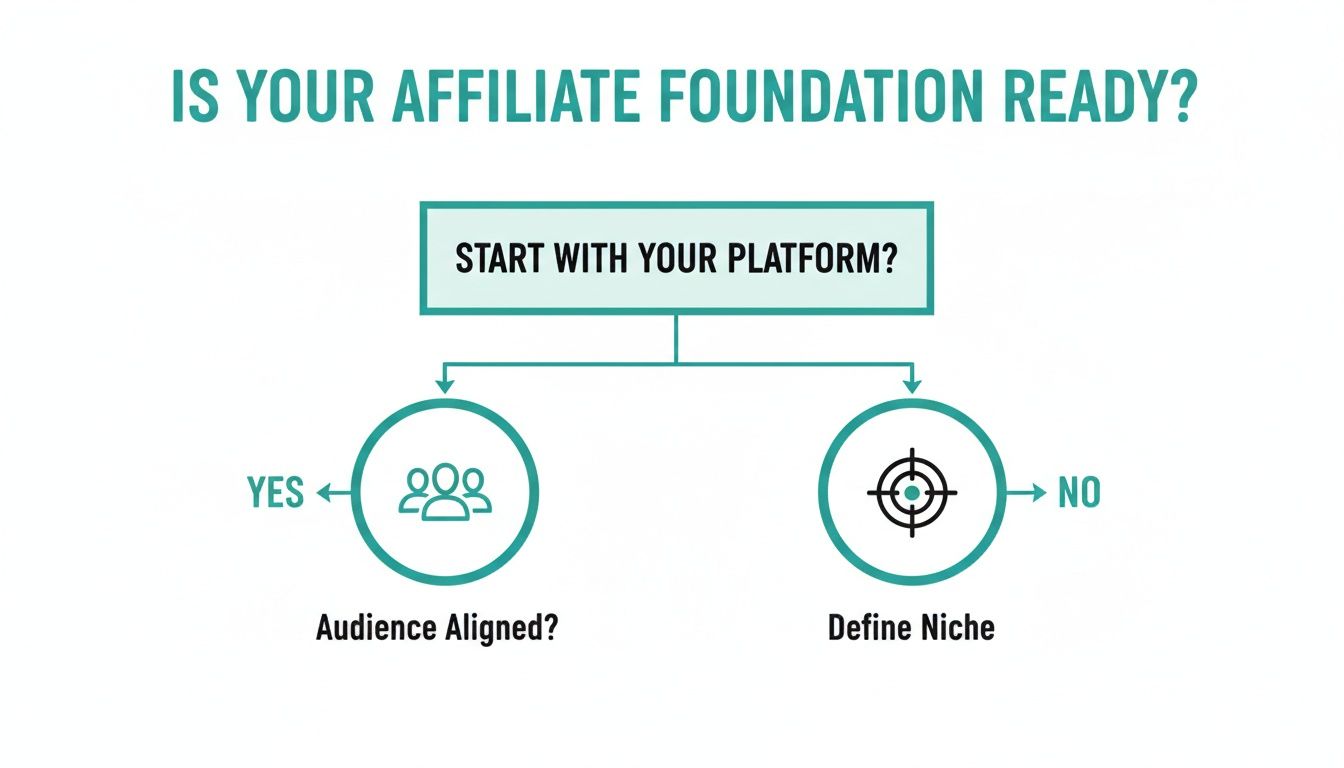
This simple flowchart is a great gut-check. Before you dive deep into the search, just make sure your platform and audience are aligned and ready to go.
Start with the Major Affiliate Networks
Think of affiliate networks as huge marketplaces connecting brands with publishers like us. They’re central hubs where you can find, apply to, and manage tons of programs all in one place. You've probably heard of the big ones: CJ (formerly Commission Junction), ShareASale, Rakuten Advertising, and Impact.
The real skill here is mastering their search and filter tools. Don't just skim the homepage. Get your hands dirty and dig into their merchant databases.
- Filter by Category: This is your first move. Immediately narrow the results to your specific niche, whether that's "Software," "Home & Garden," or "Financial Services."
- Sort by Performance: Always look for ways to sort by metrics like "Network Earnings," "EPC" (Earnings Per Click), or "Conversion Rate." This pushes the programs that are actually making money for other affiliates right to the top.
- Check Program Features: Many networks let you filter for specifics like auto-approval, deep linking, or certain cookie durations. Use these to find programs that fit your style.
A high EPC is a massive green flag. It tells you that other affiliates are successfully sending traffic that converts. This usually means the offer is solid and the brand’s checkout process isn’t a mess.
Use Specialized Affiliate Directories to Get the Full Picture
Networks are fantastic, but they only show you programs on their own platform. That's a huge blind spot. This is where specialized directories become your secret weapon, pulling opportunities from all over the web into one searchable database.
A great example is the Affiliate Landscape database. With global affiliate spending hitting $17 billion and over 80% of brands running affiliate programs, you can imagine how impossible it is to find the best partners manually.
Agencies have reported cutting their research time by 50% just by using a central directory. When you consider there are nearly 9,600 affiliate service providers out there, having a platform with built-in scoring is a game-changer for finding the right fit. It allows you to compare programs side-by-side, no matter which network they call home.
Do Some Smart Competitor Spying
Honestly, one of the slickest ways to find programs that convert is to see what's already working for your competition. They've done the hard work of testing and vetting, so you can learn from their efforts.
Pick 3-5 successful blogs, YouTube channels, or social accounts in your niche and start digging.
- Check their "Resources" or "Tools" pages. These are often goldmines of affiliate links.
- Read their product reviews and tutorials. Pay close attention to the links they use to direct readers to purchase.
- Scan YouTube video descriptions. Creators almost always list their favorite gear, software, or services—and you can bet those are affiliate links.
If you see a competitor promoting the same brand over and over again, that's a powerful signal. It means the program is profitable. Add that brand to your research list, pronto.
Go Straight to the Brands You Already Love
Sometimes, the absolute best programs are hiding in plain sight. Many companies, especially smaller or newer brands, run their own in-house affiliate programs and don't bother with the big networks.
The only way to find these is to go directly to them.
Start by making a list of the products and services you already use and genuinely recommend. Promotions feel most authentic when they come from a place of real experience.
Head over to their website and scroll all the way down to the footer. Look for a link that says "Affiliates," "Partners," or something similar. Can't find it? Don't stop there. A quick Google search for "[Brand Name] affiliate program" often uncovers a hidden sign-up page.
If you still come up empty, a direct email to their marketing or partnerships team can be incredibly effective. A personal note explaining why you love their product and how your audience would benefit from it can open doors that aren't publicly advertised. This hands-on approach often leads to the most rewarding partnerships.
Affiliate Program Discovery Methods Compared
To help you decide where to focus your energy first, here’s a quick breakdown of the methods we just covered. Each has its place in a well-rounded strategy.
| Method | Pros | Cons | Best For |
|---|---|---|---|
| Affiliate Networks | Centralized management, thousands of programs, reliable payments. | Can be competitive, some platforms have a learning curve. | Finding and managing multiple mainstream programs efficiently. |
| Specialized Directories | Comprehensive market view, discovers hidden gems, compares across networks. | Can be overwhelming, may require a subscription for full access. | Serious affiliates who want a complete view of all available partners. |
| Competitor Analysis | Reveals proven, profitable programs, saves testing time. | Can lead to a "copycat" strategy if not adapted, limited to what's public. | Finding high-converting offers in a new or competitive niche. |
| Direct Outreach | Builds strong relationships, potential for exclusive terms, promotes authenticity. | Time-consuming, success rate can be low without a strong pitch. | Partnering with beloved brands that don't have public programs. |
Ultimately, a mix of these strategies will give you the best results. Start with the networks for some quick wins, use directories and competitor analysis to find proven performers, and don't be afraid to go direct for those passion-project partnerships.
Alright, you've got a list of potential affiliate programs. That’s the easy part. The real work—the stuff that separates the pros from the hobbyists—is digging in and vetting each one.
Skipping this step is a classic rookie mistake. You wouldn’t build a house on a shaky foundation, right? Committing to a program without doing your homework is pretty much the same thing. You're setting yourself up for headaches down the road.
Think of the next few steps as your pre-partnership checklist. This is how you find true partners, not just another link to add to your dashboard.

Deconstruct the Commission Structure
The commission rate is the shiny object that catches everyone's eye, but the number itself is only a small piece of the puzzle. What you really need to understand is how you get paid. Most programs use one of a few common models, and each has its own quirks.
- Cost Per Sale (CPS) or Revenue Share: This is the bread and butter of affiliate marketing. You earn a percentage or a flat fee for every sale your link generates. It's clean, simple, and directly rewards you for sending high-quality traffic that actually buys something.
- Cost Per Lead (CPL): With this model, you get paid when someone completes a specific action, like signing up for a free trial or filling out a form. CPL is fantastic when your audience isn't quite ready to pull out their credit card but is definitely interested in what the brand offers.
- Cost Per Click (CPC): You don't see this one as much anymore, but it's still out there. You earn a tiny amount for every single click, sale or not. It’s lower risk, but the earning potential is usually much, much lower.
And please, don't get hypnotized by a high percentage. A 50% commission on a $10 ebook is only $5. A 10% commission on a $500 piece of software is $50. Always do the math.
Look Beyond the Commission Rate
A juicy commission rate is worthless if the program's terms are designed to trip you up. Two of the most important details hiding in the fine print are the cookie duration and the payment terms. These two things can absolutely make or break your profitability.
Cookie Duration Explained
The cookie duration (sometimes called cookie life) is the window of time after someone clicks your link where you still get credit for a sale. For example, with a 30-day cookie, if a reader clicks your link today and buys anytime in the next 30 days, you get paid.
A longer cookie duration is almost always better. It gives your audience time to think things over without you losing the commission. A super short cookie life, like 24 hours, is a huge red flag, especially for expensive products with a longer sales cycle.
Payment Terms and Thresholds
Let's be honest, we're all in this to get paid. So, it’s critical to get clear answers to these questions before you sign up:
- What's the minimum payout? ($50? $100?)
- How often do they pay? (Net-30? Net-60?)
- What are my payment options? (PayPal? Direct deposit?)
An absurdly high payout threshold (anything over $100 should make you pause) can be a sign of a program that makes it difficult for new affiliates to ever see their money. You also want a reliable, predictable payment schedule. Pro programs pay on time, every time.
We dig deep into how these factors and others contribute to a program's overall quality in our guide on how affiliate scoring works.
Assess the Brand and Its Assets
Finally, take a step back and evaluate the company itself. It doesn't matter how great the commission is if the brand has a terrible reputation or a website that looks like it was built in 1998. Your reputation is tied to every single product you recommend.
Start by clicking around their website. Pretend you're a customer. Is it professional? Is it easy to find what you're looking for? Is the checkout process a nightmare? A clunky, confusing site is a conversion killer, and it will tank your earnings.
Next, check out the quality of their creative assets. Do they give you good-looking banners, email copy, and high-res product photos? When a brand invests in quality marketing materials for its affiliates, it’s a clear sign they're serious about the partnership. Remember that businesses can earn $6.50 for every $1 they spend on affiliate marketing, but 45% of affiliates say getting traffic is their biggest struggle. Good creative support from the brand makes your job a whole lot easier. You can explore more affiliate marketing statistics to get a better feel for these industry trends.
By looking at the whole picture—commissions, terms, and the brand itself—you stop just collecting links and start building strategic, profitable partnerships.
Getting Your Foot in the Door: Crafting an Application That Gets Approved
Finding a killer affiliate program is only half the battle. Now you have to convince them to let you in. Especially with top-tier programs, affiliate managers are wading through a sea of applications every single day. Your job is to make theirs an easy "yes."
Think about it from their perspective. They're looking for real partners, not just another affiliate ID to add to their roster. A generic, copy-and-paste application screams "I don't really care about your brand," and it's the fastest way to land in the trash folder. You have one shot to make a great first impression, so let's make it count.
Think Like a Partner, Not an Applicant
First things first, get out of the "applicant" mindset. You're not asking for a job; you're proposing a business partnership. That means you need to present your website, YouTube channel, or social profile as a professional media property.
Before you even think about hitting "apply," give your platform an honest look. Is it clean and easy to navigate? Does it clearly showcase your expertise and the value you provide to your audience? Trust me, the very first thing an affiliate manager will do is click over to your site. A messy, half-finished blog or an inactive social media account is a red flag they can't ignore.
The Anatomy of an Application That Works
Whether you’re filling out a form on a big network or shooting off a direct email, the fundamentals of a winning application are the same. You need to quickly and clearly communicate why you’re a good bet.
Here’s what you absolutely must include to get noticed:
- Who You Are & Who You Serve: Don't just give them your website URL. Briefly explain your niche and, more importantly, describe your audience. Who are they? What are their pain points? Why do they trust you?
- Show Off Your Numbers (the Right Way): Be upfront with your metrics. Share your monthly traffic, follower counts, and email list size. But don't stop there. Context is king. Mention your email open rates, average watch time, or comment threads. High engagement on a smaller audience can often be more valuable than a huge, passive one.
- Connect the Dots for Them: This is the most critical part. Explain why their brand is a perfect fit for your audience. "I've personally used your X software for years and it's the only one I recommend to my readers for Y" is a million times more powerful than "I think your products would be a good fit."
A personalized application proves you've done your homework. It tells the affiliate manager you're not just chasing a commission—you're genuinely invested in a partnership that makes sense for everyone.
Lay Out Your Game Plan
This is where you can really separate yourself from the pack. Most applicants just say they'll promote the product. You're going to tell them exactly how. A specific, thoughtful promotional plan turns your application from a simple request into a compelling business proposal.
Get specific. Give them a tangible sense of what you'll do. For example:
- A Deep-Dive Review: "I plan to publish a comprehensive review of your flagship product, complete with custom photography and a video tutorial, scheduled for early next month."
- Strategic Content Placement: "I'll be updating my 'Best Tools for Project Managers' article, which gets over 5,000 organic visits a month, to include your service in the top three."
- Multi-Channel Promotion: "After the review goes live, I'll feature it in my newsletter to 10,000 subscribers and create a dedicated Instagram Stories series walking my audience through its key features."
See the difference? You’ve just shown them you're a serious marketer with a plan to deliver actual results.
Following Up and Asking for More
If you don't get a response in a week or so, don't sweat it. A polite follow-up email is perfectly acceptable and often necessary. Applications get buried. A friendly nudge can bring yours right back to the top of the pile.
And remember, once you’re in and you start driving consistent sales, the terms you started with aren't necessarily set in stone. After you’ve proven your value for a few months, you’re in a great position to negotiate. Many top affiliates successfully ask for higher commission rates, a longer cookie duration, or even a custom coupon code for their audience. The key is to deliver undeniable results first, then open the conversation.
Onboarding and Scaling Your New Affiliate Partnerships
Getting that "approved" email feels great, but it’s just the starting gun. The real work—and the real income—starts now. It’s time to shift from just finding affiliate programs to actually making them profitable and building partnerships that last.
This next phase is all about execution. We'll get into the nitty-gritty of the technical setup, how to weave promotions into your content without sounding like a salesperson, and the art of turning a simple link into a serious revenue stream.
Nail Your Technical Setup from Day One
Before you can earn a single commission, your tracking has to be perfect. This is the absolute foundation of your affiliate business. If you mess this up, you're literally just leaving money on the table.
The first thing you should do is get comfortable with the affiliate dashboard. This is your mission control for everything from performance reports to your unique tracking links.
Here’s what to tackle right away:
- Generate Your Links: Grab your main affiliate link. But don't stop there. Most programs let you create "deep links" that point to specific product pages. These almost always convert better than a generic link to the homepage.
- Understand SubIDs: Many platforms let you add a SubID (or tracking ID) to your links, and this is a total game-changer for optimization. You can create unique SubIDs for different pages, campaigns, or even individual buttons to see exactly what’s driving clicks and sales. For instance, a link could have
&subid=product-review-sidebarto track clicks from a specific banner. - Install Tracking Pixels (If Needed): Some more advanced programs might give you a tracking pixel for your website. This helps them gather better data and can seriously improve attribution, making sure you get credit for every sale you influence.
Getting these technical bits sorted from the get-go ensures every click is counted and every sale is credited. If you want to dive deeper into the tools that run these systems, exploring a guide to the best affiliate marketing platforms is a great next step.
Build a Strong Relationship with Your Affiliate Manager
Think of your affiliate manager as your most valuable asset. They aren't just a support contact; they're your inside line to the brand. A good relationship with them can open doors to opportunities that the average affiliate never sees.
Treat them like a true partner. Once you’re approved, send a quick intro email. Briefly outline your promotional plans and ask if they have any tips or top-performing creative assets you should be using.
A proactive, professional affiliate is a manager's dream. Keep them in the loop on your big promotions and share your wins. This simple communication can lead to exclusive coupon codes, commission bumps, and a heads-up on new product launches.
Scale Your Success with Data
Once your promotions are live, your affiliate dashboard is your roadmap. It’s packed with data that tells you exactly what’s working and what’s falling flat. The top earners in this industry are absolutely obsessed with their analytics.
The affiliate marketing world is projected to become a $37.3 billion market, and with search interest jumping 264% in recent years, more brands are vying for partners like you. Understanding your data is what will set you apart. Since over 81% of marketers run these programs and mobile traffic accounts for 62% of affiliate visits, tracking your performance and making sure your links are mobile-friendly is non-negotiable.
To scale your income, keep a close eye on these key metrics:
- Clicks: Are people actually clicking your links? If clicks are low, your call-to-action or link placement probably needs work.
- Conversion Rate (CR): What percentage of those clicks turn into sales? A low CR might mean there's a disconnect between your audience and the product, or maybe the brand's sales page isn't doing its job.
- Earnings Per Click (EPC): This metric boils it all down to how much you earn, on average, for every single click you send their way. It’s the ultimate measure of your traffic quality.
Use this data to double down on what works. If one blog post is driving 80% of your sales, it’s time to create more content around that topic. If your SubID data shows that in-text links are outperforming banners by 10-to-1, maybe it’s time to ditch the banners.
This constant cycle of promoting, analyzing, and optimizing is how you turn a partnership from a side hustle into a major revenue stream.
Of course. Here's that section rewritten to sound more natural and human, as if it's coming from an experienced affiliate marketer.
Got Questions? Let's Clear Things Up
Diving into affiliate marketing for the first time? It's totally normal to have a bunch of questions. New terms, different platforms, weird acronyms... it can feel like a lot. Getting some straight answers right from the start can save you a ton of headaches and help you avoid those classic beginner mistakes.
Let's walk through some of the most common questions that pop up when you're hunting for the right affiliate programs.
How Many Affiliate Programs Should I Join When I'm Just Starting Out?
When you're new to the game, it's all about quality over quantity. I know it's tempting to sign up for everything that looks interesting, but trust me on this one: don't.
Kick things off with just one to three core programs that are a perfect match for your niche. This laser-focused approach lets you really get to know the products inside and out. You can create genuinely helpful content, learn what actually clicks with your audience, and build a real relationship with the brand. If you spread yourself too thin right away, your efforts get diluted, and it's almost impossible to get any real momentum.
Once you’ve got a good system down and you're seeing consistent clicks and commissions from those first few partners, then you can start looking to slowly and strategically add more to your lineup.
Affiliate Network vs. In-House Program: What's the Real Difference?
Getting this distinction is crucial because it dictates where you'll spend your time searching for partners. Each path offers a pretty different experience.
- An affiliate network is basically a huge marketplace. Think of platforms like CJ, ShareASale, or Impact. They're the middleman connecting thousands of brands with affiliates like us. The network handles the messy stuff—tracking, reporting, payments—all through one dashboard.
- An in-house program is run directly by the brand itself, usually on their own software. The big advantage here is that you often get a much closer relationship with an affiliate manager. Sometimes, you can even negotiate better terms because there's no network taking a cut.
Networks give you variety and make management easy. In-house programs can lead to deeper, more lucrative partnerships. Honestly, the best long-term strategy usually involves a mix of both.
It's never about whether a network or an in-house program is "better." It's about what makes sense for that specific partnership. Some of my most profitable relationships have come from reaching out to a brand directly.
Can I Get Approved for Programs if My Audience Is Still Small?
Yes, you absolutely can. Don't let a small following hold you back.
While it's true that some big-name, highly competitive programs might look for huge traffic numbers, countless brands are eager to work with smaller creators who have a clear, engaged audience. Your value isn't just in your follower count; it's in your expertise and the trust you've built.
When you apply, don't focus on the numbers. Instead, sell them on the quality of your platform and your audience. Make sure you highlight things like:
- Your specific niche and why you're an authority.
- The quality of your content (link them to your best stuff!).
- Any proof of high engagement, like comments, email open rates, or video watch time.
A micro-influencer with a few thousand die-hard fans is often way more valuable to a brand than a massive account with a passive, unengaged audience. Start by applying to programs known for being friendly to newcomers, build a little history of success, and then you can start aiming higher.
Finding the right affiliate partners is the most important step in building a successful monetization strategy. AffiliateLandscape is the definitive directory for the performance marketing ecosystem, helping you discover thousands of programs, networks, and tools all in one place. Stop wasting time with endless searches and start building profitable partnerships faster at https://affiliateislandscape.com.
Ready to explore the affiliate landscape?
Discover networks, tools, and opportunities in our directory.
Explore Directory