
Landing a brand deal isn't about chasing follower counts. It's about building a genuine brand with a clear niche, polishing your digital footprint, and then creating a media kit that leaves no doubt about the value you bring to the table. The real secret is proving you have high engagement and a strong connection with your community.
Build a Brand That Partners Want to Work With
Before you even think about sending that first pitch, you need to lay the groundwork. Your goal is to become "partnership-ready," making you an obvious and easy choice for brands. Too many creators get hung up on vanity metrics, but I can tell you from experience, brand managers look way deeper than that. They're hunting for audience trust, consistent engagement, and a specific niche that perfectly matches their ideal customer.
The idea isn't just to be visible, but to be seen as a credible, professional partner. Every single part of your online presence, from your bio down to how you handle your comment section, should scream "high-quality." A messy or inconsistent brand identity is one of the fastest ways to get your pitch deleted.
Define Your Niche and Audience Value
The very first question a brand will ask is, "Who are they, and who do they reach?" A vague answer like "I'm a fitness creator" just won't fly. You need to get specific. Are you the go-to expert for budget-friendly home workouts for busy parents, or do you review high-end gaming PCs? That level of specificity is your biggest advantage.
Once your niche is solid, you have to know your audience inside and out. I'm talking about more than just surface-level stats.
- Demographics: Get a handle on their age, gender, location, and even their general income level.
- Psychographics: This is where the magic happens. What are their interests, pain points, and motivations? Why do they actually follow you? What problems are you helping them solve?
- Behavior: Pay attention to what they engage with. Do they love your short-form video tutorials, devour your in-depth blog posts, or show up for every interactive Q&A?
This deep understanding is what you're actually selling. You aren't just offering eyeballs; you're offering access to a targeted, engaged community that trusts what you have to say.
A micro-influencer with a 7% engagement rate can often drive far better results for a niche brand than a massive creator with millions of passive followers. It's the quality of the connection, not the quantity of followers, that leads to real sales and brand loyalty.
Polish Your Online Presence
Think of your social media profiles, blog, or YouTube channel as your digital storefront. A brand manager is going to check you out there long before they ever see a media kit. A professional, cohesive presence is a clear signal that you take this seriously. If you need some inspiration, check out how top creators set up their platforms in our guides for affiliates and publishers.
This simple process flow breaks down the key stages of getting your brand ready for partnerships.
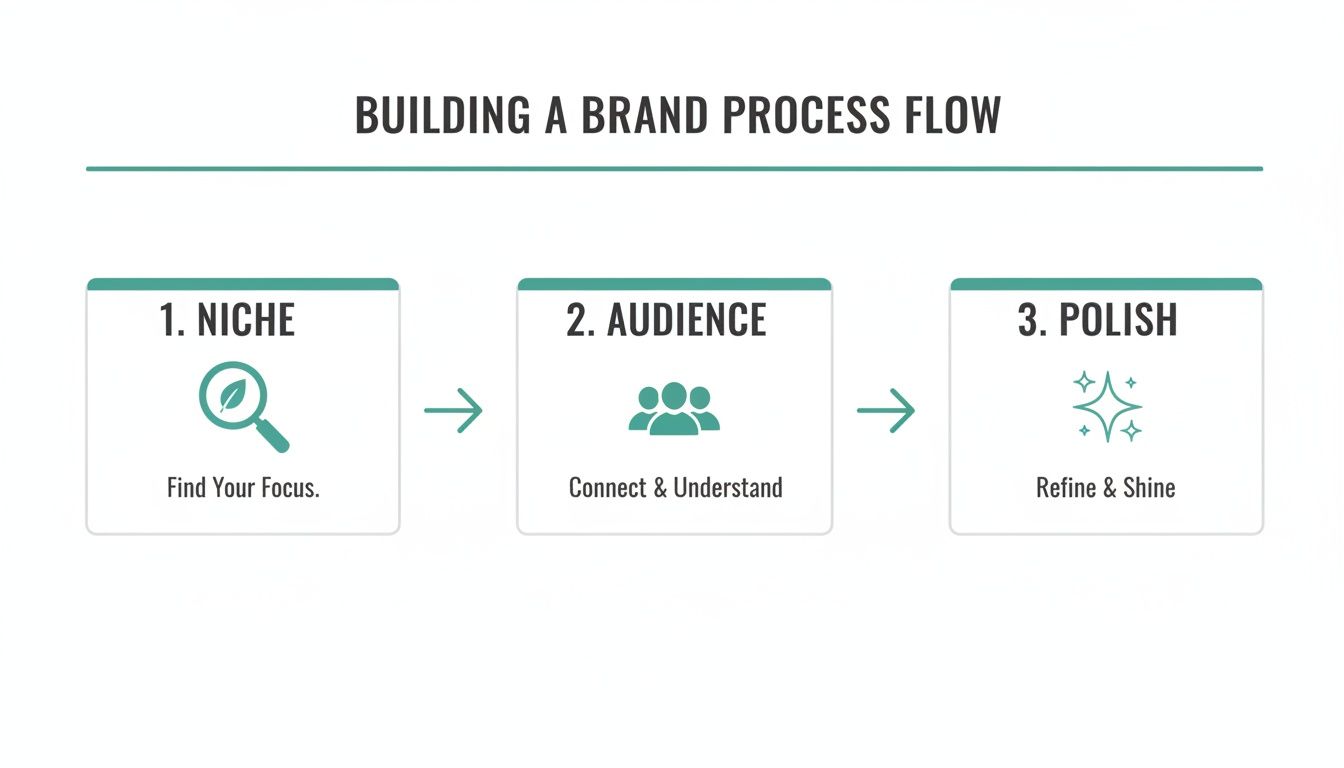
It really is that straightforward: start with a focused niche, which naturally attracts a specific audience. Then, add that final layer of professional polish before you start reaching out.
Tell a Compelling Story with Analytics
Finally, you have to learn how to frame your analytics. Don't just spit out numbers—tell a story. A high click-through rate on your links proves your audience takes action. A high completion rate on your videos shows you know how to hold their attention.
Start reframing your data to answer a brand's unspoken questions:
Instead of: "I get 50,000 views per video."
Try: "My long-form tutorials average an 8-minute watch time, which shows my audience is deeply invested in learning about products."
Instead of: "I have 10,000 followers."
Try: "My community of 10,000 has a 9% engagement rate, and I get DMs daily asking for recommendations, which points to strong purchase intent."
This narrative approach turns dry statistics into undeniable proof of your influence. It’s this kind of strategic thinking that separates a good creator from a sought-after brand partner.
Craft a Media Kit That Sells Your Value
Think of your media kit as your professional handshake. It's often the very first—and sometimes only—impression you'll make when you’re trying to land a brand deal. A generic, data-dump kit will get you ignored, but a sharp, well-designed one opens the door to serious conversations. It’s your chance to tell your story, prove your influence, and show a brand exactly why partnering with you is a smart move.
This isn't just about showing off your follower count. A truly effective media kit wraps your data in a compelling story, turning raw numbers into a clear value proposition. It needs to be visually appealing, easy to scan, and laser-focused on answering the brand manager's biggest question: "What's the ROI here?"
What to Include in a Deal-Closing Media Kit
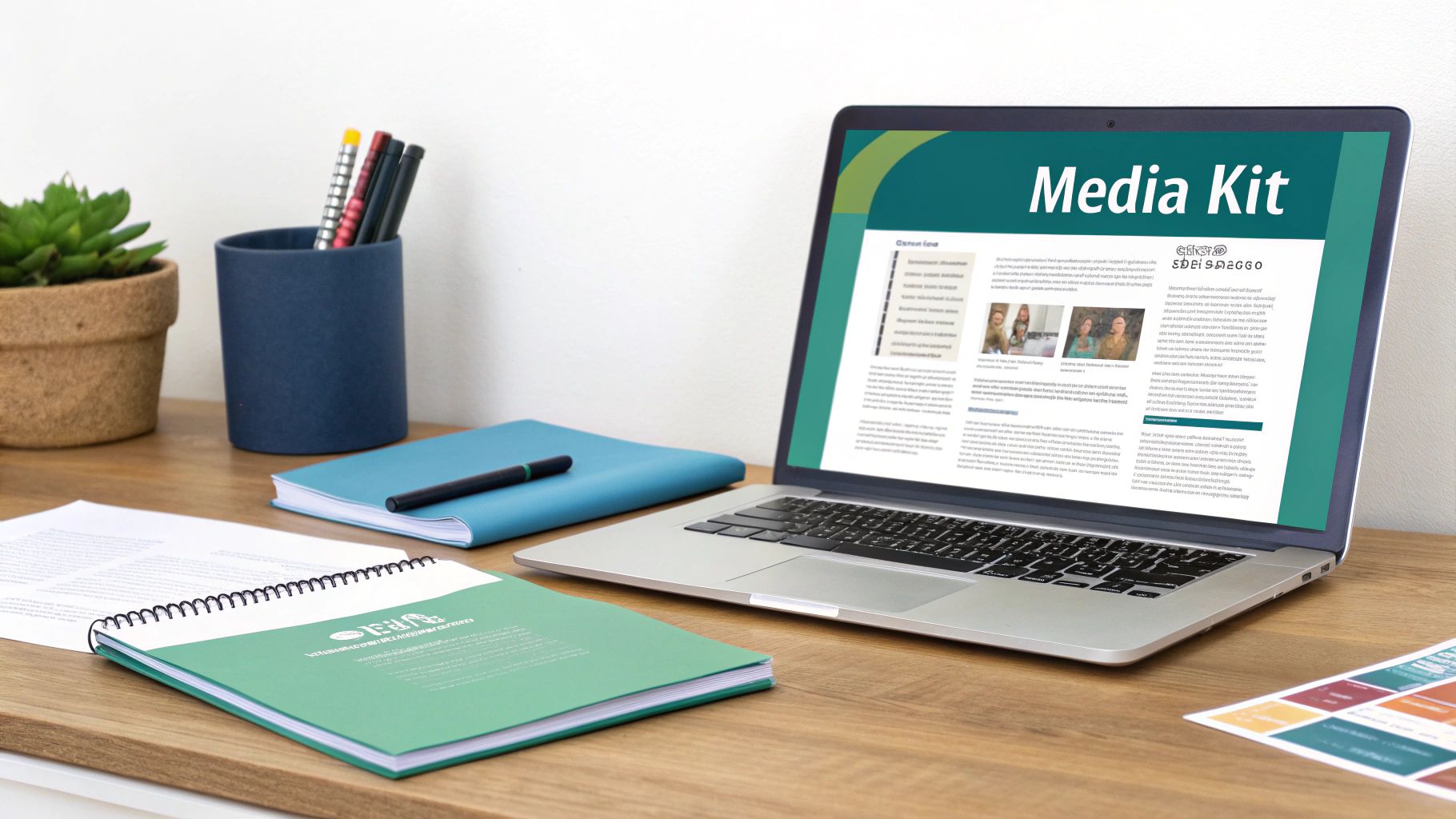
Your media kit should be a concise, one-stop shop for everything a brand needs to know. I recommend a polished 2-3 page PDF that matches your personal brand's vibe. Every single piece of it should be crafted with the brand's goals in mind.
- A Powerful Bio and Intro: Don't just say, "I'm a creator." Tell them your story. What’s your mission? Why are you obsessed with your niche? This is where you build a real connection and let your unique voice shine through.
- Detailed Audience Demographics: Brands are buying access to your audience, so they need to know if it’s a match. Include verifiable data on age, gender, top locations, and interests. I always suggest including screenshots straight from your platform's analytics—it adds a ton of credibility.
- Key Performance Metrics: This is the heart of your kit. Forget vanity metrics and focus on the data that proves you have real influence and can deliver a return on their investment.
Your media kit’s job is to prove you have an engaged, trusting community that takes action. Focus on metrics that signal purchase intent and brand loyalty over simple follower counts.
For instance, a high click-through rate (CTR) on your affiliate links is gold. It shows that your audience trusts your recommendations enough to pull out their wallets. Likewise, a strong average watch time on your videos proves you can hold attention—a priceless commodity for brands trying to cut through the noise.
Showcasing Your Past Success and Offerings
Once you've established who you are and who you reach, you need to show brands what you can actually do. This is where you turn potential into tangible partnership opportunities.
Start by including case studies or highlights from previous collaborations. Even if they were just unpaid product trades, you can still showcase the beautiful content you created and the fantastic engagement it got.
Here’s a quick example:
- Partner: Aura Skincare (Gifting Collaboration)
- Deliverables: 1 Instagram Reel, 3 Stories
- Results: The Reel hit 2.5x my average view count and a 12% engagement rate. It also drove over 200 link clicks to their product page in the first 48 hours.
See how specific and results-focused that is? It’s incredibly persuasive.
Next, lay out a clear menu of your services. This makes it dead simple for brands to see how they can work with you. A simple table often works best.
| Service Offered | Description | Starting Rate |
|---|---|---|
| Dedicated Instagram Post | A high-quality, in-feed post featuring the product in an authentic setting. Includes caption and hashtags. | $XXX |
| Instagram Story Package | A series of 3-5 interactive stories (e.g., polls, Q&A) to drive engagement and clicks. | $XXX |
| Dedicated YouTube Video | A 5-8 minute video review or integration showcasing the product's features and benefits. | $XXXX |
| UGC Content Bundle | 5 high-resolution photos and 2 short-form videos for the brand to use on their own channels. | $XXX |
Finally, make your contact info impossible to miss. Add your email, direct links to your social profiles, and a link to your website or portfolio. The goal is to remove every ounce of friction for an interested brand manager to get in touch. As you build your track record, you’ll get a better sense of what makes a partnership truly valuable, which you can learn more about by understanding how scoring works in professional partner directories.
Find and Qualify the Right Brand Partners
Let's get one thing straight: mass-emailing a generic pitch is the fastest way to get ignored. If you want to land a great brand deal, the real work happens before you ever hit send. It all comes down to strategic targeting and finding brands that are a genuine, authentic fit for your audience.
This isn’t just about pitching brands you personally love. You have to think like a marketing manager. The sweet spot is finding companies whose products and mission align so perfectly with your community that the partnership feels like a natural recommendation, not a forced ad. That’s where the magic happens.
Using Directories and Marketplaces to Your Advantage
The affiliate marketing world is booming. Projections show the global market could rocket past $20 billion by 2026, and with 40% of marketers planning to pump more money into their affiliate budgets, brands are actively hunting for creators just like you.
This growth means you don't have to start from scratch. Specialized directories and creator marketplaces are goldmines for connecting with brands that are already looking to collaborate.
Think of these platforms as a warm introduction. They let you filter by your niche, preferred commission models, and the type of program you're looking for. Instead of sending a cold pitch out into the void, you’re connecting with brands that have already signaled they’re ready to partner up.
A discovery platform like AffiliateLandscape, for instance, can cut your research time dramatically by showing you who the key players are.
A quick glance lets you see top-performing brands and drill down into specific categories. It’s a shortcut to finding companies that are already serious about creator and affiliate marketing.
Do Your Homework: Research a Brand’s Collaboration History
Finding a brand that looks good on paper is just the first step. Now, you need to qualify them. A little detective work will reveal if they're truly a good partner for you. Your mission is to understand their marketing playbook and how they work with creators.
Start by digging into their social media feeds and, more importantly, their tagged photos. Ask yourself a few questions:
- Who are they working with? See if they’re partnering with other creators in your niche. Are they micro-influencers or mega-stars? This gives you a clue about the audience size they typically target.
- What does their sponsored content look like? Is it creative and authentic, or does every post look like a cookie-cutter ad? This tells you how much creative freedom you can expect.
- How do they treat their partners? Look for brands that re-share creator content and give shout-outs. It's a great sign that they truly value the relationship.
A brand's past collaborations are a roadmap to their marketing priorities. If they consistently partner with creators who have a similar audience and content style to yours, you have a much stronger case for why you're a perfect match.
This homework is non-negotiable. It not only confirms the brand is a solid fit but also gives you fantastic talking points for your pitch. You can even see who's making waves by checking out regularly updated leaderboards of top merchants and brands.
Find the Right Person, Not Just the Right Company
After all that effort to find and vet the perfect brand, don't let your pitch die in a generic info@brand.com inbox. It's a total waste. The final, crucial piece of the puzzle is finding the specific person who manages creator or affiliate partnerships.
LinkedIn is your best friend here. Get on there and search for titles like:
- "Influencer Marketing Manager"
- "Affiliate Manager"
- "Partnerships Coordinator"
- "Brand Marketing Manager"
If you find a few possibilities, zero in on the most specialized role. Sending your pitch directly to the person whose job it is to build these relationships instantly shows you’re a pro who does their research. It dramatically increases your odds of actually getting a response.
Master Your Outreach and Pitching Strategy
Okay, you've got your polished media kit and a killer list of dream brands. Now for the hard part: making contact. This is exactly where so many creators go wrong, firing off generic, self-serving emails that are destined for the trash folder.
A great pitch isn't about you—it's about what you can do for them. Think of it as a strategic conversation starter, one designed to prove you get their goals and you're the perfect person to help them hit those targets. The best pitches feel personal and scream value. A brand manager can spot a copy-and-paste job from a mile away, so your goal is to show you've done your homework.
Crafting a Pitch That Actually Gets a Response
Your pitch email is your first impression. It needs to be sharp, compelling, and laser-focused on the brand's world. Ditch the long, rambling story about your creator journey and get straight to the point.
Every pitch that has ever landed me a deal contained three key things:
- A personalized hook that shows I'm paying attention.
- A clear, undeniable link between my audience and their ideal customer.
- A specific, creative idea for how we could work together.
Don't just ask for a partnership; propose one. Instead of a vague "let's collaborate," suggest something tangible. For instance, "I envision a three-part TikTok series showing how your travel backpack holds up on a chaotic weekend trip through NYC, hitting on its durability and security features." That’s an idea they can actually visualize.
Your pitch has to answer the brand's unspoken question: "What's in it for us?" When you lead with the value you can bring them, not the deal you want from them, everything changes. This mindset shift is the single most powerful way to boost your response rate.
The Not-So-Secret Art of the Follow-Up
Radio silence after a pitch doesn’t automatically mean they’re not interested. Brand managers are juggling a million things, and your email can easily slip through the cracks. A polite follow-up isn't pushy; it's professional.
Give it about 5-7 business days. Then, simply reply to your original email with a short, friendly nudge. Something like, "Hey [Name], just wanted to float this to the top of your inbox in case you missed it. Happy to answer any questions about the media kit!" It’s a gentle reminder that shows you’re serious without being annoying.
If another week goes by with no word, you can try one last time. After that? It's time to move on. Knowing when to stop is just as crucial as knowing when to follow up.
Anatomy of a Winning Pitch Email
To really nail this, it helps to break down your email into its core components. Each part has a specific job to do, guiding the brand manager from "Who is this?" to "Let's book a call."
This table shows how each piece works together to create a pitch that's impossible to ignore.
| Email Component | Purpose | Example Snippet |
|---|---|---|
| Compelling Subject Line | To get your email opened in a crowded inbox. Be specific and intriguing. | Partnership Idea: Your Backpacks + My Travel Audience |
| Personalized Opener | To show you've done your homework and build instant rapport. | I've been a huge fan of your sustainable mission ever since I saw your Earth Day campaign. |
| Value Proposition | To quickly connect the dots between your audience and their marketing goals. | My audience of 25-35 year old urban professionals trusts my recommendations for eco-friendly gear... |
| The Creative Concept | To offer a tangible idea that proves your creativity and brand understanding. | ...which is why I'd love to create an Instagram Reel showing how your new blender streamlines my busy morning routine. |
| Call to Action & Closing | To make the next step obvious and easy for them to take. | Is this something you handle, or is there a better person to chat with? My media kit is attached with more detail. |
By treating your outreach as a repeatable system rather than a shot in the dark, you'll start seeing real, consistent results and land the brand deals you deserve.
Negotiate Contracts and Pricing with Confidence
That rush you feel when a brand says "yes" is amazing. But what comes next is where the real work begins: the negotiation. This is the moment you shift from creator to business owner, and honestly, it’s where a lot of people leave money on the table.
Knowing your worth and being able to back it up with data is what separates a decent one-off project from a fantastic, long-term partnership. The goal isn't just to land on a number. It's to build a fair, crystal-clear agreement that protects your time, your creative energy, and your bottom line. Walking into this conversation prepared will make you feel less like you're just asking for money and more like you're a partner presenting a business case.

Setting Your Rates and Choosing a Pricing Model
Let's get one thing straight: there's no magic number for what to charge. Your rate should be a strategic calculation based on your audience metrics, the scope of the project, and what the market commands—not just a gut feeling.
Here are the most common ways to structure a deal:
- Flat Fee: This is your bread and butter. You charge one fixed price for a specific set of deliverables—say, one TikTok video and three Instagram Stories. It’s clean, simple, and provides certainty for both you and the brand.
- Commission-Based (Affiliate): With this model, you earn a percentage of every sale you drive through your unique link or discount code. Brands love this because it's low-risk for them, but it’s a killer option for you if you have a highly engaged audience that trusts your recommendations.
- Hybrid Model: This is a smart blend of the two, combining a lower base fee with a performance commission. It’s becoming way more common because it guarantees you get paid for your creative work while also giving you a piece of the upside you help create.
When you're figuring out that flat fee, look beyond your follower count. Factor in your production time, gear costs, and your average engagement rate—if your audience is super interactive, that’s worth a premium.
And here’s a powerful stat to have in your back pocket: customers acquired through affiliate channels often have a 21% higher average order value. Don't be afraid to bring that up. You can find more affiliate marketing trends and statistics to build an even stronger case.
My best advice? Know your "walk-away" number before you even start talking. This is the absolute minimum you'll accept for the work involved. Setting this boundary from the start keeps you from caving and taking on a project that just isn’t worth it.
Deconstructing the Brand Deal Contract
Once the price is agreed upon, the contract lands in your inbox. I know, it’s tempting to skim through the legalese, but that’s one of the biggest mistakes you can make. This document is your safety net. It’s what prevents headaches and "he said, she said" arguments down the road.
Zero in on these key clauses:
- Scope of Work & Deliverables: This needs to be incredibly specific. How many posts? On what platforms? Are there required talking points, hashtags, or calls to action? If this section is vague, push for more detail.
- Content Usage Rights: This is a big one. The contract should state exactly how the brand can use your content. Can they only post it on their own social media ("organic usage"), or can they put ad spend behind it to run as a commercial ("paid media")? If they want paid media rights, your rate should be significantly higher. They’re getting far more value out of your work.
- Exclusivity: It's standard for a brand to ask you not to work with their direct competitors for a certain period. But this clause has to be fair. A 30-day exclusivity period within their specific product category is reasonable. A six-month ban on working with any company they deem a "competitor" is not—and you need to be paid extra for any exclusivity.
- Payment Schedule: When do you actually get paid? Common terms are "Net-30" or "Net-60," which means 30 or 60 days after you send your invoice. For any large-scale project, it's completely reasonable to ask for 50% upfront to cover your production costs.
Never be afraid to ask for changes. Any professional brand expects a bit of back-and-forth and will respect you for treating your work like a real business. If you need a better sense of how platform fees and other factors play into the bigger picture, you can learn more about how AffiliateLandscape pricing works.
Answering Your Top Questions About Brand Deals
Navigating the world of brand partnerships can feel like trying to find a secret club with unwritten rules. If you're just getting started, you've probably got a ton of questions. Let's clear up some of the most common ones so you can move forward with confidence and avoid some classic rookie mistakes.
How Many Followers Do I Need to Get a Brand Deal?
Forget the idea that there's some magic number. The game has changed. Brands are now looking past raw follower counts and focusing on what really matters: genuine engagement and authority within a specific niche. The era of chasing vanity metrics is over—connection is the new currency.
Right now, nano-influencers (with 1,000–10,000 followers) and micro-influencers (with 10,000–100,000) are having a moment. Why? Their audiences are often incredibly loyal and trusting, and that’s a goldmine for brands.
Think about it this way: A creator with 5,000 followers and a 10% engagement rate is often way more valuable to a niche brand than someone with 500,000 followers and a lukewarm 0.5% rate. Brands want partners who can actually get people to act, not just scroll past.
Pour your energy into building a strong, interactive community. When you can prove your audience listens and responds, the right brands will notice, no matter how many followers you have.
Should I Accept Free Products Instead of Payment?
This one’s tricky, and it really comes down to your personal goals and the actual value of the product. If you're new to this, a product-only deal (often called "gifting") can be a great way to build your portfolio and work with a brand you genuinely love.
But here’s the critical part: if a brand sends over a detailed creative brief with a list of specific deliverables—like one reel and three stories with mandatory talking points—they're not just giving you a gift. They're asking for marketing services. And professional work deserves professional payment.
Consider a product-only deal if:
- The product's retail value is high and genuinely exceeds what you'd charge.
- It’s something you were going to buy anyway and can't wait to share.
- You're just starting and need to build case studies to show future partners.
Otherwise, you should feel empowered to ask for payment. Your time, your creativity, and the access you provide to your audience are all valuable assets.
What Is the Biggest Mistake Creators Make When Pitching?
Hands down, the single biggest mistake is making the pitch all about you. Brands get dozens of emails every day that basically say, "I love your stuff, and my audience would too. Let's work together!" That approach is instantly forgettable because it’s completely self-serving.
A pitch that actually works does a complete 180. It has to answer the brand's silent, all-important question: "What's in it for us?"
Your outreach needs to prove you've done your homework. Show them you understand their marketing goals, that your audience is their ideal customer, and that a partnership with you will help them get a real result. Always, always lead with the value you bring to the table, not what you hope to get from them.
How Do I Set My Rates for a Brand Collaboration?
Figuring out your rates is more of an art than a science; there’s no simple formula. A very common starting point many creators use is to charge roughly 1-2% of their follower count for a single in-feed post. For an account with 10,000 followers, that would be in the ballpark of $100–$200.
But that's just a baseline. A truly professional rate has to account for a few other crucial factors:
- Engagement Rate: The more your audience interacts, the more valuable your influence is. Higher engagement justifies a higher price.
- Scope of Work: A professionally shot and edited video is a whole different beast than a single iPhone photo. Price your effort accordingly.
- Content Usage Rights: This is a big one. If the brand wants to use your content in their own ads ("paid media"), you should be charging significantly more. You're basically licensing your work for them to use commercially.
- Exclusivity: If a brand asks you not to work with their competitors for a certain amount of time, that exclusivity should come at a premium.
Do some digging to see what other creators in your niche with similar numbers are charging. It's a great way to make sure you're in the right range. And a final pro-tip: always propose a rate that gives you a little wiggle room for negotiation.
Ready to stop guessing and start connecting with the right partners? AffiliateLandscape is the definitive directory for the performance marketing ecosystem, helping you discover brands that are actively seeking creators just like you. Explore our platform to find your next great partnership.
Find brand deals now on https://affiliatelandscape.com
Ready to explore the affiliate landscape?
Discover networks, tools, and opportunities in our directory.
Explore Directory