
97% of brands surveyed were already using AI in their partnership programs in 2025, according to impact.com's research covering more than 1,500 marketers, publishers and creators across eight countries, as reported by CMOtech. That establishes adoption, not proof of return. For professionals evaluating affiliate marketing with AI, the useful question is whether a workflow creates additional value after review costs, attribution uncertainty and compliance exposure are accounted for.
AI can support content production, partner discovery, forecasting and operational checks. The strongest implementation starts with an auditable decision, not a promise to automate everything.
Table of Contents
- Where AI Already Fits in Affiliate Marketing
- Keeping AI Affiliate Content Compliant and Search-Safe
- Targeting and Predictive Analytics for Partner Matches
- Fraud Detection and Automation Behind the Scenes
- Measuring Whether AI Adds Real Revenue
- Choosing AI Tools by Participant Type
- Choose One Pilot and Measure It Before Scaling
Where AI Already Fits in Affiliate Marketing
In the APMA's 2025 survey of 175 affiliate-industry respondents, approximately two-thirds of those answering the relevant question actively used AI, while the remainder were exploring it; among publishers, 67% reported active use, yet 40% were exploring tools without having invested. Leading applications were data analysis and performance insights at 32%, campaign optimization and targeting at 29%, content creation at 28%, and SEO and traffic optimization at 25%.
These findings distinguish usage from commitment. A publisher testing an assistant for report summaries and a network deploying automated risk scoring may both use AI, but their financial exposure, data requirements and oversight needs differ substantially.
Match the application to its inputs
AI applications in affiliate marketing, data needs and risks
| AI application | What it does | Data it needs | Main risk |
|---|---|---|---|
| Content generation | Drafts, summarizes and localizes reviews and comparison pages | Verified product data and hands-on testing notes | Unsupported claims and search-policy exposure |
| Audience targeting and partner matching | Scores which audiences or partners fit an offer | Click, conversion and consented audience data | Rewarding users who would have bought anyway |
| Predictive analytics | Forecasts conversions, payouts and traffic by publisher | Event-level revenue and refund data | Overconfident forecasts from thin data |
| Fraud detection | Flags abnormal clicks, duplicate conversions and bot traffic | Click logs, device signals and conversion timestamps | False positives that hold genuine partner commissions |
| Workflow automation | Creates links, runs reports, reconciles payouts and sends alerts | Clean partner and offer records | Errors repeated at scale before anyone notices |
These are workflow designs, not guaranteed capabilities of every product carrying an AI label. Some link generation and reconciliation tasks may be better handled by deterministic rules. An AI component earns its place only when it improves a decision that fixed rules cannot handle adequately.
For visual-content workflows, Pin Generator's affiliate pin template guide offers a focused resource for considering Pinterest assets. A template should remain a production aid, not evidence that a product claim or endorsement is accurate.
Practical rule: Start with the application whose data is already clean and whose failure mode is easiest to catch.
That might mean summarizing approved reports rather than generating product reviews. The distinction matters because an incorrect summary can be checked against a report before distribution, while an invented product experience requires editorial investigation and may already have reached readers.
Keeping AI Affiliate Content Compliant and Search-Safe
AI itself isn't the search-policy problem. Google's spam policies target scaled content abuse, including pages generated primarily to manipulate rankings while adding little or no user value. Scraping, automatic translation and stitching together existing pages can create the same problem.
Consider a hypothetical publisher releasing thousands of merchant pages without testing, compared with a smaller collection of comparisons built from documented observations and checked prices. The distinction isn't just volume. It's whether the publisher contributes something useful beyond repackaged merchant information.
Build evidence into publication
A defensible editorial workflow should follow these steps:
- Draft from verified inputs. Supply merchant documentation, approved specifications and source URLs rather than asking a model to fill gaps.
- Add authentic observations. Distinguish hands-on testing from desk-based analysis. Never turn the latter into a claim of personal use.
- Verify commercial details. Check price, features and availability against the merchant's current source.
- Require editorial value. Add a reasoned comparison, limitation or buying criterion that helps the reader choose.
- Remove weak pages. Merge, improve or exclude from Search pages that contribute nothing distinctive.
For ecommerce-specific editorial context, Shopify SEO principles from Rankira can supplement a quality checklist. Search optimization shouldn't replace product verification.
Keep endorsements and disclosures distinct
The FTC's endorsement guidance requires truthful, nonmisleading endorsements and disclosure of material financial relationships; endorsers shouldn't describe experiences with products they haven't tried. AI-written reviews, synthetic voices and generated spokespersons don't turn invented experience into a valid endorsement.
The FTC's online advertising disclosure guide emphasizes clear and conspicuous disclosures. Test placement in mobile layouts, videos and social posts, not just desktop previews. Commercial disclosure and synthetic-media disclosure address different facts, so one shouldn't be treated as a substitute for the other.
Route health, finance and children's product content to human review. Maintain an asset record containing model version, prompt or source inputs, testing status, claim substantiation, reviewer identity, approval, disclosure text, publication timestamp, destination URLs and update date. Automated checks can flag omissions, but a reviewer must resolve unsupported claims.
The affiliate marketing compliance guide provides broader context for integrating those checks into program governance.
EU AI Act transparency dates for affiliate AI content
| Date | Obligation | Applies to |
|---|---|---|
| Before 2 August 2026 | Earlier content needs no retroactive label under the transition described by the European Commission's AI framework guidance | Text, images and video generated before that date |
| 2 August 2026 | Article 50 transparency rules are scheduled to apply, including applicable AI-interaction disclosures and machine-readable synthetic-content marking, according to the Commission's Article 50 FAQ | Chatbots, AI agents, avatars and synthetic-content generators, with duties determined by provider or deployer role |
| 2 December 2026 | Marking and detection compliance deadline for systems placed on the market before the Article 50 application date | Providers of those systems |
These obligations aren't a universal visible-label requirement for ordinary AI-assisted marketing copy. The Commission's transparency factpage distinguishes technical marking from deployer disclosures for specified outputs, including deepfakes and certain public-interest text, and describes assistive-editing exceptions.
The final editorial test remains straightforward: would this page still be worth publishing if search engines didn't exist?
Targeting and Predictive Analytics for Partner Matches
A high conversion score isn't necessarily a good partner recommendation. Before acting on a model's ranking, a program manager needs to understand what the score predicts and which publishers the training data excludes.

Separate the modeling jobs
Propensity modeling estimates how likely a user is to convert on an offer, using permitted signals such as on-site behavior, category interest and device context. Partner matching assesses publisher fit through audience overlap, historical earnings per click, vertical relevance and content topics.
Predictive analytics estimates future conversions, payouts or budget pacing from historical activity. It should express uncertainty rather than presenting a forecast as a commitment.
These models support different decisions. A merchant selecting recruitment prospects needs audience and editorial fit; an agency planning commission exposure needs a forecast that reflects approval delays and refunds.
Challenge the apparent winners
Consider a publisher whose audience predominantly searches for a merchant by name. Its historical conversion performance may look excellent, but a model trained on completed purchases cannot establish whether that publisher introduced new demand.
New or specialist publishers face the opposite problem: limited history can make them appear unattractive even when their audience is relevant. Reserve an exploration route for such partners rather than allowing historical scores to become a closed recruitment policy.
The guide to finding affiliate partners supports the qualitative side of discovery. Affiliate Landscape also lets professionals browse affiliate programmes by 16 industries, including AI & Software, Travel, Dating and iGaming & Betting, providing a structured starting point rather than a performance prediction.
Before procurement, request:
- Training provenance: Which sources and historical periods inform the model?
- Volume requirements: What evidence supports each score, and when does the system decline to score?
- Consent basis: Does permitted use cover every audience field?
- Experimental support: Can the operator maintain a holdout?
- Explainability: Can an affiliate understand why its score changed?
Require documented minimum conversion volume, inspect regional and demographic concentration, and distinguish missing evidence from poor performance. A score should prioritize investigation, not end it.
Fraud Detection and Automation Behind the Scenes
Treat fraud detection as evidence triage, not automatic guilt. A suspicious event deserves investigation, while a partner's unpaid commission requires a documented decision.
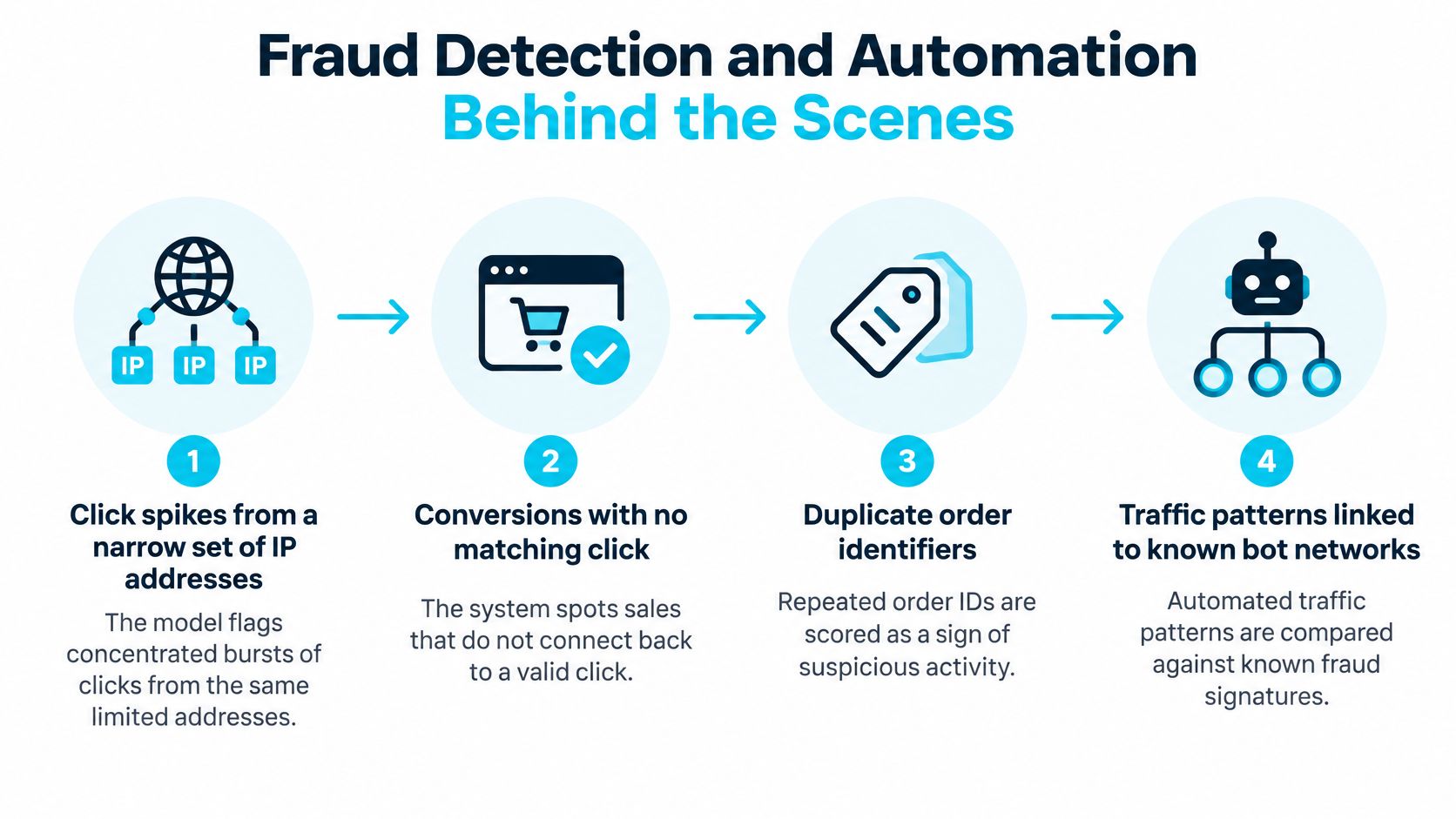
Useful signals to configure include concentrated click spikes, conversions without matching clicks, duplicate order identifiers and traffic resembling known bot signatures. Review sub-ID sequences that suggest cookie stuffing and refund or cancellation clusters associated with a publisher, but don't assume any isolated pattern proves abuse.
Use a reversible investigation process
- Collect event-level logs. Preserve clicks, conversions, order references and timestamps so a reviewer can reconstruct the sequence.
- Apply rules and anomaly detection. Compare publisher activity with documented rules and an appropriate historical baseline.
- Hold flagged conversions. Keep the original records and flag reason rather than deleting disputed events.
- Review representative cases. Check merchant records, tracking interruptions and publisher explanations before classifying the activity.
- Resolve with evidence. Adjust thresholds and reverse commissions only when the investigation supports that action under program terms.
A conversion without a recorded click may reflect broken tracking rather than misconduct. A burst of activity may follow a legitimate newsletter. Reviewers need that context before interpreting an anomaly.
The affiliate fraud prevention tools guide can support a shortlist, but vendor evaluation should include a demonstration using exportable event records.
Automate routine work without surrendering authority
Use controlled automation for tracked-link creation, consistent campaign parameters, payout reconciliation against network reports and alerts when earnings per click moves outside its established range. Validate output against a known-correct sample before allowing a workflow to write into production systems.
Not every task needs machine learning. Parameter validation and duplicate-order checks can use fixed rules; anomaly detection is more useful where the operator needs to identify unfamiliar patterns.
Human-control boundary: Partner termination, commission disputes and changes to refund treatment should require accountable approval.
A fraud or tracking vendor should explain:
- Log access: Can the merchant or authorized agency export the underlying events?
- Rule transparency: Does each flag include its trigger and rule version?
- Reversal workflow: Can reviewers restore an incorrectly held conversion without losing its history?
Affiliate professionals can leave reviews of networks, platforms and tools in the directory. Those accounts can help identify questions for a demonstration, but they shouldn't substitute for testing the system against the program's own records.
Measuring Whether AI Adds Real Revenue
Attribution allocates credit. Incrementality estimates additional outcomes. A conversion journey can contain several affiliate and non-affiliate interactions without proving that every credited interaction changed the buyer's decision.
Google's AI-driven measurement guidance combines attribution with incrementality experiments and marketing-mix modeling, and reports incrementality testing availability for campaign budgets as low as $5,000. That availability isn't a promise that every affiliate program qualifies for a particular experiment or that the budget guarantees statistical certainty.
Make the event history usable
Use a unified schema with a record for each touchpoint and conversion. Capture publisher ID, click time, campaign metadata, consented identifiers, conversion event, refund status and post-purchase value, while keeping event types distinguishable.
Preserve corrections rather than overwriting the history. Otherwise, an analyst may compare a baseline of approved sales with a test period containing provisional transactions and mistakenly report improvement.
Record the AI decision as well: the score, model version, eligible population and action taken. Without that information, a team cannot reliably reconstruct what treatment the exposed group received.
Test the decision, not the dashboard
Randomly assign eligible users or partners to an AI-driven treatment and an appropriate control where feasible. A geo experiment can be an alternative when individual-level separation isn't practical, provided the analyst accounts for regional differences and spillover.
Say a merchant uses AI to select product recommendations. If the holdout converts at almost the same rate as the exposed group, the results don't support claiming meaningful incremental conversion lift. Wide uncertainty, however, may mean the experiment is inconclusive rather than proving no effect.
Report business outcomes alongside attributed conversions:
- Quality: Refund and cancellation rates after comparable maturation periods.
- Revenue: Cohort revenue by publisher and post-purchase value.
- Journey contribution: Assisted-conversion patterns without treating assistance as causal proof.
- Economics: Margin after commissions, AI tooling, implementation and human-review costs.
The affiliate marketing KPI guide can help standardize reporting definitions across stakeholders.
Every AI performance claim should state its baseline, test design and confidence range before informing a client presentation or budget decision.
Efficiency also deserves its own measurement. A reporting assistant may be worthwhile because it reduces verified analyst effort, even when it has no plausible direct effect on sales. Don't relabel operational savings as incremental revenue.
Choosing AI Tools by Participant Type
The right tool depends on who controls the inputs and who bears the consequences. A publisher cannot independently validate merchant margin, while a merchant may lack access to a publisher's editorial testing records.
Compare responsibilities before features
| Participant | Priority requirement | Risk to test |
|---|---|---|
| Merchants and brands | Event-level program data, consent controls and refund feeds | Paying for apparent targeting success without additional value |
| Affiliates and publishers | Original-testing support, disclosure logs and exportable performance records | Publishing unverifiable recommendations |
| Networks and platforms | Documented tracking rules, fraud flags and payout reconciliation | Unexplained commission holds or tracking changes |
| Agencies and OPMs | Separate client access, approvals and comparable reporting | Cross-client data exposure or inconsistent conclusions |
| Software providers | Model documentation, input requirements and output exports | Scores that customers cannot independently evaluate |
Creative tools need a separate editorial assessment. For example, the ShortGenius AI ad creative tool can be considered within an AI video and ad-generation shortlist, but inclusion isn't an endorsement or evidence of campaign performance. Evaluate whether the proposed workflow preserves source claims, approval history and disclosure placement.
Apply a shared procurement scorecard
Use data access, consent basis, auditability, holdout support and pricing transparency as common criteria. Mark each as demonstrated, conditional or unavailable, with evidence attached.
The person who will rely on the output should participate in scoring. A program manager may accept a useful recommendation interface, while a finance reviewer needs an export that reconciles to approved orders.
Treat critical controls as gates, not features that can be averaged away. Attractive creative output shouldn't compensate for unclear content rights, and a polished fraud dashboard shouldn't compensate for missing event logs.
Request a representative output and reproduce its conclusion outside the vendor interface. Confirm how usage charges, review labor and export restrictions affect the actual operating cost. Commercial or Featured placement should never count as evidence that a product meets these requirements.
Choose One Pilot and Measure It Before Scaling
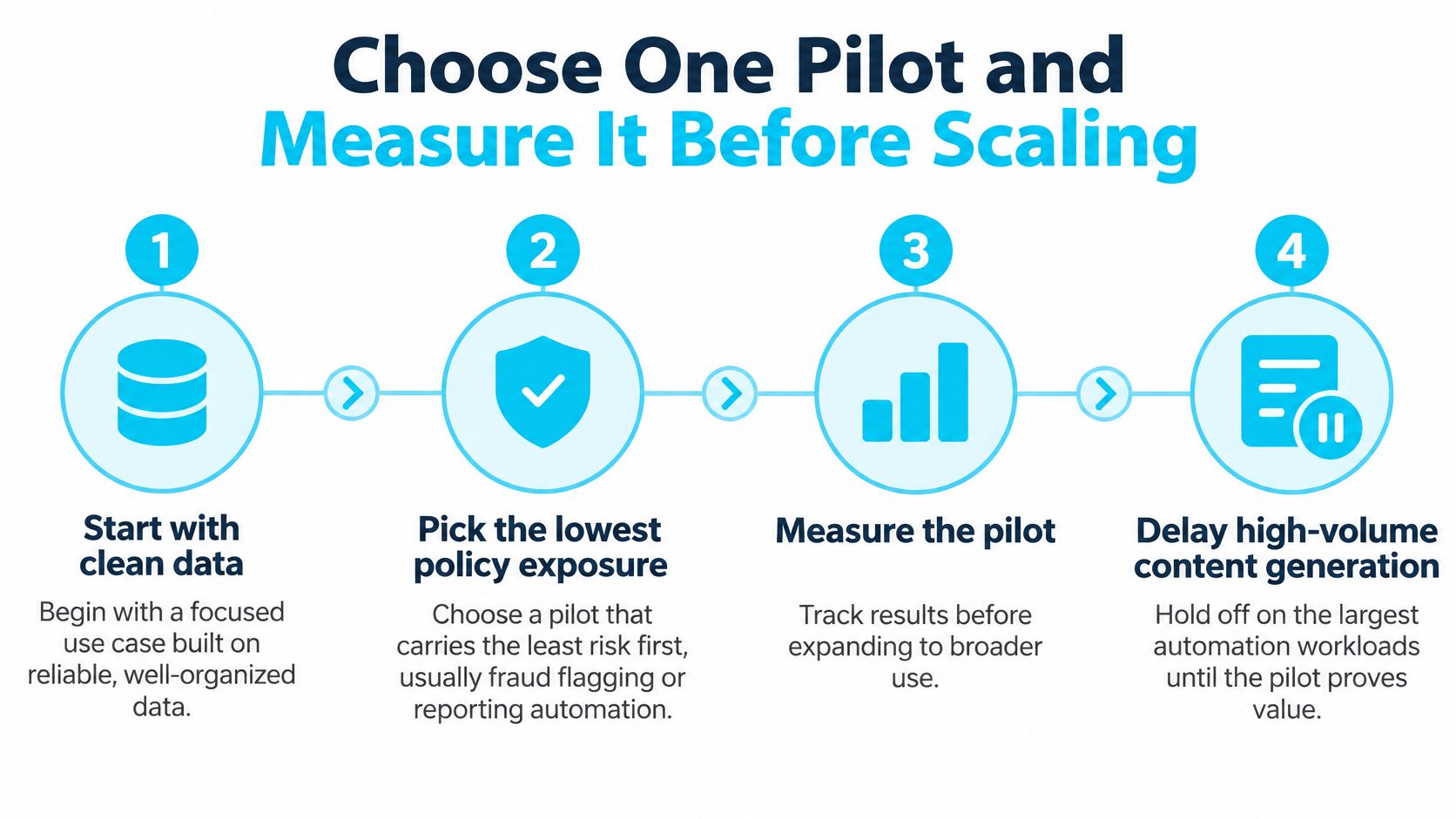
Start with clean data and low policy exposure, usually reporting automation or fraud flagging that leaves consequential decisions with a reviewer. Delay high-volume content generation until claim verification, disclosure and approval controls work reliably.
For fraud detection, an initial pilot can run in shadow mode: the model flags events without changing payouts. That allows reviewers to assess useful detections and false positives without creating avoidable commission disputes.
Make expansion conditional
Four-phase AI rollout for affiliate programs
| Phase | Goal | Key actions | Exit check |
|---|---|---|---|
| 1. Audit | Confirm data and rules | Map event data, consent records and disclosure requirements | Clean event schema and approved disclosure text |
| 2. Pilot | Test one use case against a control | Run one application against a holdout group | Measured lift, refund rate and cancellation rate reported |
| 3. Expand | Add use cases with review gates | Add content or targeting with human review of flagged items | Review backlog within the agreed limit |
| 4. Scale | Keep results and controls current | Audit pages and models on a set schedule and review holdout results | Documented decision and owner for each live model |
During the audit, assign a named owner to every live model. That owner should have authority to pause the workflow, investigate unexpected output and authorize a documented change.
Before launch, define the baseline, select the holdout size with an analyst and agree on refund and cancellation thresholds that would stop the test. Set the evaluation window around the program's conversion and approval cycle rather than a convenient reporting deadline.
Distinguish discovery from validation
A discovery assistant can produce a partner shortlist, but program eligibility, commercial terms and suitability still need verification. Keep the shortlist separate from the approved recruitment list so an exploratory AI answer doesn't become an operational commitment.
Expansion should follow demonstrated usefulness and manageable review demand, not output volume. A pilot is only decision-ready when its results have been compared with the holdout and assessed against the agreed customer-quality thresholds.
This platform connects professionals researching merchants, publishers, networks, agencies, tracking technologies and other performance marketing participants. Its Resources & Tools include Affiliate Program Lookup and the ChatGPT & Claude Connector, which lets users search programme data from their AI assistant. Visit Affiliate Landscape to build a focused partner and technology shortlist, then apply the measurement and governance checks before committing to a pilot.
Ready to explore the affiliate landscape?
Discover networks, tools, and opportunities in our directory.
Explore Directory