

Before you even think about sending that first outreach email, you need a plan. Finding the right affiliate partners isn’t about casting the widest net; it’s about knowing exactly who you’re looking for and what you want to achieve together.
This starts with two core actions: first, defining your Ideal Partner Profile (IPP) and second, setting concrete, measurable goals. This foundational work is the difference between a thriving partner program and one that just drains your resources.
Laying the Groundwork for High-Impact Partnerships
Jumping straight into sourcing affiliates without a clear strategy is a recipe for frustration. It’s easy to get distracted by vanity metrics like follower counts, but the most successful programs are built on a deep understanding of who makes a great partner for your specific brand.
Think of this initial prep work as creating a blueprint. It guides every decision you make, from who you contact to how you structure your commission.
Define Your Ideal Partner Profile
Your Ideal Partner Profile (IPP) is essentially a detailed persona for your perfect affiliate. This isn't just about their niche; it's a deep dive into who they are, who they talk to, and how they operate. A well-defined IPP is your most powerful filtering tool.
Here's what you need to nail down:
- Audience Alignment: Who is their audience? It should be a near-perfect match for your target customer’s demographics, interests, and pain points. If they’re selling to budget shoppers and you have a luxury product, it’s a non-starter.
- Content Quality and Style: How do they engage their audience? Look for partners who produce high-quality, trustworthy content. Their tone and style should feel authentic and complementary to your own brand voice.
- Promotional Methods: Are their methods ethical and brand-safe? You want partners who build trust through honest reviews, helpful tutorials, and genuine recommendations—not those using spammy tactics or clickbait.
A micro-influencer with 10,000 highly engaged, niche followers is almost always more valuable than a generalist with 500,000 who couldn't care less about what you offer. It's about the right audience, not just the biggest one.
Set Clear, Measurable Goals
Once you know who you're looking for, you need to define what success actually looks like. A vague goal like "get more sales" won't cut it. You need specific Key Performance Indicators (KPIs) to track what’s working and what isn’t.
This process ensures your entire approach is buttoned up. You've defined the ideal partner, set clear targets, and established the metrics for success.
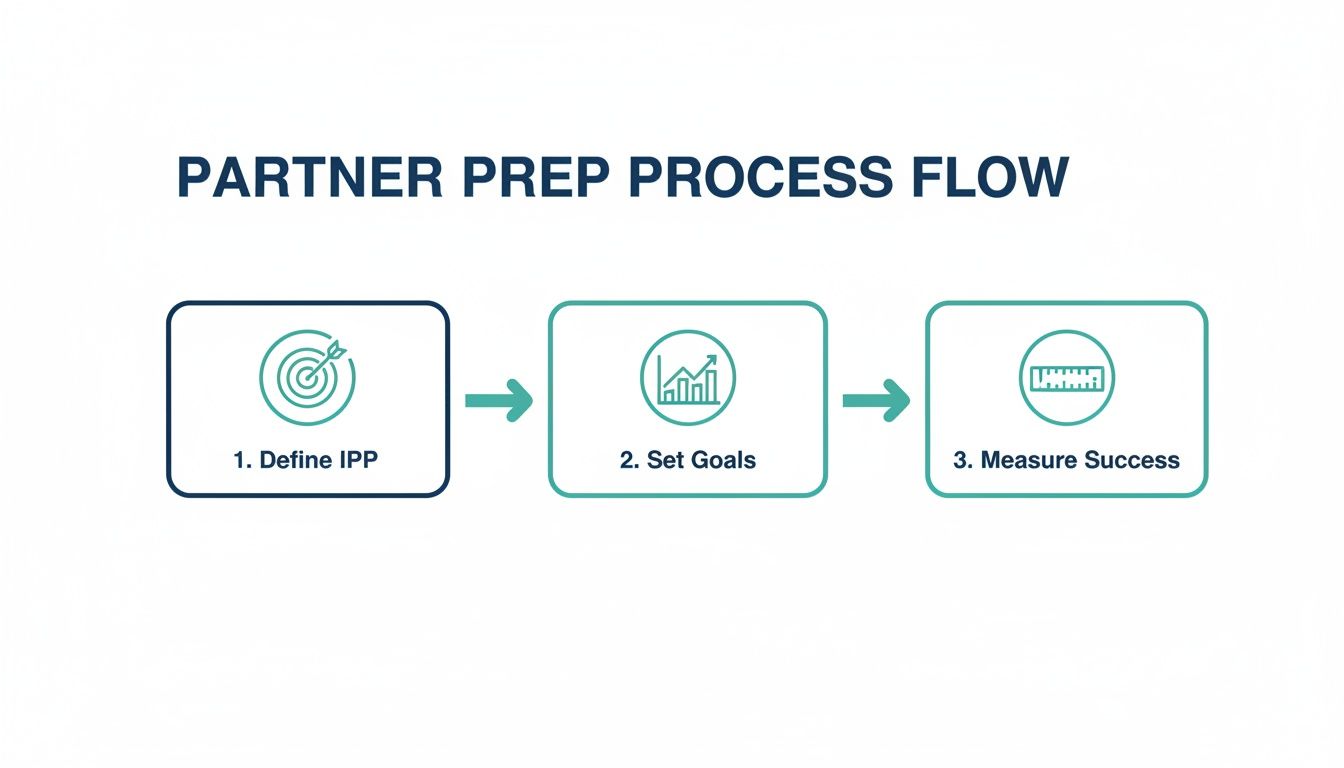
As this flowchart shows, a structured approach that starts with your IPP directly links your recruitment efforts to real business outcomes.
The affiliate world is only getting bigger. Over 80% of brands now have affiliate programs, and the industry is on track to hit $15.8 billion in spending by 2028. This isn't just background noise; it's a signal that a strategic approach is mandatory to stand out and attract top-tier talent. After all, affiliates drive a significant 16% of all eCommerce orders.
Ultimately, this prep work turns your partner search from a guessing game into a strategic hunt. For a deeper dive into the fundamentals, check out this guide on what is affiliate marketing.
Proven Sourcing Channels to Uncover Top Affiliates
Alright, you've mapped out your Ideal Partner Profile. Now comes the fun part: moving from planning to action. The real trick here is to build a diversified pipeline of potential partners, not just throwing all your eggs in one basket. This multi-channel approach makes sure you’re finding talented people wherever they hang out, from big, bustling networks to quiet, niche communities.

Think of this less like casting a wide, clumsy net and more like precision fishing. We're looking for high-quality candidates who are a perfect match for the blueprint you've already created.
Tap Into Specialized Directories and Networks
Affiliate directories and networks are the most obvious places to start, and for good reason—they are marketplaces built to connect brands with publishers. But you have to be smart about how you use them, because not all platforms are created equal.
- Specialized Directories: Think of a platform like AffiliateLandscape as your map of the entire ecosystem. It doesn't just list affiliates; it indexes publishers, the networks they use, and even the tech tools they prefer. This is my go-to for discovery and due diligence, as it helps you find pre-vetted partners in your niche without sifting through thousands of irrelevant profiles.
- Major Affiliate Networks: Giants like ShareASale, CJ Affiliate, and Impact host an incredible number of programs. They're fantastic for scaling up, but you have to use their search and filtering tools strategically to cut through the noise. I recommend focusing on categories relevant to your industry and keeping an eye out for partners with high network performance scores.
Pro Tip: Don't just browse—actively recruit. Use the platform’s internal messaging tools to reach out to promising affiliates who are already promoting non-competing products in your vertical. It shows you've actually done your homework.
Conduct Smart Competitor Analysis
One of the sneakiest—and most effective—ways to find great affiliate partners is to see who's already successfully promoting your direct competitors. These affiliates have a proven track record of driving relevant traffic and sales in your exact market. This isn't about poaching; it's about identifying proven performers.
You can uncover these partnerships with SEO tools like Ahrefs or Semrush. Just plug in a competitor's domain and look for their "Referring Domains" report.
Filter this list to find high-authority blogs, review sites, and publications. When you spot a site sending a good chunk of traffic to a competitor, that's a huge signal that they have a successful affiliate relationship. Get them on your outreach list immediately.
This data-driven approach is a game-changer because it builds your prospect list on real-world success, not guesswork. For a more direct route, you can explore detailed leaderboards of top-performing affiliates and publishers to see who’s making waves across different industries.
Leverage Professional and Social Platforms
Your ideal partners aren't just sitting around inside affiliate networks. They’re active professionals and community members on platforms like LinkedIn and in very specific forums. Getting proactive in these spaces can help you uncover some real hidden gems.
LinkedIn Sales Navigator
This tool is incredibly powerful for finding the right people at larger publisher sites or media companies. Instead of blindly emailing a generic address, you can search for specific job titles like "Partnership Manager," "Affiliate Manager," or "Head of Business Development" at the companies you want to work with. It makes sure your pitch actually lands in the right inbox.
Niche Communities
Go where your ideal partners gather and engage authentically. This could be in specific subreddits, private Facebook groups, or industry forums. Jump into discussions, offer real value, and build relationships before you ever mention your affiliate program. This positions you as a helpful community member, not just another recruiter spamming for links.
Deciding where to invest your time can be tough, so here’s a quick breakdown of the most common sourcing channels.
Comparison of Affiliate Sourcing Channels
This table compares the pros and cons of different channels for finding affiliate partners, helping you decide where to focus your efforts.
| Sourcing Channel | Best For | Pros | Cons |
|---|---|---|---|
| Affiliate Networks | Broad-scale recruitment and managing many partners at once. | Large pool of pre-qualified affiliates; built-in tracking and payment systems. | High competition; can be difficult to stand out; network fees. |
| Specialized Directories | Targeted discovery and vetting of high-quality, niche partners. | Curated lists of proven performers; deep data on partner tech and reach. | Smaller pool than major networks; may require more direct outreach. |
| Competitor Analysis | Finding proven performers with a track record in your exact niche. | Data-driven approach; partners are already familiar with your product type. | Requires SEO tool subscription; partners may have exclusivity clauses. |
| LinkedIn & Social | Finding key decision-makers at media companies or solo content creators. | Direct access to individuals; relationship-building opportunities. | Time-intensive; requires a "soft-sell" approach; not everyone is open to cold outreach. |
| Forums & Communities | Uncovering niche experts and building authentic relationships. | Builds trust and credibility; access to highly engaged audiences. | Very time-consuming; requires genuine participation, not just recruitment. |
Each channel has its place in a well-rounded strategy. A mix of these approaches will yield the best results.
This kind of strategic sourcing is critical in today's market. Affiliate marketing is projected to drive over $210 billion in US eCommerce sales in 2025, and 74% of brands now generate a significant portion of their revenue from these partnerships. Considering that 65% of merchants report affiliates drive up to 20% of their annual revenue, mastering partner discovery is a massive growth lever.
By combining these different channels—directories, competitor research, and direct outreach—you'll create a robust system for consistently finding affiliate partners who can make a real impact on your bottom line.
Crafting Outreach That Actually Gets a Response
You've done the hard work of finding the perfect affiliate prospect. That's a huge step, but it's only half the battle. Your outreach email is what stands between you and a killer partnership, and top-tier partners get dozens of pitches every single week. Yours has to cut through the noise.

The secret weapon? Personalization. A message that feels like you wrote it just for them will always, always outperform a generic template. It shows you respect their time and actually care about what they do.
Writing a Subject Line That Demands to Be Opened
Think of your subject line as the gatekeeper. If it’s weak, your carefully crafted email is heading straight to the trash folder, unread. The goal is to be specific and intriguing without ever sounding like spammy clickbait.
From my experience, a few angles consistently get the best open rates:
- Reference Their Content: "Loved your piece on productivity tools"
- Mention a Mutual Connection: "Intro from [Mutual Connection] / Partnership Idea"
- Propose a Specific Collaboration: "Partnership idea for your [Niche] audience"
- Highlight Clear Value: "Collaboration for your [Specific Content Series]"
Each of these proves you're a real person who has done their homework. They signal that what's inside is relevant, making it far more likely they'll click to see what you have to say.
The Anatomy of a Winning Outreach Email
Once they open your email, the first two sentences are make-or-break. This is your chance to prove you understand their brand and audience. A truly effective pitch isn't just a list of your program's features; it’s a conversation starter built on four key pillars.
1. The Personalized Opener
Kick things off by referencing something specific they've created. Did you love a recent blog post? A YouTube video? A specific point they made on social media? Mention it. This immediately builds rapport and shows you're not just blasting out a form letter.
Real-world example: "Hi [Partner Name], I just finished reading your guide on remote work software and was really impressed with your breakdown of [Specific Tool]. Your focus on real-world use cases is exactly what the industry needs."
2. The Clear Value Proposition
This is where you quickly pivot to what's in it for them. Don't just talk about your brand. Frame your program as a genuine benefit to their audience and their business.
- Highlight your commission rates, especially if they are competitive or recurring.
- Mention a long cookie duration (e.g., 90 days) as a key selling point.
- Clearly explain how your product solves a problem their specific audience faces.
3. The Social Proof and Credibility
You need to build trust, and fast. Briefly mention anything that lends you credibility. This could be a shout-out from a well-known industry figure, a high rating on a review site like G2 or Capterra, or the fact that other respected creators in their niche are already partners.
4. The Clear and Simple Call to Action
End with one, single, low-friction next step. Don't ask them to fill out a long form or jump on a 30-minute call right away. That's too much commitment for a first touch. A simple question is usually best.
Real-world example: "Would you be open to learning more about our partner program? I can send over a one-pager with all the details."
This approach turns a cold outreach into a warm conversation. You’re not just asking for a favor; you’re presenting a well-researched, relevant opportunity. Remember, how you find affiliate partners is one thing, but how you approach them makes all the difference.
Vetting Partners to Protect Your Brand and ROI
Just because a potential partner looks fantastic on paper doesn’t mean they’re the right fit. I've seen it happen time and again: a single bad partnership can tarnish a brand's reputation, burn through your budget on junk traffic, and create massive compliance headaches.
That's why building a thorough, non-negotiable vetting process is one of the most important things you can do for your affiliate program. Think of it as essential due diligence. You wouldn't hire a key employee without checking their references, right? The same logic applies here. You're entrusting a piece of your brand to this partner, so you have to be sure they meet your standards before you commit.
Analyzing Traffic Quality and Relevance
First things first: their traffic. Where does their audience actually come from, and is it the audience you want to reach? Huge traffic numbers are completely meaningless if they’re from the wrong countries or are just low-quality clicks.
You have to put on your detective hat here. Tools like Ahrefs or Similarweb are your best friends for getting a clear picture of their traffic breakdown.
Here’s what I always look for:
- Geographic Distribution: Does their audience live in the countries you actually ship to? If 90% of their visitors are from a region you don't serve, it's an immediate dealbreaker.
- Primary Traffic Channels: Where is the traffic coming from? A strong organic search presence is a fantastic signal of authority and trust. If it's all coming from paid ads, you'll want to dig a little deeper.
- Keyword Rankings: What specific keywords are they ranking for? Do those search terms show real intent to buy what you're selling? A "tech review" site whose top keywords are all for free software probably won't be able to convert visitors for your premium SaaS product.
A partner with 10,000 monthly visitors from super-relevant, long-tail keywords is infinitely more valuable than a partner with 100,000 visitors from broad, untargeted search terms. Focus on relevance, not just volume.
Assessing Content and Brand Alignment
Once you've confirmed their traffic is legitimate and relevant, it's time for a more qualitative check of their content. This is where you figure out if their brand voice, values, and overall presentation actually align with yours. A mismatch can create a jarring experience for potential customers and reflect poorly on your brand.
Take a deep dive into their website, social media profiles, and any other platforms they use. Ask yourself some tough questions. Does their content feel authentic and genuinely helpful, or is it just a thin excuse to cram in affiliate links? You can usually get a gut feeling pretty quickly.
Key Content Evaluation Points:
- Tone and Voice: Does their communication style mesh with your brand’s personality? If you’re a serious B2B brand, a partner who relies heavily on memes and slang probably isn't a great fit.
- Professionalism and Design: Is their website well-designed and easy to use? Or is it cluttered with intrusive, flashy ads? A poorly maintained site can make your brand look bad by association.
- Accuracy and Expertise: Do they actually know what they're talking about? Inaccurate or sloppy content can erode the trust of both their audience and yours.
This deeper analysis of their content and traffic is central to how we evaluate potential partners. To get a better sense of how we weigh all these factors, you can learn more about how our scoring works.
Checking for Compliance and Red Flags
Compliance is completely non-negotiable. An affiliate who ignores legal requirements, like FTC disclosure guidelines, is putting your brand at serious risk. The first thing I do is scan their content for clear and conspicuous affiliate disclosures. A lack of transparency is a massive red flag.
The affiliate marketing industry is projected to be worth over $17 billion globally in 2025, and all that growth brings more scrutiny. Protecting your brand means only working with partners who operate ethically and above board. For example, using a curated directory can cut your research time by up to 70%, helping you find high-quality partners who are far more likely to follow industry standards. You can read more about the growth of the affiliate industry.
Beyond disclosures, keep an eye out for other warning signs. Below is a checklist that outlines the key areas to investigate to ensure you're bringing on partners who will be assets, not liabilities.
Affiliate Partner Vetting Checklist
Use this checklist to systematically evaluate potential partners and ensure they align with your brand's standards for quality, compliance, and performance.
| Vetting Area | Key Metrics/Questions to Ask | Red Flags to Watch For |
|---|---|---|
| Traffic Quality | What are the primary traffic sources (organic, social, paid)? What are the top referring countries? Do they rank for relevant, high-intent keywords? | Traffic primarily from low-value sources (e.g., pop-ups). Audience geography doesn't match your target markets. Ranking for irrelevant or spammy keywords. |
| Audience Alignment | Does their audience demographic match your ideal customer profile? Is their content focused on a relevant niche? | Broad, unfocused content. Audience demographics are completely different from your customer base. |
| Content & Brand Fit | Is the website professional and well-designed? Does the tone of voice match your brand? Is the content high-quality, accurate, and helpful? | Poor website design, excessive ads, and broken links. A jarring mismatch in brand voice (e.g., overly casual for a formal brand). Thin, inaccurate, or AI-generated content. |
| Promotional Methods | How do they plan to promote your brand? Do their methods align with your brand guidelines (e.g., no trademark bidding)? | Vague or evasive answers about promotional tactics. History of using spammy methods like email spam or comment spam. |
| Compliance & Ethics | Are affiliate disclosures clear and conspicuous (FTC compliant)? Do they have a privacy policy? Is their site secure (HTTPS)? | Missing or hidden affiliate disclosures. No privacy policy. An insecure (HTTP) website. |
Following a structured process like this helps you build a program with integrity, ensuring your growth is both sustainable and completely brand-safe.
Getting New Partners Off to a Strong Start
Alright, you’ve found and vetted a great affiliate. The handshake is done, but the real work—and the real partnership—is just beginning. Those first 30 days are absolutely critical. I've seen it time and time again: a smooth, supportive onboarding process turns a good partner into a great one, while a clunky start leaves them inactive and kills potential revenue.
This isn't just about dotting the i's on a contract. It's about making your new partner feel like part of the team, armed with everything they need to get excited and start promoting you right away. A solid onboarding plan removes friction and gives them the confidence to launch their first campaign.
Hammering Out a Win-Win Agreement
Before they’re officially in the fold, you need to nail down the partnership agreement. You probably have a standard offer, and that’s fine for most, but be ready to be flexible for those high-value partners who can really move the needle. Getting everything crystal clear now saves you from headaches and "he said, she said" arguments down the road.
Here are the usual sticking points you’ll want to iron out:
- The Commission Structure: Are we talking a flat fee per sale, a percentage, or some kind of hybrid model? Your top-tier affiliates will likely want to negotiate for a higher rate or even a tiered system that bumps up their commission as they hit sales goals.
- The Cookie Window: This is a big one. Offering a longer cookie duration, like 90 or 120 days, is a huge sign of good faith. It tells the partner you respect their role in the entire customer journey, not just the last click.
- Payment Terms: Be upfront about how and when they get paid. Is it NET 30? Is there a minimum payout of, say, $100? Affiliates love predictability and hate chasing down payments.
A partnership agreement isn’t about one side winning. It’s about building a solid foundation where both you and your affiliate are motivated to grow together. Think long-term success, not short-term wins.
Creating the Ultimate Affiliate Welcome Kit
Once the ink is dry on the agreement, it’s time to roll out the red carpet. Don't just fire off a generic email with a login link. Put together a dedicated resource hub or a slick, well-organized document with everything they need to start strong. A great welcome kit is part tool, part motivator.
Think of it as their one-stop shop. The goal is to answer their questions before they even have to ask them.
What to Put in Your Welcome Kit
A truly effective welcome kit gives your partners the keys to the car from day one. Here’s what every good one includes:
- Their Unique Tracking Links: Give them their main affiliate link right away. More importantly, show them how to create deep links to specific product pages. This is a game-changer for targeted campaigns.
- Brand Guidelines & Creative Assets: Set them up with a folder full of high-res logos, slick product photos, and clear brand guidelines. Be specific about your brand's voice, what they can and can't say, and any promotional no-nos (like bidding on your branded keywords).
- Proven, High-Converting Creative: Don’t make them guess what works. Give them a swipe file of your best-performing email copy, social media posts, and banners. This makes it incredibly easy for them to get their first promotion out the door.
- A Human Point of Contact: Nothing beats a personal connection. Assign them a dedicated affiliate manager and give them their direct contact info. Knowing there’s a real person ready to help with strategy or tech issues makes a world of difference.
A well-thought-out onboarding process is one of the pillars of a thriving affiliate program. If you’re building your program from the ground up, our guide on how to start an affiliate program covers more of these foundational steps. Putting in this effort upfront pays off massively in the form of motivated, effective, and loyal partners.
Common Questions About Finding Affiliate Partners
As you start recruiting affiliates, a lot of questions pop up. It's totally normal. Here are some straightforward answers to the questions I hear most often from people building out their affiliate programs.
How Many Affiliates Do I Actually Need?
It's easy to get caught up in the numbers game, but honestly, quality trumps quantity every single time in affiliate marketing. A small, focused group of 10-20 highly engaged partners who genuinely align with your brand will drive far more revenue than hundreds of inactive or mismatched ones.
Remember the 80/20 rule. It holds incredibly true here: you'll likely find that 80% of your revenue comes from the top 20% of your partners. My advice? Start small, focus on building real relationships, and then scale up as you nail down your recruitment and management process.
What's a Fair Commission to Offer?
There’s no magic number here. A "fair" commission really depends on your industry, product margins, and your customer lifetime value (LTV). Before you decide on a rate, do your homework and see what your direct competitors are offering.
As a general rule of thumb, you can expect these ranges:
- Digital Products & SaaS: Margins are better, so rates are higher. Think 20-50%, and sometimes even recurring commissions for subscriptions.
- Physical Goods: Tighter margins mean lower rates, usually somewhere between 5-15%.
A fantastic strategy is to set up a tiered commission structure. This approach rewards your top performers with better rates when they hit certain sales targets. It’s a powerful motivator and makes your best partners feel genuinely valued.
What Are the Biggest Red Flags to Look for in a New Partner?
Your brand's reputation is everything, so you have to protect it. When you're vetting potential affiliates, keep an eye out for warning signs that a partnership could do more harm than good. If your gut tells you something is off, it probably is.
Here are a few major red flags to watch for:
- A history of promoting spammy or low-quality products.
- A total lack of transparency about where their traffic comes from or how they promote.
- An audience with obviously fake engagement (like tons of followers but zero comments or shares).
- A poorly designed website that's just a mess of ads and pop-ups.
- Unprofessional communication or someone who pressures you into sketchy terms.
An affiliate’s website and content say a lot about their standards. If they don't care about their own brand, they definitely won't care about yours.
How Long Does It Take to Onboard a Good Affiliate?
Be patient. You can find potential partners pretty quickly, but getting them from that first email to being a fully active, revenue-generating partner usually takes two to six weeks.
The whole process has several steps: that first contact, follow-ups, a proper discovery call, negotiations, getting contracts signed, and all the technical setup. If you rush it, you risk creating misunderstandings that sour the relationship from the start.
Building a strong affiliate program is a marathon, not a sprint. A steady, thoughtful approach to recruitment will always pay off more in the long run than blasting out emails to a huge, untargeted list. You're looking for true partners, not just temporary promoters.
Ready to stop guessing and start finding high-quality partners? AffiliateLandscape is the definitive directory for the affiliate marketing ecosystem, giving you the tools to discover and vet the perfect affiliates, networks, and agencies to scale your program. Explore our platform today
Ready to explore the affiliate landscape?
Discover networks, tools, and opportunities in our directory.
Explore Directory