

Last updated: 14 August 2026
Affiliate marketing for content creators generates income by embedding tracked links in your content, earning commissions when readers purchase through them. Commission rates typically range from 5% to 50% depending on the product and program. Most creators receive their first payout within 30 to 90 days of publishing monetized content. Growth depends on audience trust and traffic volume rather than follower count alone, which means smaller creators with engaged audiences often outperform larger accounts with passive followers.
Word count: 82
That range is wide on purpose. The median affiliate income for content creators in 2024 sits closer to $1,000 to $3,000 per month for part-time operators, while full-time creators with established audiences report $5,000 to $50,000 monthly. Post Affiliate Pro's 2024 industry benchmarks put the global affiliate market above $18.5 billion, with creator-driven channels accounting for a growing share of that spend.
One honest caveat: those upper-end figures represent a small percentage of participants. Most creators in their first year earn supplemental income, not a salary replacement.
Program selection and content fit move the needle more than anything else. A creator recommending tools they actually use converts at a meaningfully higher rate than one chasing high-commission products they have no experience with. Finding the right programs for your niche is often the first practical step, and it is exactly what a directory like AffiliateLandscape is built to help with.
What You Need Before You Pick a Single Affiliate Link
Before applying to any affiliate program, you need three things in place: an active publishing platform with a measurable audience, a basic tracking setup, and a clear content niche. Without those, you are collecting program names, not building income.
Minimum Audience Size and Engagement
Most affiliate programs do not publish hard minimums, but the practical floor is real. Amazon Associates, one of the most accessible entry points, requires at least three qualifying sales within the first 180 days or your account closes. More selective programs, particularly in software and finance, routinely ask for 5,000 to 10,000 monthly unique visitors before they approve an application.
Raw size matters less than engagement. A blog with 3,000 monthly readers who click, comment, and buy converts better than a channel with 50,000 passive followers. Wecantrack's affiliate performance benchmarks show average affiliate conversion rates sitting between 0.5% and 1% across most verticals. A small, engaged audience can still generate meaningful commissions while a large, disengaged one produces almost nothing.
The trade-off is real: building audience first delays monetization. Some creators join programs early, before they have the traffic to convert. That approach rarely produces income, but it does force you to learn how tracking and disclosure work before the stakes are high.
Platform Eligibility: Blogs, YouTube, Podcasts, and Social
Not all platforms are treated equally by affiliate programs. Blogs remain the most universally accepted channel because they produce indexable content, trackable traffic, and a permanent home for disclosure language. YouTube is close behind, with most major programs accepting it outright, though some require a minimum subscriber count (typically 1,000) and a linked website.
Podcasts are trickier. You can verbally deliver a promo code, but most affiliate networks track clicks rather than code redemptions, so attribution gets messy unless the program specifically supports vanity URLs or podcast-friendly tracking. Social-only creators face the steepest friction: Instagram, TikTok, and Pinterest are accepted by some programs but rejected by others, and link-in-bio setups add one more click between your audience and the merchant's checkout.
The practical read: if you publish in more than one format, lead with your blog or YouTube channel on applications. List secondary channels as supporting assets, not primary ones.
Tools You Will Actually Use
You do not need an elaborate stack. Three tools cover almost everything at the start.
A link tracker is the most important. Pretty Links (WordPress plugin) or a simple redirect through your own domain keeps your affiliate URLs clean, lets you see click counts, and survives the inevitable situation where a merchant changes their link structure. Relying on raw affiliate URLs with no layer of your own tracking means you are flying blind on which content actually drives clicks.
A disclosure plugin, or at minimum a sitewide disclosure banner, is a legal requirement in most jurisdictions. The FTC's guidelines in the US require clear, conspicuous disclosure before the affiliate link, not buried in a footer. WordPress users can handle this with a plugin like WP Disclosure or a sticky header bar. Non-WordPress creators need a manual solution, but the requirement is the same.
The third tool is a spreadsheet. One tab per program: merchant name, commission rate, cookie window, payment threshold, and the date you applied. Tracking conversions and refining campaigns only works if you have a record of what you are actually enrolled in. Creators who skip this end up with orphaned links, missed payment thresholds, and no way to compare which programs are worth keeping.
Get those four things in place before you touch a single application: an engaged audience on an accepted platform, a link tracker you control, a disclosure setup that meets FTC standards, and a spreadsheet that tracks every program you join.
Step 1: Choose Affiliate Programs That Match Your Audience
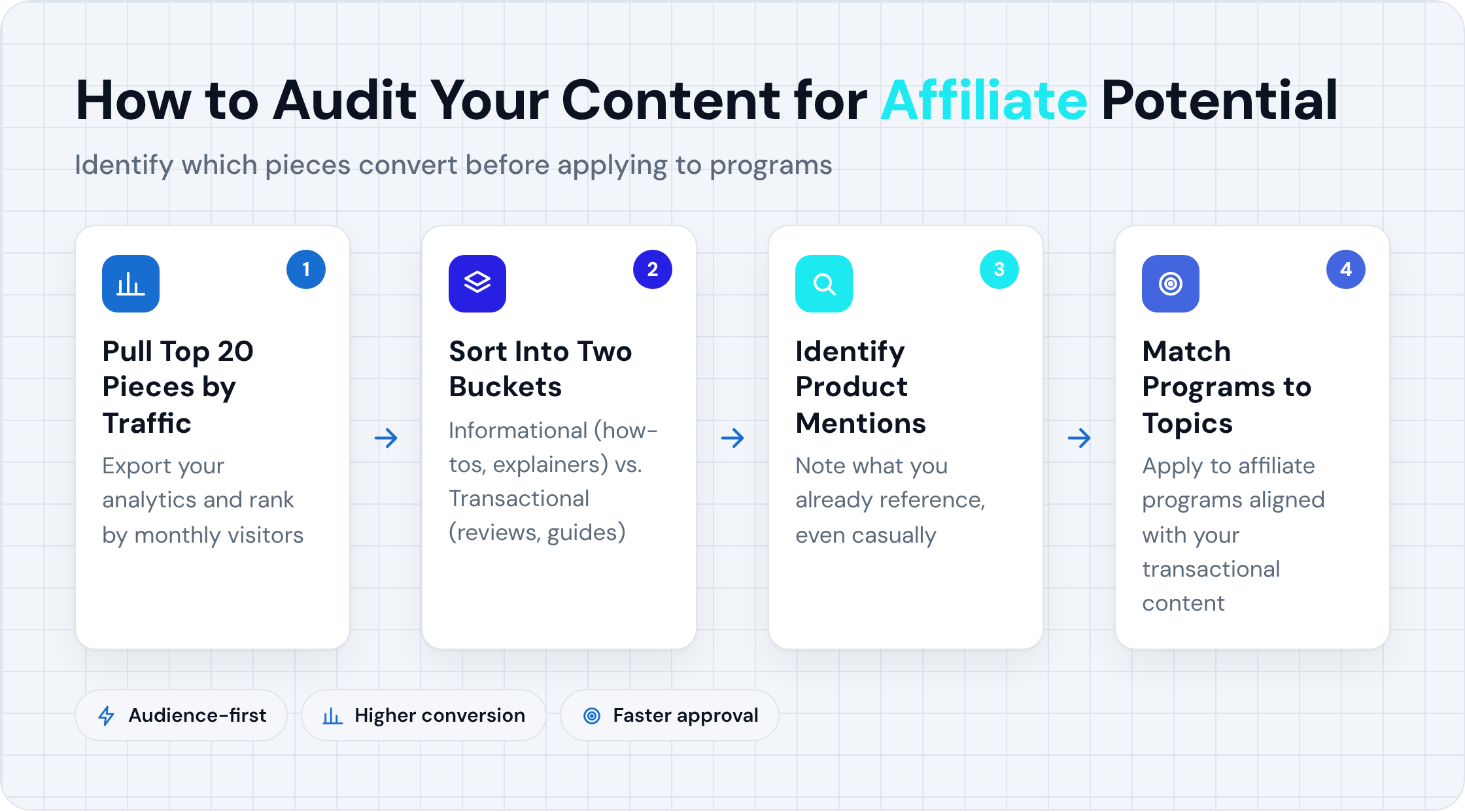
The most reliable way to earn affiliate income as a content creator is to promote products your audience is already researching. Audit your existing content before you apply to a single program. Matching program type, commission structure, and cookie duration to your audience's actual purchase behavior separates a creator earning $40 a month from one building a consistent revenue stream.
Audit Your Content Topics First
Pull your top 20 pieces by traffic and sort them into two buckets: informational content (how-tos, explainers, comparisons) and transactional content (reviews, "best of" lists, gear guides). Transactional content is where affiliate links convert. Informational content can support them, but it rarely drives clicks on its own.
Look at the products or services you already mention, even casually. If you write about home espresso setups and you reference a specific grinder three times across five posts, that is a category signal. You already have audience trust around that topic. Find programs that serve it.
Coursera's affiliate marketing guide frames this well: affiliate marketers are valuable to merchants precisely because they reach specific audiences composed of potential customers, not general traffic. Specificity is the asset.
Comparing Program Types
Three structures dominate the space, and each carries a different trade-off.
Affiliate networks like ShareASale and CJ Affiliate aggregate hundreds of merchant programs under one dashboard. You apply once to the network, then apply individually to merchants within it. The upside is variety and consolidated reporting. The downside is that approval is not guaranteed per merchant, and commission rates are often compressed because the network takes a cut between you and the brand.
Direct programs are run in-house by the merchant. Many software companies, course platforms, and DTC brands manage their own affiliate relationships outside any network. Commission rates tend to be higher (no middleman), and you often get a dedicated affiliate manager. The trade-off is fragmented tracking: if you work with six direct programs, you are logging into six separate dashboards.
ClickBank sits in its own category. It focuses heavily on digital products, info products, and supplements, with some commission rates running above 50%. The numbers look attractive, but product quality varies considerably. A creator with a professional audience in B2B software or personal finance will find most ClickBank offers a poor fit, regardless of the payout percentage.
The range across program types is significant. Tapfiliate's 2026 creator program comparison covers dozens of programs across categories, and commission rates range from under 5% for physical goods to 30% or more for SaaS and digital products. Knowing that range before you apply helps you evaluate an offer in context rather than in isolation.
Three Signals That Separate Good Programs From Mediocre Ones
Cookie duration. A 24-hour cookie (common on Amazon Associates) means you earn nothing if a reader buys on day two. Programs with 30, 60, or 90-day cookies give your content time to do its job, especially for higher-consideration purchases.
Commission structure. One-time payouts reward volume. Recurring commissions, common in SaaS, reward retention. If your audience buys tools they use monthly, recurring structures compound over time in ways a flat CPA never will.
Conversion rate data. Some programs share average earnings per click (EPC) in their network listings. A high commission rate paired with a low EPC usually means the merchant's landing page or checkout flow is leaking conversions. EPC is a more honest signal than the headline rate.
One real limitation: newer creators with smaller audiences sometimes get rejected by competitive direct programs that require traffic minimums before approval. In those cases, starting with a network like ShareASale gives you a track record to point to when you apply directly later. Patience with the sequencing matters more than chasing the highest rate on day one.
Step 2: Build Trust Before You Ask Readers to Click
Readers click affiliate links from creators they trust, and trust is built before any product recommendation appears. Disclose your relationships clearly, review products with enough honesty to be useful, and only recommend things you have actually used. Skip any one of those and your conversion rate suffers, but more importantly, so does your audience's confidence in everything else you publish.
FTC Disclosure: What You Actually Have to Say
The FTC's endorsement guidelines require that any "material connection" between you and a brand be disclosed clearly and conspicuously. In plain language: if you earn a commission when someone buys through your link, you must say so before the link, not buried in a footer or hidden behind a "legal" tab.
"This post contains affiliate links. I earn a commission if you buy through them, at no extra cost to you" placed near the top of a post satisfies the standard. A hashtag like #ad tucked at the end of a caption does not, if a reader would have to scroll to find it.
The disclosure must also be platform-specific. A YouTube video needs a verbal mention and an on-screen note, not just a line in the description. A newsletter needs it in the body, not the footer.
Reviewing Products Honestly Without Burning Relationships
Honest reviews do not mean hostile reviews. The practical approach is to lead with what a product does well, then name the specific conditions where it falls short. "This tool works well for solo creators but gets expensive fast once you add team seats" is more useful to a reader than either a glowing endorsement or a takedown. Readers who feel informed make purchases they do not regret, and that reduces refund rates, which protects your standing with the merchant.
One structural habit that helps: separate your personal experience from general claims. "I used this for six months on a Windows machine and had no issues" is verifiable. "This is the best tool on the market" is not. Readers can calibrate the first statement. They have no reason to trust the second.
Step 3: Create Content That Actually Converts
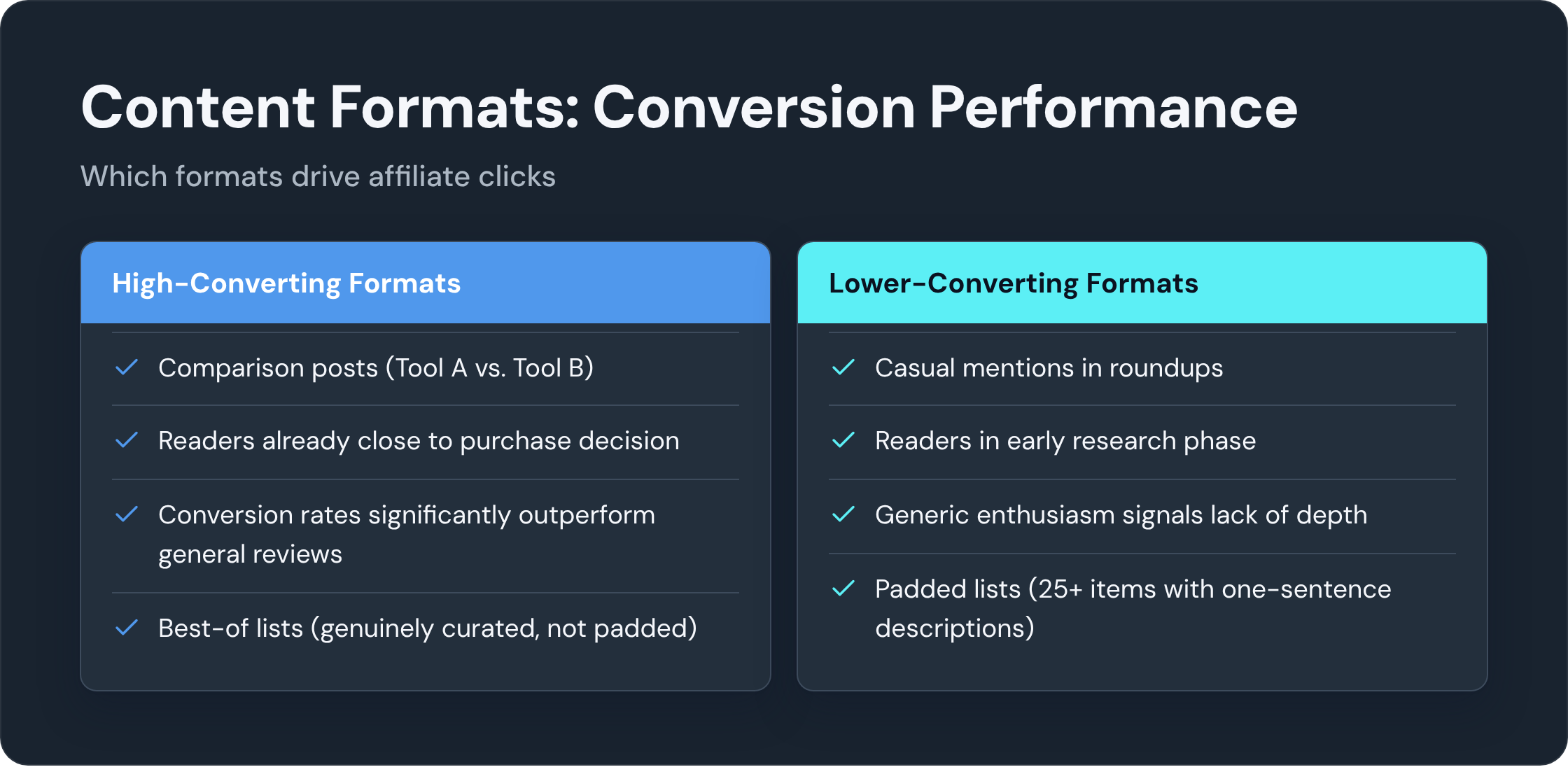
Affiliate marketing for content creators lives or dies on content format. The same product recommendation placed in a comparison post versus a casual mention in a roundup can produce conversion rates that differ by a factor of five or more. Format, placement, and intent alignment all matter.
Content Formats That Drive Affiliate Clicks
Comparison posts ("Tool A vs. Tool B") attract readers who are already close to a purchase decision. They are searching for a reason to choose, not an introduction to the category. Conversion rates on well-structured comparison posts routinely outperform general reviews.
Best-of lists work when they are genuinely curated rather than padded. A "7 best email marketing tools for newsletters" post that actually evaluates seven tools converts. A list of 25 tools with one-sentence descriptions does not, because it signals to the reader that you have not used most of them.
Tutorial content with embedded recommendations converts when the product is necessary to complete the tutorial. "How to set up a podcast feed" that requires a specific hosting platform gives you a natural, non-forced placement. The reader needs the tool to accomplish the goal, so the recommendation feels like help rather than a pitch.
Product reviews are the most direct format, but they require the most credibility investment. A review that includes screenshots, specific use cases, and at least one honest limitation outperforms a review that reads like a press release.
Placement and Link Density
More links do not mean more clicks. Readers who encounter affiliate links in every paragraph start to read the content as advertising rather than editorial. A reasonable density for most content is two to four affiliate links per 1,500 words, placed where they are contextually relevant rather than distributed evenly.
The first link placement matters most. Readers who click early in a piece are more likely to convert than those who reach a link after scrolling through 2,000 words. If your strongest recommendation belongs in the piece, put it where readers are still engaged, not as a reward for finishing.
SEO and Affiliate Content
Affiliate content competes for the same search real estate as editorial content, and Google has been explicit about its preference for content that demonstrates first-hand experience. The "helpful content" guidance from Google's 2023 and 2024 updates penalized thin affiliate pages that aggregated product specs without adding original perspective.
The practical implication: write from experience where you have it, and be transparent where you do not. A post that says "I tested three of these five tools personally; the other two are included based on user reviews I found credible" is more defensible than one that presents all five as equally vetted.
Step 4: Track Performance and Cut What Is Not Working
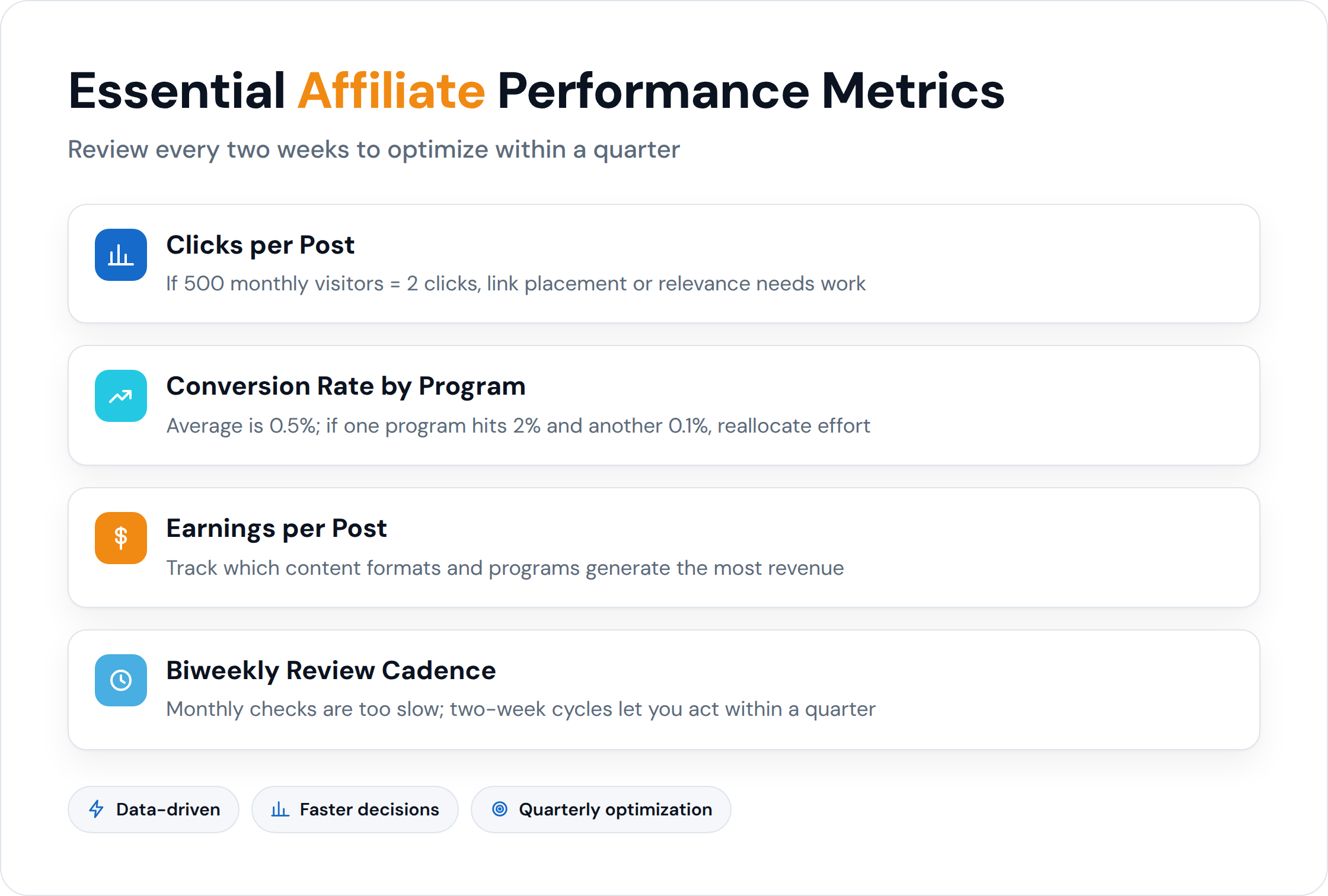
Most creators set up affiliate links and then check their dashboard once a month. That is not enough to learn anything useful. A basic performance review every two weeks, covering click counts, conversion rates, and earnings per post, gives you enough data to make decisions within a quarter rather than a year.
Metrics Worth Tracking
Clicks per post. If a post gets 500 monthly visitors and generates two clicks on your affiliate link, the link placement or the recommendation itself is not resonating. Either the product is not relevant to what readers came for, or the link is buried where readers do not reach it.
Conversion rate by program. A 0.5% conversion rate is average across most verticals, per Wecantrack's benchmarks. If one program consistently converts at 2% and another at 0.1%, the difference is usually the merchant's landing page or checkout experience, not your content. That is useful to know before you spend more time promoting the underperformer.
Earnings per click (EPC). This is the single most useful number for comparing programs with different commission rates and conversion rates. A program paying 40% commission on a $20 product with a 0.2% conversion rate produces a lower EPC than one paying 10% on a $200 product with a 1% conversion rate. Calculate it, do not assume.
When to Drop a Program
Drop a program when it has received meaningful traffic (at least 200 to 300 clicks) and produced no conversions. That is enough data to conclude the fit is poor. Do not wait six months hoping the numbers will shift.
Also drop programs that change their terms without notice, particularly commission rate cuts applied retroactively. It happens, and it is a signal about how the merchant treats its affiliate partners. Your time is better spent on programs that are transparent about changes.
Frequently Asked Questions
How much can a beginner realistically earn from affiliate marketing in the first year?
Most beginners earn between $500 and $3,000 in their first year, with income heavily weighted toward the second half once content starts ranking and building traffic. The creators who reach the higher end of that range typically publish consistently (at least two to four pieces per month), focus on transactional content formats, and choose programs with cookie durations of 30 days or more.
Do you need a website to do affiliate marketing as a content creator?
You do not strictly need a website, but having one significantly improves your approval odds with most programs and gives you a permanent, trackable home for your links. YouTube channels and newsletters can work as standalone platforms for some programs, but social-only creators face frequent rejections from mid-tier and premium affiliate programs that require a domain-based presence.
What is a good commission rate for affiliate marketing?
Commission rates vary too much by product category to have a single "good" benchmark. Physical goods typically pay 3% to 10%. Digital products and software commonly pay 20% to 50%, with some SaaS programs offering recurring commissions on monthly subscriptions. A more useful benchmark than the rate alone is EPC (earnings per click), which accounts for both the commission and the merchant's conversion rate.
How long does it take for affiliate content to rank on Google?
New content from a site without established authority typically takes three to six months to rank for competitive keywords. Less competitive, long-tail keywords can rank faster, sometimes within four to eight weeks. This is one reason most creators see their first meaningful affiliate income in months two through four rather than week one: the content needs time to accumulate search traffic before it can generate clicks.
Is affiliate marketing still worth starting in 2026?
The market is more competitive than it was five years ago, but it is also larger. The $18.5 billion global affiliate market figure from Post Affiliate Pro's 2024 benchmarks reflects continued growth, and creator-driven channels are taking a larger share of that spend. The creators who struggle are those producing generic content that competes on volume. The ones who do well are those with genuine subject-matter depth and an audience that trusts their recommendations. The bar is higher, but the ceiling is also higher.
Can you do affiliate marketing without disclosing it?
No. The FTC requires disclosure of any material connection between a creator and a brand, and that requirement applies regardless of platform or audience size. Failing to disclose can result in FTC enforcement action, and several high-profile cases have resulted in settlements and consent orders. Beyond the legal risk, readers who discover undisclosed affiliate relationships tend to lose trust in the creator entirely, which is a harder problem to recover from than any fine.
A Note on Picking Programs You Can Actually Evaluate
One pattern that consistently separates creators who build durable affiliate income from those who plateau early: they only promote products they can speak to from direct experience, or they are explicit about the limits of their knowledge. Readers are better at detecting generic enthusiasm than most creators realize.
The programs worth your time are the ones where you can write a sentence like "I have used this for eight months and here is what I would change about it." That sentence, more than any commission rate or cookie window, is what earns a click.
If you are still working out which programs fit your niche and audience, AffiliateLandscape is a practical starting point. Browse the directory, filter by category and commission structure, and apply to programs where you already have something genuine to say.
Ready to explore the affiliate landscape?
Discover networks, tools, and opportunities in our directory.
Explore Directory