
When we talk about the ROI vs ROAS debate, it's easy to get them confused. At their core, the difference is surprisingly simple: ROAS looks at top-line revenue versus your ad spend, while ROI digs deeper into bottom-line profit against your entire investment.
One tells you if your ads are driving sales; the other tells you if your business is actually making money. Getting this right is everything.
ROI vs ROAS: The Fundamental Difference
On the surface, both Return on Investment (ROI) and Return on Ad Spend (ROAS) seem to measure the same thing—what you get back for what you put in. But in practice, they operate on completely different levels and answer very different questions for your business. One is a tactical tool for your campaign managers, while the other is a critical health check for the entire operation.
Failing to see the distinction is a common pitfall. I've seen countless brands celebrate a high ROAS while unknowingly bleeding cash because their overall profitability was in the red. It creates a dangerous false sense of security.
ROAS: A Tactical Metric
ROAS is your in-the-trenches metric. It’s laser-focused, measuring the gross revenue you generate for every single dollar spent on advertising. This is the go-to number for media buyers and affiliate managers because it gives them quick, direct feedback on ad performance.
For example, you spend $1,000 on a campaign and it brings in $5,000 in sales. That’s a 5x or 500% ROAS. This tells your team that the ads are working effectively to drive revenue, but it stops there. The story is far from complete.

If you want a deeper dive specifically into this metric, Silver Spoon Agency has published a solid breakdown, What Is Return On Ad Spend: A Complete Guide.
ROI: A Strategic Metric
This is where the bigger picture comes into view. ROI provides a holistic look at your profitability by measuring the net profit from an investment after all associated costs are subtracted. It’s not just about ad spend.
Think of all the other costs that go into making that sale happen:
- Cost of Goods Sold (COGS)
- Affiliate commissions and network fees
- Shipping and fulfillment expenses
- Software costs, team salaries, and other operational overhead
A high ROAS indicates efficient advertising, but only a positive ROI confirms true business profitability. Ignoring ROI is like celebrating a touchdown without checking the final score of the game.
That impressive 5x ROAS from our example might look a lot less exciting once you factor in product costs, shipping, and commissions. In fact, it could easily turn into a negative ROI, meaning you lost money on every sale. This broad scope is what makes ROI the ultimate measure of financial health.
To put it all together, here’s a quick breakdown of how these two metrics stack up.
ROI vs ROAS Quick Comparison
This table neatly summarizes the core differences between these two essential metrics, helping you see where each one fits into your strategy.
| Metric | What It Measures | Formula Focus | Strategic Use |
|---|---|---|---|
| ROAS | Gross revenue generated per dollar of ad spend. | Revenue / Ad Spend | Tactical campaign optimization and ad efficiency. |
| ROI | Net profit generated from a total investment. | (Net Profit - Investment) / Investment | Overall business health and long-term profitability. |
Ultimately, ROAS helps you fine-tune your marketing engine, while ROI tells you if the whole car is moving in the right direction and is worth the fuel you're putting in. You need both to win.
How to Calculate ROI and ROAS Accurately
Knowing the difference between ROI and ROAS is one thing, but calculating them correctly is where your strategy actually starts making money. To make smart decisions, you need to get comfortable with the formulas and, more importantly, know exactly which costs to include.
Let's walk through the math step-by-step.

We'll start with the simpler metric of the two: Return on Ad Spend.
Calculating Your Return on Ad Spend (ROAS)
ROAS is your go-to metric for measuring advertising efficiency. It answers one simple question: for every dollar you put into ads, how many dollars of revenue came back out?
The formula couldn't be more straightforward:
ROAS = Total Revenue Generated / Total Ad Spend
Let’s put this into a real-world affiliate marketing scenario. Say you’re an e-commerce brand that partners with a content creator for a special campaign.
- Total Ad Spend: You pay the affiliate a $2,000 flat fee for a series of promotional posts.
- Total Revenue: Their tracking link shows they brought in $10,000 in sales.
Plugging that into the formula:
ROAS = $10,000 / $2,000 = 5
Your ROAS is 5x, or 500%. This means for every single dollar you paid that affiliate, you generated $5 in gross revenue. On paper, that looks fantastic.
Calculating Your Return on Investment (ROI)
Now for the moment of truth. To calculate your true profitability, you need ROI. This metric demands a much wider, more honest look at your costs, digging far deeper than just ad spend. ROI tells you the net profit you pocketed from your total investment.
Here's the formula:
ROI (%) = (Net Profit / Total Investment) x 100
To use this, we first need to figure out your Net Profit by subtracting all related costs from your revenue. Let’s stick with the same e-commerce campaign, but this time, we’ll pull in all the other costs that came with those sales.
Campaign Financials:
- Total Revenue: $10,000 (from the affiliate campaign)
- Cost of Goods Sold (COGS): The products sold cost you $4,000 to make.
- Shipping & Fulfillment: It cost $1,000 to pack and ship all the orders.
- Affiliate Commission: Your payment to the affiliate was $2,000.
- Platform & Transaction Fees: E-commerce and payment processor fees totaled $500.
- Operational Overhead: A portion of your team's salary and software costs allocated to this campaign came to $500.
First, let's tally up your Total Investment:
$4,000 (COGS) + $1,000 (Shipping) + $2,000 (Affiliate Fee) + $500 (Platform Fees) + $500 (Overhead) = $8,000
Next, calculate your Net Profit:
$10,000 (Revenue) - $8,000 (Total Investment) = $2,000
Now we can plug these numbers into the ROI formula:
ROI = ($2,000 / $8,000) x 100 = 25%
This example perfectly highlights the profitability gap. Your campaign delivered an impressive 5x ROAS, making it look like a runaway success. However, the actual ROI was only 25%.
This distinction is absolutely critical. I've seen campaigns hit a 5:1 ROAS that, after factoring in all operational costs, resulted in a 0% ROI—the business literally just broke even despite strong-looking ad metrics. That's why you have to look beyond the surface-level data. Understanding both ROAS and ROI is essential for making sound financial decisions and ensuring your marketing efforts are actually growing the bottom line.
To manage these calculations effectively, especially with the complexities of affiliate marketing, having the right tools is non-negotiable. You can find a detailed comparison in our guide on the best affiliate tracking software.
It’s easy to talk about metrics in theory, but the real test comes when you apply them to an actual business. The gap between ROAS and ROI isn't just a topic for a marketing textbook; it’s a real-world problem with serious financial consequences that can slowly bleed a company dry. Let's walk through a scenario that should serve as a cautionary tale for any marketer who wants to build something that lasts.
Picture this: a marketing team is high-fiving over what looks like a wildly successful campaign. The dashboard is glowing with a 4x ROAS, a number that would get you a pat on the back in almost any boardroom. On the surface, it seems simple—for every dollar they put into ads, they're getting four dollars back in sales.
But here's the catch: that rosy picture hides a much darker financial reality.
Digging Into the Real Numbers
The celebration doesn't last long. Once someone takes a look at the entire financial picture, the gap between ROAS and ROI becomes painfully clear. In one real-world case, a campaign that boasted a 4x ROAS was actually delivering a razor-thin 10.5% ROI. The company had poured $18,100 into the total operation, only to walk away with $1,900 in net profit. This is precisely why you can't just rely on ROAS. For a more detailed breakdown of these numbers, check out this insightful post on ROAS vs ROI.
So, where did it all go wrong? While the ads were clearly effective at driving top-line revenue (that 4x ROAS proves it), the total cost of running the business ate up nearly all the margin. ROAS, by its very nature, is blind to these other costs.
Total Costs Beyond Ad Spend:
- Cost of Goods Sold (COGS): The raw cost to create the products being sold.
- Shipping and Fulfillment: All the expenses tied to picking, packing, and shipping orders.
- Platform and Transaction Fees: The cut taken by payment gateways and e-commerce hosts.
- Affiliate Payouts or Commissions: The money paid to partners who helped generate the sales.
- Operational Overhead: Things like salaries, software subscriptions, and rent.
Once you add all of that up, the $7,600 in revenue generated from the $1,900 ad spend (the 4x ROAS) starts to shrink fast. After all those other costs were paid, the company was left with just $1,900 in profit from a total business investment of $18,100. That’s how you end up with a 10.5% ROI.
The Core Lesson
This scenario perfectly illustrates why the ROI vs ROAS debate is so critical for a business's long-term health. It all comes down to one simple truth.
ROAS measures campaign efficiency, but ROI measures business viability. Focusing only on ad platform metrics can hide significant losses and lead to poor strategic decisions.
A high ROAS can give you a false sense of security, making you think it’s a great idea to scale a campaign that's barely breaking even or, even worse, is actually losing money. For affiliate managers, it's a stark reminder that rewarding partners based on gross revenue alone is a dangerous game if you don't know the actual profit behind those sales. If you're responsible for growth, understanding this profitability gap isn't optional—it's essential.
Choosing the Right Metric for the Right Situation
So, you understand the difference between ROI and ROAS. That’s the easy part. The real skill comes from knowing which one to use in a given situation, because this is where good strategy is born. These metrics aren't rivals; they're partners that give you a complete picture of your marketing performance. The right choice always comes down to the question you're trying to answer.
Are you trying to figure out if a specific ad is pulling its weight right now? That's a job for ROAS. Are you deciding if an entire marketing channel deserves a spot in next year's budget? You absolutely need to be looking at ROI. It's all about context.
When to Prioritize ROAS
Think of ROAS (Return on Ad Spend) as your in-the-trenches, tactical metric. It’s perfect for making fast, informed decisions at the campaign level because it cleanly separates ad performance from all the other business costs. This tight focus makes it incredibly useful in a few key scenarios.
You should be zeroing in on ROAS when your main goal is rapid optimization. It's the go-to metric for:
- A/B Testing Creative: When you're comparing two versions of an ad, ROAS gives you a straight, clean answer on which one makes more money for every dollar you put in.
- Evaluating Ad Channels: Wondering if your ad budget is working harder on Google Ads or over on LinkedIn? ROAS provides a quick, apples-to-apples benchmark for ad efficiency.
- Setting Clear Goals for Media Buyers: For the person or team managing your ad spend, a ROAS target is a clear, actionable instruction. It gives them the data they need to tweak bids and targeting on the fly.
Ultimately, ROAS is your frontline diagnostic tool for checking the health of your advertising. It gives you immediate feedback, letting you tune your campaigns without getting bogged down in complex profit calculations. It's like a speedometer for your ads—it tells you how fast you're going right now.
When to Prioritize ROI
While ROAS tells you how fast you're going, ROI (Return on Investment) tells you if you have enough fuel to finish the trip and if the journey is actually making you money. ROI is a big-picture, strategic metric. It absolutely has to be your guide when making major business and financial decisions.
Your leadership team doesn't just care about revenue; they care about profit. That's why prioritizing ROI is non-negotiable when the stakes are high and the overall health of the business is on the line.
You’ll want to lean on ROI for these critical tasks:
- Reporting to the C-Suite: When you're talking to executives, investors, or the CFO, ROI is the language they speak. It answers the ultimate question: "Is this making us money?" A high ROAS with a negative ROI is a failing investment.
- Planning Your Annual Budget: When deciding how to slice up the marketing pie for the next year, you need to know which channels are truly profitable, not just which ones bring in high revenue.
- Judging a Channel's True Worth: To know if your affiliate program is a success, you have to calculate its ROI. This means accounting for everything—commissions, network fees, management overhead—to see if the channel is a net positive for the business.
This decision tree helps visualize how you can use both metrics together, starting with ROAS for a quick health check and then moving to ROI to confirm real profitability.
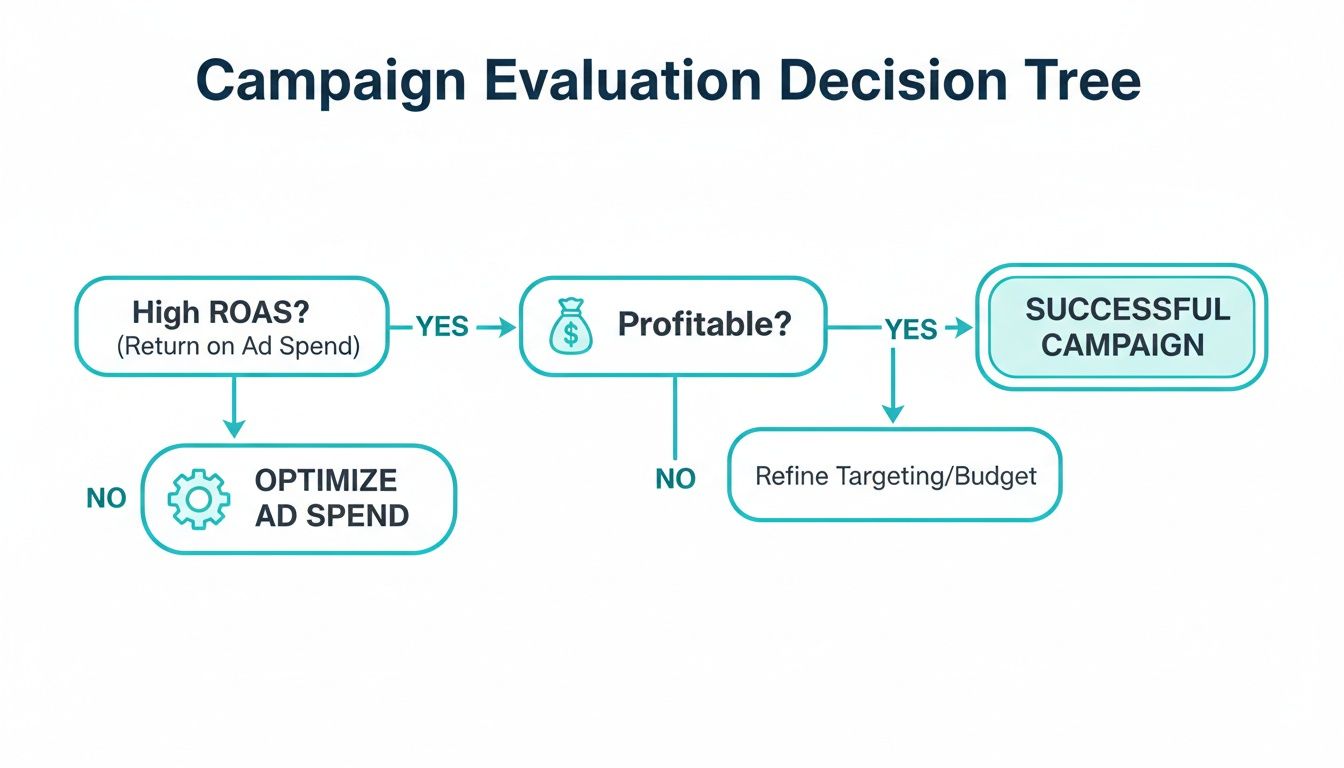
As you can see, even a campaign with a fantastic ROAS needs to pass the next test: "Is it actually profitable?" Only then can you confirm its true value to the business.
Decision Matrix Which Metric to Use When
To make this crystal clear, here’s a simple decision matrix to use as a cheat sheet. It gives you a quick guide for some of the most common situations you'll face as a marketer, helping you pick the right metric without hesitation.
| Business Scenario | Primary Metric | Reasoning |
|---|---|---|
| Daily Ad Campaign Optimization | ROAS | Provides immediate, actionable feedback on ad performance without needing full cost data. |
| Reporting to the CFO or CEO | ROI | Executives care about bottom-line profit, not just top-line revenue from ads. |
| A/B Testing New Affiliate Partners | ROAS | Offers a quick way to compare the traffic quality and revenue-driving power of new partners. |
| Annual Marketing Budget Allocation | ROI | Ensures that budget is allocated to the channels that are demonstrably profitable for the business. |
| Deciding to Scale a Specific Campaign | ROI | You should only scale campaigns that are proven to be profitable after all costs are considered. |
| Choosing Ad Platforms | ROAS | Allows for a quick comparison of advertising efficiency between different platforms like Google, Meta, or TikTok. |
This table lays out the practical application, so you're never left wondering which metric to pull up in your next meeting or report.
The fundamental rule is this: Use ROAS to manage your ads. Use ROI to manage your business. Mistaking one for the other is one of the costliest errors a marketer can make.
By understanding these different contexts, you can confidently use the right metric to hit your goals. To explore tools that can help track both, have a look at our guide on performance marketing platforms, which breaks down solutions for both tactical and strategic analysis.
Setting Realistic ROAS and ROI Benchmarks
When you start talking about benchmarks, the ROI vs ROAS conversation gets really interesting. You’ve probably heard the popular 4:1 ROAS benchmark thrown around as the gold standard for a successful campaign. The problem is, that number is practically useless—and sometimes dangerous—without the context of your profit margins.
A 4x return on ad spend means completely different things for different businesses. For example, a company reselling low-margin commodity goods might need a 10:1 ROAS just to break even after factoring in the cost of goods, shipping, and other overhead. On the flip side, a SaaS company or someone selling digital courses could be wildly profitable with a 3:1 ROAS thanks to their high margins.
Deconstructing the 4x ROAS Myth
The idea that there's a universal "good" ROAS is a complete myth. Chasing an arbitrary number can cause you to make some serious mistakes, like killing a campaign that’s actually making you money or, even worse, scaling one that's secretly bleeding you dry. Real performance is always relative to your own financial model.
The most important lesson in the ROI vs ROAS debate is that context is everything. An affiliate driving a 3x ROAS on a high-margin product could be far more valuable than one delivering a 6x ROAS on a low-margin one.
This is exactly why smart affiliate managers look past the surface-level revenue when setting up commission structures or performance goals. Sustainable growth is built on profit, not just top-line revenue. If you're looking to build out these kinds of strategies, our guide on affiliate marketing best practices is a great place to start.
Establishing Realistic ROI Benchmarks
While ROAS targets can be all over the map, ROI benchmarks give you a much more stable and honest measure of marketing profitability. Industry data shows a huge gap between what's considered a good ROAS and a good ROI. While many fixate on a 4:1 ROAS, you can learn a lot more about real performance by looking at ROI, as highlighted in this analysis of ROI vs ROAS on adapty.io.
For marketing ROI, a healthy target is typically somewhere between 200% and 500%. Here’s how you can think about that range in terms of performance tiers:
- 200%-300% ROI: This is a solid, healthy baseline. It’s the proof that your marketing efforts are genuinely generating profit for the business.
- 400% ROI: Now you're in great shape. This indicates your marketing engine is running efficiently and creating significant business value.
- 500%+ ROI: This is top-tier performance. An ROI at this level means your marketing is a powerful driver of substantial growth.
Getting this distinction right is everything. A 400% ROI is a clear, unambiguous signal that you’re growing profitably. A 4x ROAS, on the other hand, could easily be hiding a loss once you account for all your costs.
With this perspective, you can set much smarter goals. Instead of chasing a generic ROAS figure, you can zero in on achieving a healthy ROI that truly reflects your company's financial health. That shift from a revenue-first to a profit-first mindset is what separates a good marketing program from a great one.
How to Actually Track Profit and Loss

Knowing the difference between ROI vs ROAS is one thing; putting that knowledge to work is another challenge entirely. To get the real story on your program’s financial health, you have to look beyond the default dashboards in your ad platforms. It’s time to build a tech stack that connects all the dots, turning abstract metrics into a decision-making engine that drives real profit.
Think of it less as a single tool and more as an ecosystem. The goal is to pull data from every corner of your business—sales, marketing, finance—and merge it into one clear, honest view of your performance.
The Key Pieces of Your Tech Stack
To accurately calculate both ROAS and ROI, you'll need to get a few key platforms talking to each other. Each one holds a different piece of the puzzle, and together they help you move from surface-level ad stats to a deep understanding of your business's profitability.
Your setup will almost always include:
- Affiliate & Partner Platforms (PRMs): This is where your tactical, day-to-day data lives. These platforms are fantastic for tracking campaign-level ROAS, monitoring individual affiliate performance, and handling commission payouts.
- E-commerce & CRM Systems: Your Shopify, BigCommerce, or Salesforce instance holds the gold—data on revenue, Cost of Goods Sold (COGS), and customer lifetime value (LTV).
- Financial & Accounting Software: Tools like QuickBooks or Xero are the source of truth for your overhead costs. This is where you’ll find expenses like salaries, software subscriptions, and rent.
- Analytics & Attribution Software: This layer sits on top of everything else. It helps you connect marketing touchpoints to final sales, which is absolutely critical for assigning credit (and cost) where it's due.
What you're building is a single source of truth. So when your affiliate platform shows a campaign hit a 5x ROAS, your integrated system can immediately tell you it actually delivered a 25% ROI. That’s the full story.
A Practical Workflow for Tracking Profitability
With the right tools connected, calculating true profitability becomes a routine process instead of a quarterly headache. A crucial part of making this work is using essential data connectors to pull information from these different systems into one place.
Here’s a straightforward workflow you can implement:
- Start with Campaign ROAS: First, jump into your affiliate management platform. Get a quick read on the gross revenue generated by specific partner campaigns. This is your initial gut check on performance.
- Pull in Sales and Cost Data: Next, connect your e-commerce platform to pull in the actual transaction data, including revenue and COGS for every single sale attributed to that campaign.
- Factor in Total Overhead: Now, link your accounting software to allocate a fair portion of your operational costs—think salaries, rent, and software fees—to the campaign. This is non-negotiable for an honest ROI calculation.
- Synthesize and Visualize: Finally, funnel all this data into a central analytics dashboard. This is where everything comes together, letting you see ROAS and ROI side-by-side for every campaign, channel, and partner.
Many brands lean on tech directories like AffiliateLandscape to find the right partners to build out their stack. These resources are invaluable for comparing different platforms for tracking, analytics, and attribution, helping you find a solution that fits your specific needs—whether it's improving affiliate tracking or finding a better LTV analytics tool.
If you're in the process of building a more sophisticated program, you might also find our guide on affiliate program management software helpful. By methodically connecting these systems, you create a powerful feedback loop that ensures every marketing dollar is spent with real profit in mind.
Answering Your Top Questions About ROI and ROAS
As you get deeper into the ROI vs. ROAS discussion, a few common questions always seem to surface. These are the practical, real-world puzzles that marketers and affiliate managers run into all the time. Let's clear up the confusion so you can apply these metrics with total confidence.
We'll tackle the tricky scenarios head-on.
How Should I Calculate ROI for Content Affiliates?
This is a big one. What about affiliates who don't drive a direct sale, like a review site or a blogger writing top-of-funnel content? Their value isn't always found in that final click before a purchase. More often, they're introducing your brand to new people and warming them up for a sale down the road.
To really measure their impact, you have to look beyond direct revenue and start tracking different indicators of value:
- Assisted Conversions: How many sales funnels did this affiliate play a part in, even if they didn't get the final click?
- Brand Lift: After their content went live, did you see a bump in people searching for your brand name or visiting your site directly?
- Lead Generation: Are they driving valuable actions like newsletter sign-ups or free trial registrations?
This is where multi-touch attribution tools are non-negotiable. These platforms can assign partial credit to those upper-funnel partners, letting you finally put a number on the influence they had. It gives you a much truer picture of their total contribution and, ultimately, a more accurate ROI.
Can a Campaign Have a High ROI but Low ROAS?
Yes, it absolutely can. While it’s not the most common situation, understanding how it happens is crucial. A campaign can show a high ROI with a low ROAS when it involves very little ad spend but manages to drive a small number of sales with massive profit margins.
Let's break it down. Say you spend just $50 on a laser-focused ad that results in one single sale worth $500. Your ROAS is a fantastic 10x ($500 Revenue / $50 Ad Spend). Easy enough.
But what if you spent $500 on a different ad that only brought in $1,000 in revenue? The ROAS on that is a pretty weak 2x. At first glance, it looks like a loser. However, if the total cost to produce and fulfill that $1,000 order was only $100, your total investment is actually $600 ($500 ad spend + $100 costs). Your net profit is $400 ($1,000 - $600), which gives you a very healthy ROI of 66.7%. In this case, the ROAS looks bad, but the business is solidly profitable.
How Do I Factor Customer Lifetime Value into ROI?
Shifting from a simple, transactional ROI to one based on Customer Lifetime Value (LTV) is a game-changer. It’s the moment you stop measuring the profit from just the first sale and start thinking about all the revenue that customer is likely to generate over their entire relationship with your brand.
Calculating ROI with LTV moves your focus from short-term wins to long-term, sustainable profitability. It’s how you spot the affiliates who bring you not just any customers, but the right customers.
This is especially critical for subscription models or any business that relies on repeat purchases. To make this calculation, you simply swap "Net Profit" from a single sale in your ROI formula with the "Net LTV" of the customers you acquired. This long-term perspective helps you justify paying a little more to acquire customers from channels that deliver loyalty and higher overall value. It’s the ultimate metric for sustainable growth.
Ready to stop guessing and start knowing? AffiliateLandscape is the definitive directory for the performance marketing ecosystem. Find the perfect tracking platforms, attribution tools, and analytics partners to build a tech stack that gives you a crystal-clear view of your true profitability. Discover your next partner at AffiliateLandscape.
Ready to explore the affiliate landscape?
Discover networks, tools, and opportunities in our directory.
Explore Directory