

Navigating the world of performance marketing platforms can be a complex task. Whether you're a merchant launching your first affiliate program, an affiliate seeking new brand partnerships, or an agency managing multiple campaigns, the right technology stack is critical for success. These platforms are the central nervous system for partnership programs, handling everything from partner recruitment and tracking to commission payments and performance analytics.
This guide eliminates the guesswork by providing a comprehensive, in-depth catalog of the industry's leading solutions. We move beyond generic marketing copy to offer a practical analysis of each platform. Our goal is to equip you with the insights needed to make an informed decision that aligns with your specific goals, budget, and technical resources.
Inside this resource list, you will find:
- Detailed breakdowns of top-tier platforms like impact.com, Partnerize, CJ, and specialized solutions like PartnerStack and Everflow.
- Practical use-case scenarios tailored for merchants, publishers, and agencies to help you visualize each platform in action.
- Honest assessments of pros and cons, including potential limitations and implementation hurdles based on real-world usage.
- Clear pricing signals to help you understand the potential investment required for each option.
Each entry includes screenshots for a better visual understanding and direct links to get started. We've structured this list to be scannable and straightforward, allowing you to quickly compare the most essential performance marketing platforms and find the perfect fit to scale your partnerships efficiently.
1. AffiliateLandscape – The Affiliate & Performance Marketing Directory
AffiliateLandscape establishes itself as an essential starting point for navigating the complex world of performance and affiliate marketing. It is a meticulously curated, single-stop directory that maps the entire ecosystem. The platform methodically indexes networks, agencies, tracking tools, merchants, and publishers, fundamentally streamlining the discovery process for marketing teams.
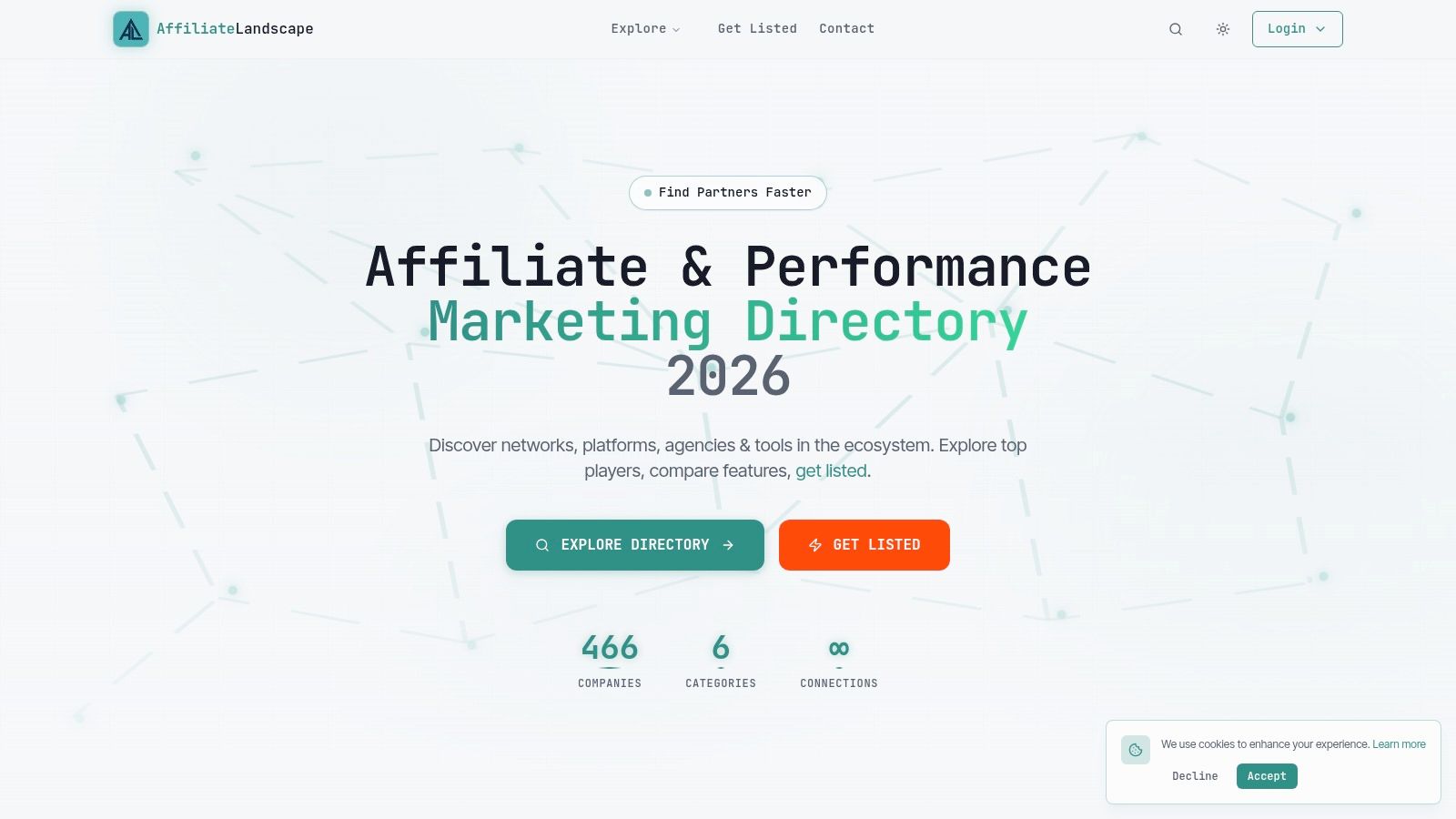
By centralizing continually updated provider data, side-by-side comparisons, and user reviews, AffiliateLandscape significantly reduces the hours of manual research that performance marketers typically endure. This accelerates the timeline for identifying and vetting high-fit partners, making it an indispensable tool for brands aiming to scale their programs and publishers seeking new monetization opportunities.
Key Features & Capabilities
AffiliateLandscape is more than just a list; it's a dynamic evaluation tool. Its side-by-side comparison tables and transparent scoring system allow users to quickly assess how different performance marketing platforms measure up against each other. This is complemented by a marketplace functionality that directly connects program owners with traffic partners, supporting the entire due diligence lifecycle.
The platform's profile system adds a crucial layer of trust. AI-generated profiles can be claimed and upgraded to a Verified status, granting companies full control, a trust badge, and access to built-in analytics. This allows users to see profile views, clicks, and engagement, offering tangible data on their visibility within the ecosystem.
Ideal Use Cases & Audience
- Merchants & Brands: Quickly discover and vet affiliate networks, tracking solutions, fraud prevention tools, and OPM agencies to build or scale an affiliate program.
- Affiliates & Publishers: Find high-converting affiliate programs and merchant partners across various niches.
- Agencies & Networks: Gain visibility, showcase verified credentials, and connect with potential brand clients and publisher partners.
Pros and Cons
| Pros | Cons |
|---|---|
| Comprehensive Index: Reduces research time by centralizing providers across the entire performance marketing stack. | Listing Dependent: Coverage relies on listings; some new or niche providers might not be present until added. |
| Trust & Verification: Verified profiles, reviews, and analytics increase transparency and aid in due diligence. | Profile Control: Advanced features and analytics require companies to claim and upgrade their profiles. |
| Actionable Comparisons: Leaderboards and scoring help users quickly evaluate the best-fit partners and tools. | AI-Generated Content: Initial AI-generated profiles may require manual correction by the company after claiming. |
Access to the directory is free for browsing and discovery. Companies wishing to enhance their visibility can claim their profiles and opt for a "Verified" subscription for advanced features and analytics. For those new to the space, the platform also offers valuable educational resources to help you understand the fundamentals of affiliate marketing and its core concepts.
Website: https://affiliatelandscape.com
2. impact.com
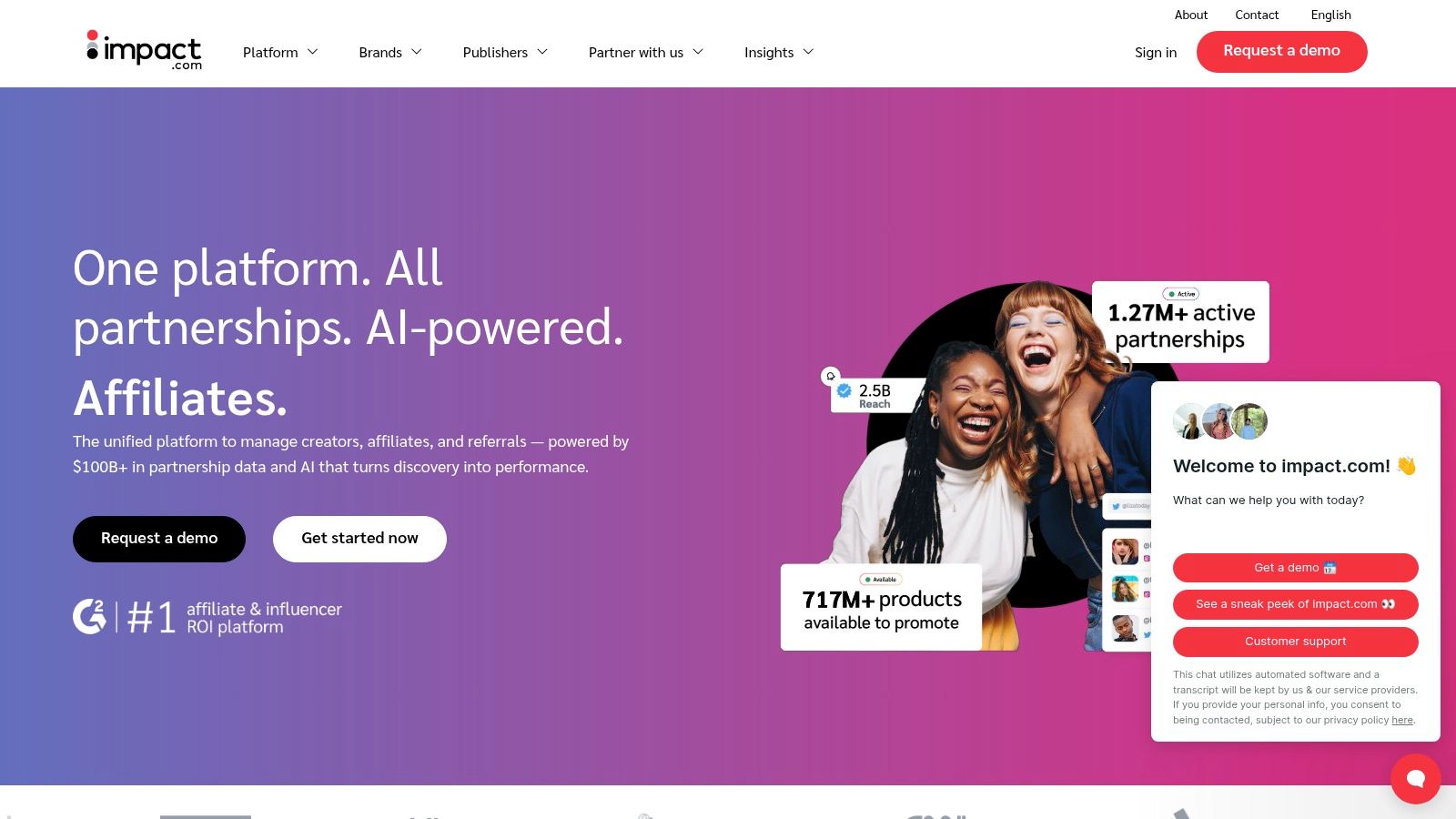
Impact.com, often referred to as the Partnership Cloud, positions itself as an end-to-end management solution for all types of partnerships, moving beyond traditional affiliate marketing. Its strength lies in automating the entire partnership lifecycle, from discovery and recruitment to contracting, tracking, and payment processing. This unified approach makes it a standout choice for brands looking to scale their affiliate, influencer, and B2B channel partnerships under one roof.
The platform is one of the few enterprise-grade performance marketing platforms that offers transparent, tiered pricing, making it accessible even for smaller businesses. The "Starter" plan provides a crucial entry point for companies new to the space.
Key Platform Highlights
- Best For: Merchants and agencies seeking a scalable, all-in-one platform for diverse partnership types, from influencers to strategic B2B partners.
- Unique Feature: Its comprehensive "Partnership Cloud" framework which integrates different partner models seamlessly, a significant advantage over platforms focused solely on affiliates.
- Implementation Tip: Utilize the Marketplace (available on Essentials+ plans) early to accelerate partner recruitment. Proactively filter and invite partners rather than waiting for them to apply. If you need foundational guidance, you can learn more about starting an affiliate program before diving in.
- Pricing Signal: Published tiered plans (Starter, Essentials, Pro, Enterprise) plus a 2.5% transaction fee on partner-driven revenue.
Pros & Cons
| Pros | Cons |
|---|---|
| Transparent pricing with a low-cost entry point for new programs. | Transaction fees can become significant for high-volume advertisers. |
| Expansive marketplace with over 90,000 vetted partners. | Advanced features like fraud scoring are reserved for top-tier Enterprise plans. |
| Robust cross-device tracking and deep analytics via its Data Lab reporting. | The platform can feel complex for beginners due to its extensive feature set. |
Website: https://impact.com
3. Partnerize
Partnerize positions itself as an enterprise-grade partnership automation platform, built to manage and scale large, global partner programs. Its primary strength lies in its robust infrastructure and flexible commercial models, which cater to the complex procurement and budgeting needs of large corporations. The platform unifies partner discovery, recruitment, tracking, optimization, and payment processing, supporting a wide range of partnership types beyond traditional affiliates.
The all-inclusive pricing model, which avoids unexpected overage fees, is a key differentiator for businesses requiring predictable costs. This makes Partnerize a strong contender among performance marketing platforms for established brands managing multi-region campaigns and diverse partner portfolios.

Key Platform Highlights
- Best For: Mid-market and enterprise-level brands that need to manage complex, global partner programs with predictable platform costs.
- Unique Feature: Its flexible commercial models, offering a choice between a traditional license fee or a performance-based structure, which is rare at the enterprise level. This allows companies to align platform costs with their specific financial strategy.
- Implementation Tip: For global brands, leverage Partnerize's strong multi-currency and multi-language support from the outset to create localized experiences for partners in different regions. This can significantly improve partner engagement and performance.
- Pricing Signal: Custom pricing that requires a sales consultation. Models include fixed license fees or performance-based fees, with no public rate card.
Pros & Cons
| Pros | Cons |
|---|---|
| Flexible commercial models align with different budgeting approaches. | No public rate card means pricing transparency is low without a sales call. |
| Scales effectively for complex, multi-region and multi-currency programs. | May be overly complex or cost-prohibitive for small businesses or new programs. |
| All-inclusive pricing structure prevents unexpected overage fees. | The extensive feature set can present a steeper learning curve for new users. |
Website: https://partnerize.com
4. CJ (formerly Commission Junction)
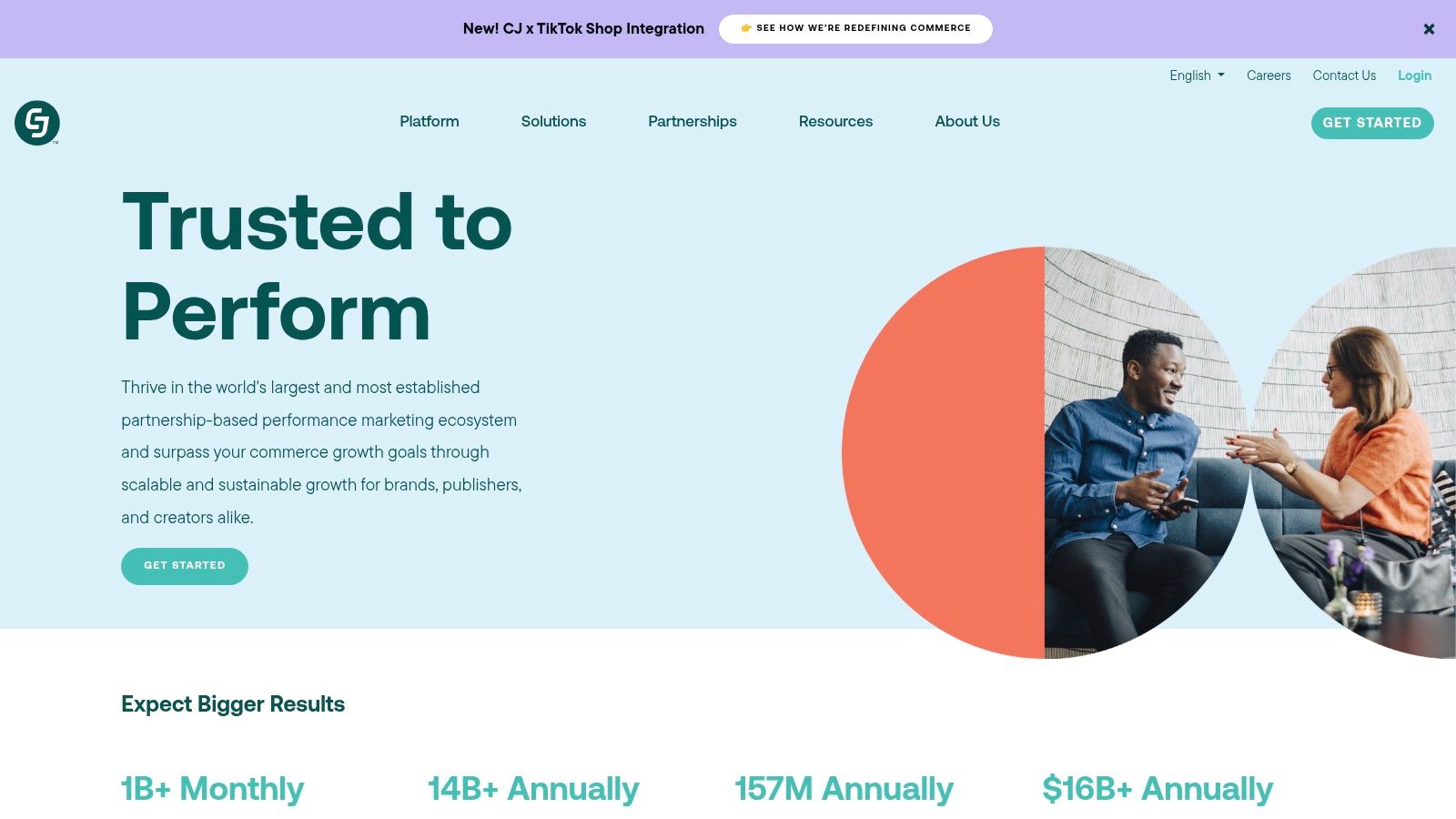
As one of the oldest and most established players in the affiliate space, CJ (formerly Commission Junction) operates a vast global network that connects tens of thousands of advertisers with high-quality publishers. Its reputation is built on reliability, offering mature tools for tracking, reporting, and payment processing designed to support large-scale, enterprise-level affiliate programs. The platform is a go-to for established brands seeking access to a deep pool of experienced publishers across nearly every vertical imaginable.
CJ's strength lies in its expansive publisher base and the robust, time-tested infrastructure that underpins its operations. For advertisers with the resources to manage it, the network provides unparalleled reach and sophisticated program management capabilities.
Key Platform Highlights
- Best For: Large-scale enterprises and advertisers with dedicated affiliate managers looking to tap into a massive, pre-vetted publisher network.
- Unique Feature: Its sheer scale and longevity in the market, which translates to a deep and diverse publisher base that is difficult for newer performance marketing platforms to replicate.
- Implementation Tip: Leverage CJ's internal account management teams for strategic guidance. Publishers looking to join can learn more about how to start affiliate marketing to maximize their chances of being accepted into premier programs.
- Pricing Signal: Opaque; pricing is custom-quoted via a sales onboarding process and typically includes setup fees, monthly fees, and performance-based commissions.
Pros & Cons
| Pros | Cons |
|---|---|
| Deep pool of established publishers across a wide range of verticals. | Pricing and commercial terms are not publicly listed and require sales engagement. |
| Mature tooling and strong support for large, complex affiliate programs. | The user interface is often cited as being complex and less intuitive than modern rivals. |
| Strong reputation for reliable tracking and on-time publisher payments. | Better suited for established brands, not typically ideal for small businesses or startups. |
Website: https://www.cj.com
5. Rakuten Advertising
Rakuten Advertising, one of the oldest and most established affiliate networks, is renowned for its premium ecosystem of top-tier brands and publishers. It leverages its extensive history and global reach to foster high-value relationships, making it a go-to platform for established advertisers in the retail, D2C, and travel sectors looking to connect with a curated pool of high-performing publishers. The network emphasizes quality over quantity, providing a more selective environment than many open-access platforms.
Its longevity has allowed it to build strong, lasting connections with major media houses and content creators. For publishers, this translates to access to globally recognized brands, while advertisers benefit from a network of vetted partners with proven track records. The platform's commitment to quality makes it a key player among performance marketing platforms.

Key Platform Highlights
- Best For: Established enterprise-level advertisers, particularly in retail, and premium content publishers seeking partnerships with major brands.
- Unique Feature: An AI-driven partnership discovery tool that analyzes network data to recommend high-potential publisher matches, moving beyond simple keyword searches.
- Implementation Tip: Advertisers should engage directly with Rakuten's account managers to fully leverage their network expertise and get personalized publisher recommendations. Publishers should maintain a high-quality site and performance metrics to attract invitations from premium brands.
- Pricing Signal: Opaque; advertiser pricing is custom and performance-based, requiring contact with their sales team. Publisher sign-up is free.
Pros & Cons
| Pros | Cons |
|---|---|
| Strong relationships with a curated list of premium publishers. | Advertiser pricing is not public and can be a barrier for smaller businesses. |
| Robust publisher dashboard with detailed performance reporting. | Publisher payment timing can vary, as it often depends on advertiser remittance. |
| AI-assisted partner discovery helps find relevant opportunities. | Less suitable for brands seeking a high volume of niche or micro-influencers. |
Website: https://rakutenadvertising.com
6. Awin
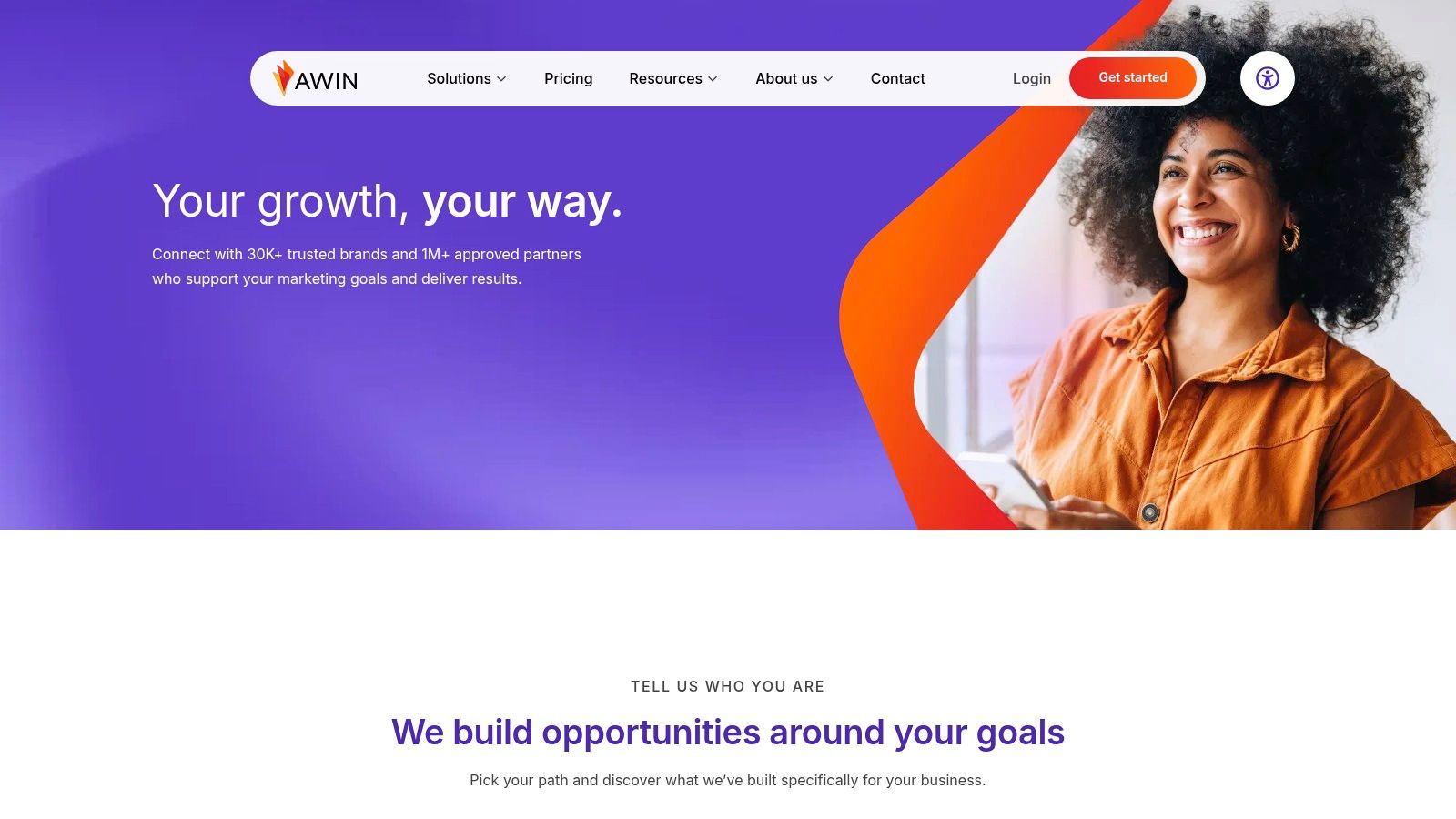
Awin is a massive global affiliate network that has made significant strides in accessibility for small-to-medium-sized businesses. Its primary differentiator is a transparent, self-serve entry plan called Awin Access, which removes the high setup fees and long-term commitments often associated with major performance marketing platforms. This approach allows new and growing advertisers in the US to test the affiliate channel with a predictable, modest investment.
The platform provides a clear pathway for growth. Advertisers can start on the self-serve plan and, as their program matures and requires more advanced tools or managed services, they can transition to higher-tier plans like Accelerate or Advanced by working with the Awin sales team. This scalability makes it a strong contender for businesses at various stages.
Key Platform Highlights
- Best For: SMBs and e-commerce brands looking for a low-risk, low-commitment entry point into affiliate marketing with a major, reputable network.
- Unique Feature: The Awin Access plan, which offers a rare combination of self-service onboarding, published pricing ($49/month), and a short 3-month minimum term.
- Implementation Tip: Use the initial three-month term to aggressively recruit a core group of publishers. Focus on activating them quickly to generate enough data to prove the channel's ROI before deciding to continue or scale up your investment. You can find more details by exploring different affiliate networks and platforms to see how this model compares.
- Pricing Signal: Published self-serve plan (Awin Access) at $49/month plus a 3.5% tracking fee. Custom pricing for higher-tier Accelerate and Advanced plans.
Pros & Cons
| Pros | Cons |
|---|---|
| Transparent entry-level pricing and a very low barrier to start. | Combined tracking and commission fees can become costly as program revenue grows. |
| Excellent for testing affiliate marketing as a new channel. | Advanced features and dedicated support are reserved for more expensive plans. |
| Access to a large, established global network of publishers. | The self-serve model requires more hands-on management from the advertiser. |
Website: https://www.awin.com/us
7. ShareASale (by Awin)
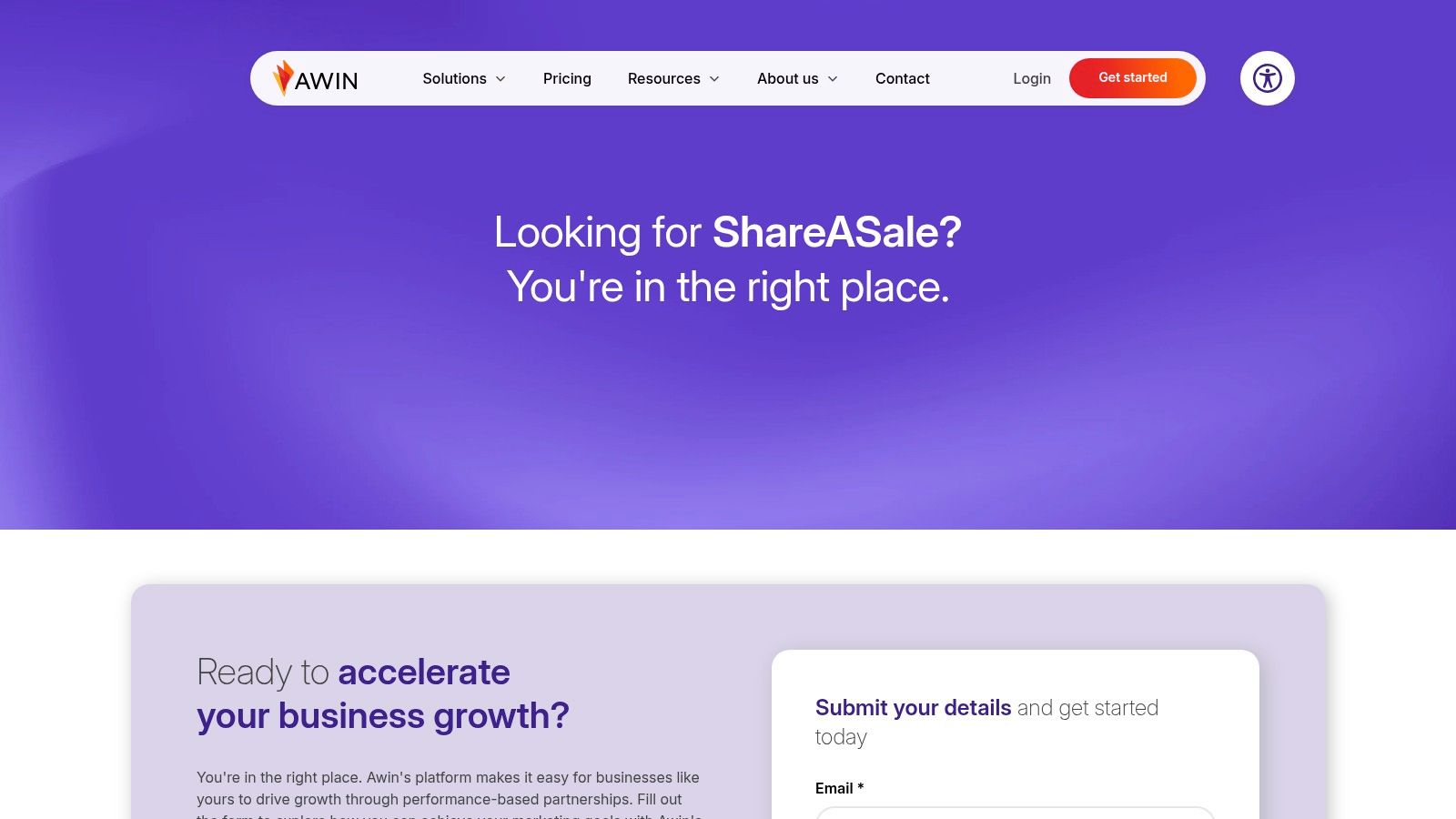
ShareASale, now part of the Awin group, is a veteran affiliate marketing network renowned for its accessibility and strong presence in the US market. It has long been a go-to platform for small-to-medium-sized businesses (SMBs) and direct-to-consumer (DTC) brands, thanks to its transparent and predictable cost structure. This straightforward approach removes much of the pricing ambiguity common with other performance marketing platforms.
The platform distinguishes itself with a one-time network access fee and a clear, percentage-based transaction fee calculated on the affiliate commission, not the total sale value. This model, combined with its large base of established content, coupon, and loyalty publishers, makes it an attractive and low-risk entry point for merchants launching their first affiliate program.
Key Platform Highlights
- Best For: SMB and DTC brands, particularly in the US, seeking a cost-effective and reputable network with a massive pool of traditional affiliate partners.
- Unique Feature: Its highly transparent pricing model with published setup costs and fees based on commissions paid, which simplifies budget forecasting for new programs.
- Implementation Tip: Leverage the platform's robust search and filtering tools to identify top-performing affiliates in your niche. Proactively send personalized recruitment messages to these publishers to build your program's foundation quickly.
- Pricing Signal: One-time network access fee ($625) plus a minimum deposit. A 20% transaction fee is charged on the commission you pay to affiliates, not the sale amount.
Pros & Cons
| Pros | Cons |
|---|---|
| Very clear, published cost structure ideal for merchants needing predictability. | The upfront joining fee and deposit can be a hurdle for bootstrapped or very small brands. |
| Large, established base of content, coupon, and loyalty publishers. | The 20% tracking fee on commissions effectively increases affiliate payout costs. |
| User-friendly interface that is relatively easy for beginners to navigate. | While part of Awin, it operates somewhat separately, with less emphasis on global or enterprise features. |
Website: https://www.shareasale.com
8. PartnerStack
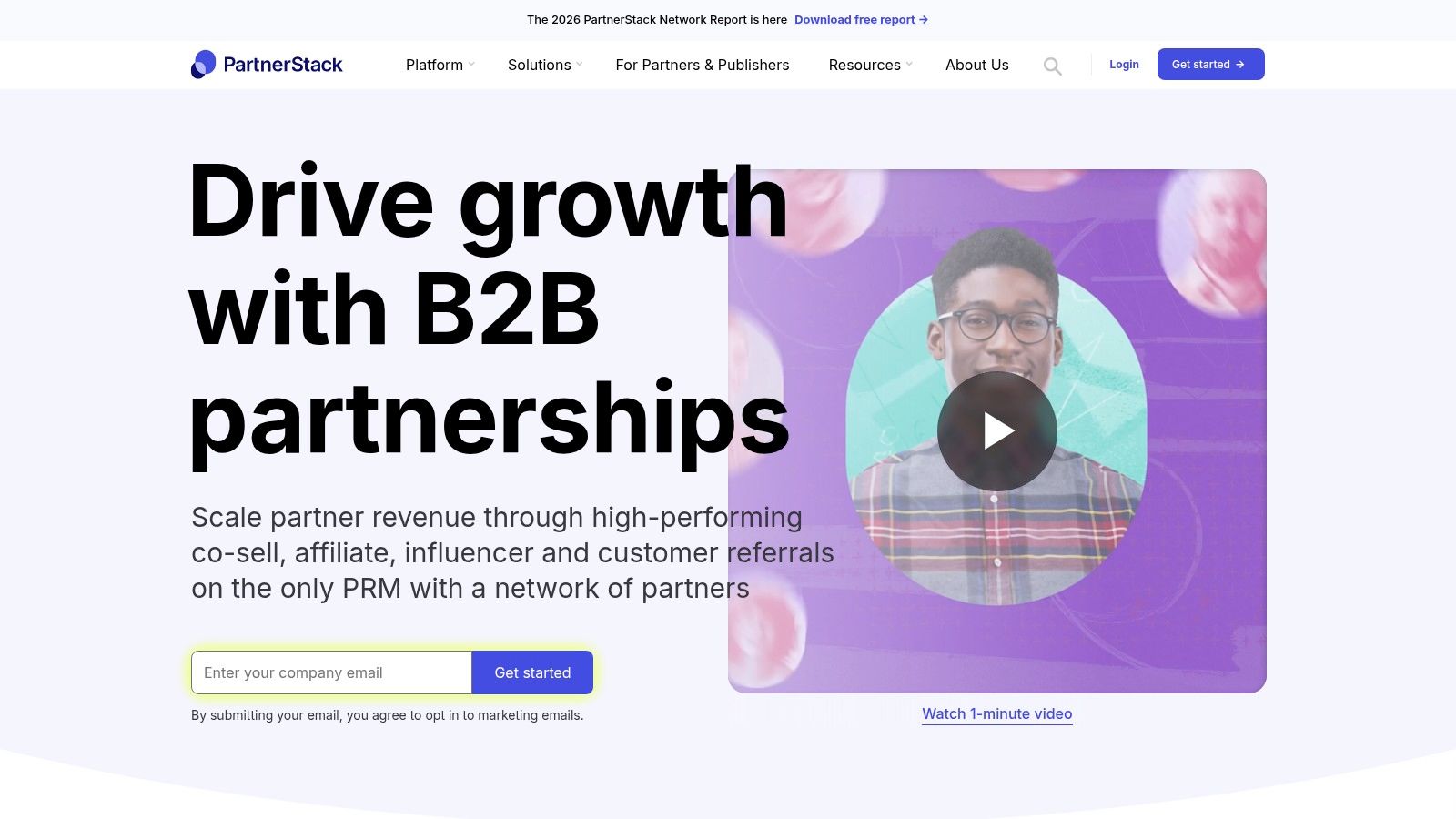
PartnerStack is a partner relationship management (PRM) platform and marketplace built specifically for the B2B SaaS industry. It excels at managing complex partner ecosystems that go beyond simple affiliate links, incorporating referral and reseller channels. The platform is designed to automate the entire partner lifecycle, from recruitment and onboarding to tracking, rewards, and payouts, making it a powerful engine for SaaS companies looking to scale through partnerships.
Its core strength is its sharp focus on B2B motions. While other performance marketing platforms serve a broader market, PartnerStack provides tools and a partner network tailored to the unique needs of software vendors, such as managing recurring commissions and multi-tiered partner programs.
Key Platform Highlights
- Best For: B2B SaaS companies that rely on a mix of affiliate, referral, and reseller partners to drive new customer acquisition and revenue.
- Unique Feature: The integrated B2B Partner Network, which gives vendors direct access to over 116,000 active partners who specialize in promoting and selling software products.
- Implementation Tip: Leverage the automated journey workflows to create customized onboarding experiences for different partner types. A well-structured onboarding process for resellers versus affiliates can significantly improve activation rates.
- Pricing Signal: Custom pricing based on business needs; requires contacting their sales team for a quote.
Pros & Cons
| Pros | Cons |
|---|---|
| Purpose-built for B2B SaaS partner motions. | Pricing is not transparent and requires a sales consultation. |
| Strong automation simplifies partner operations and payouts. | Less suited for traditional D2C/e-commerce or retail affiliate programs. |
| Multi-channel support (affiliate, referral, reseller) in one hub. | The specialized focus means its partner network is less diverse for consumer brands. |
Website: https://partnerstack.com
9. Everflow
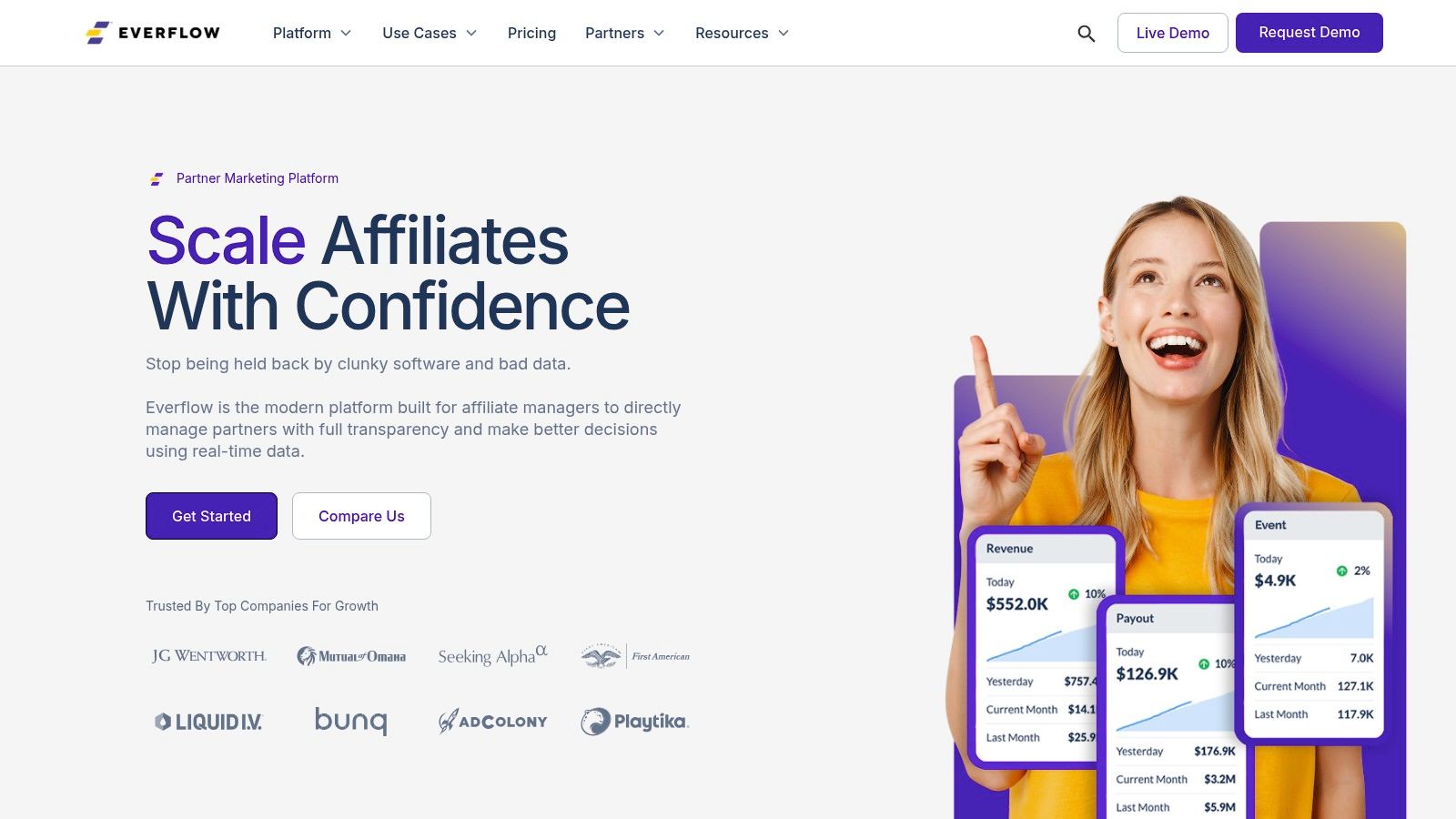
Everflow positions itself as a modern, high-speed performance marketing platform, praised for its real-time analytics and robust infrastructure. Built on the Google Cloud Platform, it emphasizes speed, scalability, and security, making it a strong contender for businesses managing high volumes of traffic and complex partnership structures. Its API-first approach appeals to tech-savvy teams looking for deep integration capabilities.
The platform excels in providing granular, instantaneous data, which empowers managers to optimize campaigns on the fly. This focus on immediate feedback loops, combined with advanced fraud prevention and flexible commissioning rules, makes it a powerful tool for performance-focused teams that require both agility and enterprise-grade reliability.
Key Platform Highlights
- Best For: Agencies, mobile app advertisers, and high-volume brands that prioritize real-time data, campaign automation, and API customization.
- Unique Feature: Its "EverXchange" feature provides a curated partner discovery network, allowing users to easily find and recruit vetted traffic sources directly within the platform.
- Implementation Tip: Leverage the "SmartSwitch" automation feature to set up performance-based rules that can automatically pause low-performing partners or shift traffic to better-converting offers, maximizing your ROI without constant manual oversight.
- Pricing Signal: Custom pricing based on clicks. Plans require a minimum 6-month commitment, indicating a focus on long-term partnerships.
Pros & Cons
| Pros | Cons |
|---|---|
| Exceptionally fast, real-time reporting and analytics for quick optimization. | Pricing is not publicly listed, requiring a demo and sales call to get a quote. |
| Enterprise-level performance and security, built on Google Cloud. | The minimum 6-month contract may be a barrier for businesses seeking more flexibility. |
| Intuitive user interface that simplifies complex campaign management tasks. | Primarily click-based pricing might be less cost-effective for high-traffic programs. |
Website: https://www.everflow.io
10. TUNE
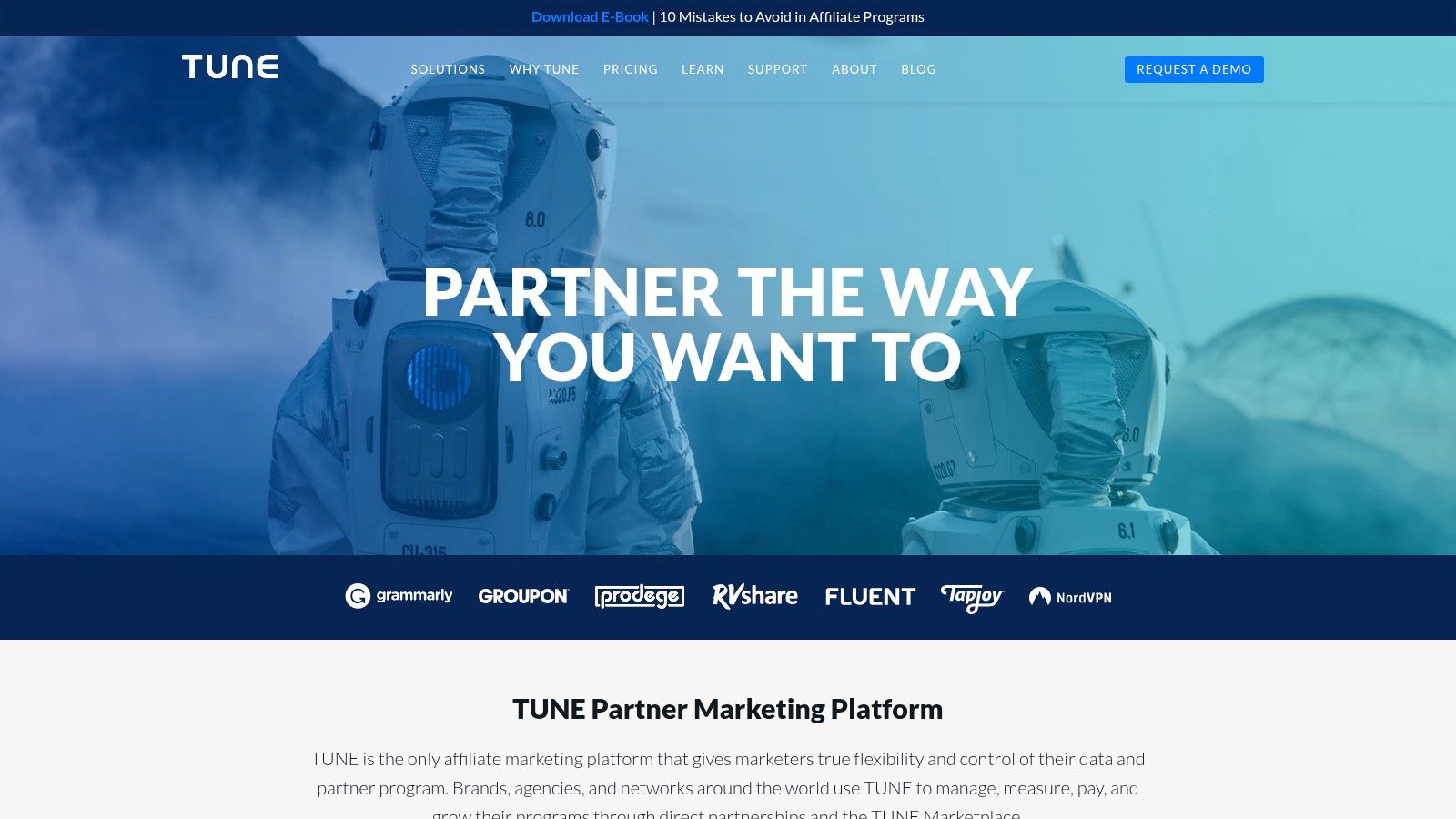
Built on the heritage of HasOffers, TUNE is a highly flexible partner marketing platform known for its technical prowess and customization capabilities. It caters to businesses that require deep control over their partnership programs, from traditional affiliates and influencers to complex mobile and app-based partnerships. TUNE's strength is its robust infrastructure, emphasizing reliable cookieless tracking and an extensive API that allows for deep integration into existing tech stacks.
This makes it a go-to choice for sophisticated advertisers and networks that need to build custom solutions or manage intricate, multi-channel partner ecosystems. The platform's powerful tracking and proactive fraud prevention are engineered to handle high-volume, global traffic across web and mobile environments with precision.
Key Platform Highlights
- Best For: Technically-savvy advertisers, mobile-first businesses, and affiliate networks that need a customizable, API-driven platform.
- Unique Feature: Its extensive API library with over 650 endpoints, offering unparalleled control and automation possibilities for developers and technical marketing teams.
- Implementation Tip: Plan for developer resources during setup. To maximize TUNE's value, you should intend to use its API for custom reporting, partner onboarding automation, or integration with internal business intelligence tools.
- Pricing Signal: Quote-based pricing tailored to usage and feature needs. It is generally positioned for mid-market to enterprise-level clients rather than small businesses.
Pros & Cons
| Pros | Cons |
|---|---|
| Highly customizable and suited to complex, technical program setups. | Steep learning curve for teams not comfortable with heavy API usage. |
| Robust mobile tracking with strong mobile measurement partner (MMP) integrations. | Pricing is not publicly listed and can be a significant investment. |
| Real-time, reliable cookieless and postback tracking capabilities. | The user interface can feel more utilitarian and less intuitive than some newer platforms. |
Website: https://www.tune.com
11. CAKE
CAKE provides performance marketing software designed for affiliate networks and advertisers who require robust tracking, lead distribution, and detailed analytics. Its platform is recognized for its reliability and precision, particularly in tracking complex, multi-touch attribution funnels. This focus makes it a go-to choice for performance-based networks that need a solid, scalable infrastructure.
The platform's offering is segmented to serve different needs, with its core strength in affiliate and network tracking. It provides a highly customizable, white-label solution, allowing networks to present a fully branded portal to their partners and clients, which is a key differentiator in a crowded market of performance marketing platforms.

Key Platform Highlights
- Best For: Affiliate networks and direct advertisers who need a dependable, white-label tracking and lead distribution system.
- Unique Feature: Its powerful, real-time reporting engine and open API provide deep customization for tracking and data integration, which is critical for networks managing thousands of campaigns.
- Implementation Tip: Take full advantage of the white-label affiliate portal from the start. Customize the branding, dashboard widgets, and communication settings to create a seamless, professional experience for your partners.
- Pricing Signal: Published pricing for its entry-tier "Basic" plan, with custom pricing for higher-tier plans (Pro, Enterprise).
Pros & Cons
| Pros | Cons |
|---|---|
| Published entry pricing is lower than many enterprise-level competitors. | The "Basic" plan's limitations (e.g., 100 offers) may cap growth before an upgrade is needed. |
| Excellent white-label capabilities for networks and advertisers. | The user interface and feature depth are more utilitarian compared to some newer platforms. |
| Reliable, real-time tracking with SOC 2 Type II compliance ensures security. | Lacks a built-in partner marketplace for discovery, focusing more on tracking existing relationships. |
Website: https://getcake.com
12. Affise
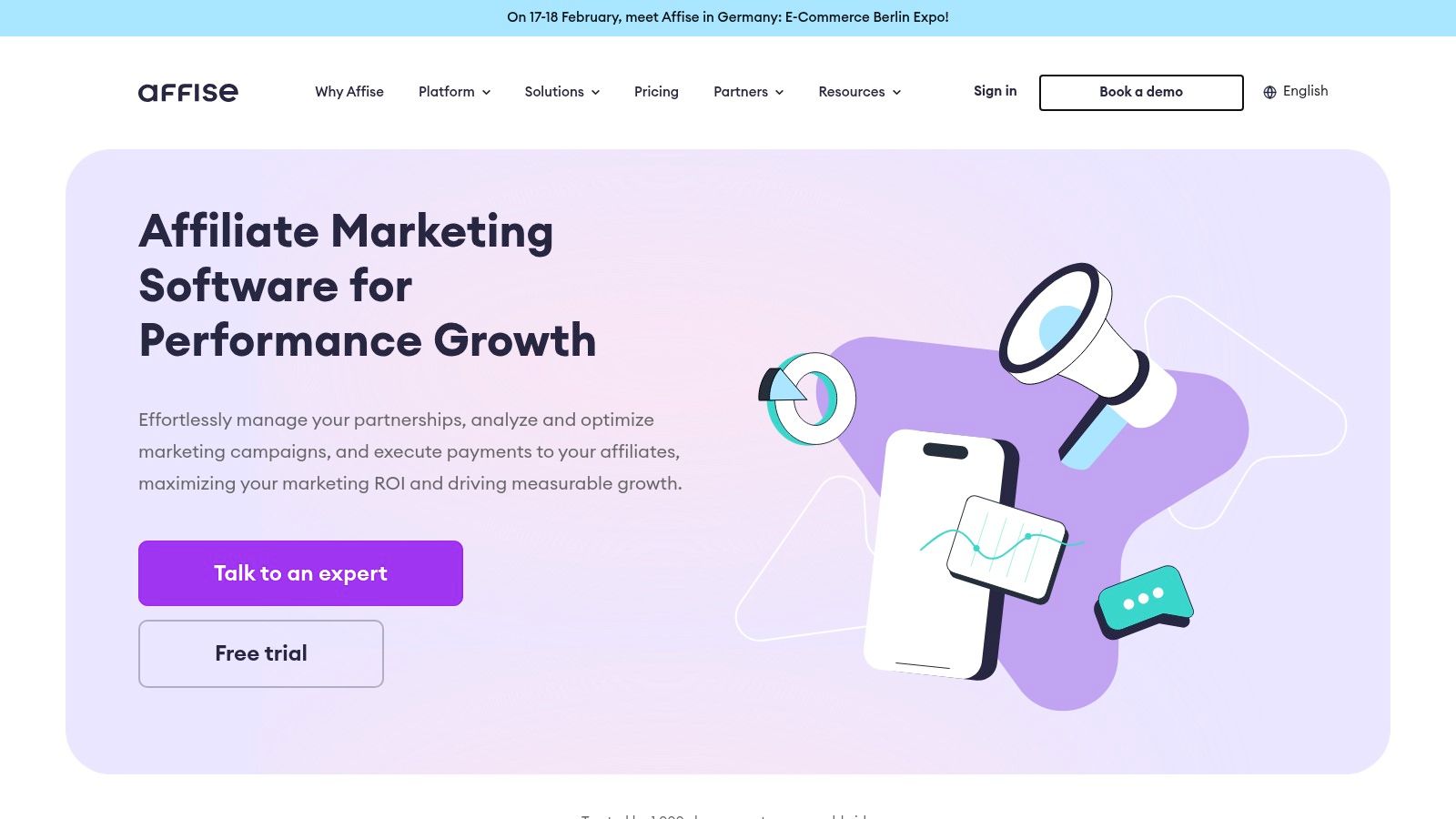
Affise presents itself as a versatile performance marketing platform tailored for networks, agencies, and brands. It carves out a niche by bundling its core tracking and partner management suite, Affise Performance, with specialized solutions like Affise MMP for mobile measurement and Affise Reach for partner discovery. This modular approach allows businesses to build a toolkit that specifically addresses their operational needs, whether they are managing an affiliate network or running direct-to-brand campaigns.
The platform is notable for its transparent, tiered plans that clearly define conversion and impression caps. This upfront clarity helps businesses anticipate costs and select a plan that aligns with their current scale, removing the ambiguity often found in enterprise software pricing.
Key Platform Highlights
- Best For: Affiliate networks and mid-market brands needing a predictable, feature-rich platform to manage both web and mobile performance marketing programs.
- Unique Feature: Its multi-product ecosystem (Performance, MMP, Reach) that allows for a customized technology stack under a single vendor, simplifying integration and support.
- Implementation Tip: Closely monitor your conversion and impression volumes against your plan's limits, especially during high-traffic periods. Proactively communicate with their team about potential overages to plan for a timely upgrade and avoid service interruptions.
- Pricing Signal: Publicly listed tiered plans (Scale, Pro, Enterprise) with defined feature sets and usage caps. Prices vary based on the contract term (monthly vs. annual).
Pros & Cons
| Pros | Cons |
|---|---|
| Transparent, line-item plan inclusions and clearly stated usage caps. | Published prices can vary by contract term, and higher-tier features are gated. |
| Balanced feature set for both network and advertiser needs at mid-market price points. | Volume caps may require careful monitoring and upgrades as a program scale grows. |
| Integrated solutions like Affise Pay streamline partner payment workflows. | The user interface can have a learning curve for those new to network management. |
Website: https://affise.com
Top 12 Performance Marketing Platforms Comparison
| Product | Core features | Target audience | Pricing & value | Unique selling points |
|---|---|---|---|---|
| AffiliateLandscape – The Affiliate & Performance Marketing Directory | Curated directory of networks, platforms, agencies, tools; side‑by‑side comparisons, leaderboards, AI‑generated profiles, analytics, marketplace | Performance marketers, affiliate managers, networks, agencies, publishers | Free discovery; companies can claim/upgrade profiles (paid) — saves research time and accelerates partner fit | Neutral, continuously updated ecosystem map; verification & trust badges; built‑in analytics for due diligence |
| impact.com | Full‑stack partnership management: contracting, cross‑device tracking, payments, analytics; marketplace (90k+) | Small to large partnership programs (affiliate, influencer, B2B) | Tiered plans (Starter → Enterprise); published tiers; 2.5% transaction fee on partner transactions | Large partner marketplace, strong analytics & enterprise security, fraud controls |
| Partnerize | Partner discovery, contracting, tracking, commissioning; optional managed services; global support | Mid‑market & enterprise brands with complex programs | Pricing/custom models via sales (license or performance‑based) | Flexible commercial models, all‑inclusive pricing option, global scale (200+ countries) |
| CJ (Commission Junction) | Global publisher network, tracking, optimization, reporting, payments | Brands seeking deep publisher pools and mature program tooling | Custom pricing via sales (not public) | Large, established publisher base and mature enterprise features |
| Rakuten Advertising | AI‑driven partner discovery, publisher dashboard, premium publisher roster | Advertisers seeking premium/retail publisher relationships; publishers (free) | Advertiser pricing typically custom; publisher sign‑up free | Strong retail relationships, AI‑assisted discovery, premium publisher network |
| Awin | Self‑serve entry plan (Awin Access: $49/mo + 3.5% tracking), scalable higher tiers | SMBs testing affiliate channel; US advertisers wanting low barrier | Published entry pricing and short minimum term (3 months) | Transparent entry pricing, low barrier to start and scale |
| ShareASale (by Awin) | Merchant onboarding fee + deposit, transaction tracking fee, monthly platform options | US DTC brands and SMBs seeking predictable fees | One‑time $625 joining fee (plus deposit); 20% tracking fee on commissions | Very clear, published cost structure; large content/coupon publisher base |
| PartnerStack | B2B partner marketplace, partner program management, automated monthly payouts | B2B SaaS vendors and partner ops teams | Custom pricing via sales | Purpose‑built for B2B SaaS, strong automation and consolidated payouts |
| Everflow | Real‑time reporting, API‑first, fraud prevention, enterprise security (Google Cloud, SOC) | Performance teams and enterprises needing speed & scale | Pricing not publicly listed; 6‑month minimum commitment | Fast usability, real‑time workflows, enterprise security posture |
| TUNE | Cookieless postback tracking, extensive API (650+ endpoints), fraud prevention, TUNE Pay | Technical teams, mobile‑first advertisers and networks | Pricing not public (mid→enterprise) | Highly customizable API surface and robust mobile/MMP integrations |
| CAKE | Affiliate/network tracking, lead distribution, white‑label portals, real‑time reporting | Networks and advertisers needing white‑label & cost‑effective entry | Published entry pricing (lower than many peers); plan limits apply | White‑label portal options, published entry pricing, SOC 2 compliance |
| Affise | Performance tracking + MMP + Reach for partner discovery; tiered plans with caps; payouts | Networks, agencies, and mid‑market brands | Tiered plans with published feature/cap limits; pricing varies by term | Transparent, line‑item plan inclusions and usage caps; balanced mid‑market feature set |
Final Thoughts
Navigating the expansive world of performance marketing platforms can feel like mapping a new continent. We've journeyed through a dozen of the industry's most significant players, from enterprise-grade titans like impact.com and Partnerize to specialized powerhouses like PartnerStack and nimble, tech-first solutions like Everflow. Each platform presents a unique combination of features, network reach, and strategic focus, underscoring a critical truth: there is no single "best" platform, only the one that is best for your specific business model, goals, and resources.
Your ideal solution depends entirely on who you are. A large enterprise merchant needs the global reach and sophisticated automation of a platform like Rakuten Advertising or Awin. In contrast, a SaaS company will find its perfect ecosystem within the B2B-centric world of PartnerStack. An agency juggling multiple clients will prioritize the granular tracking and multi-tenant capabilities offered by platforms such as TUNE or CAKE. The key takeaway is to shift your mindset from finding a universally superior tool to identifying a platform that aligns perfectly with your operational reality.
Key Takeaways: Your Strategic Checklist
As you move forward from this guide, keep these core principles at the forefront of your decision-making process. They serve as your compass in the complex landscape of performance marketing platforms.
- Business Model is Paramount: Your first filter should always be your business model. Are you a B2C e-commerce brand, a B2B SaaS provider, a mobile app developer, or a content publisher? Platforms like ShareASale excel for physical product sellers, while PartnerStack is built for recurring revenue models. Don't try to force a platform to fit your model; find one that was built for it.
- Network vs. Technology: A crucial distinction lies between platforms that offer a built-in, managed affiliate network (like CJ and Awin) and those that are pure SaaS technology plays (like Everflow and TUNE), where you build your own network. The former offers immediate access to publishers but less control, while the latter provides complete control but requires you to recruit every partner yourself.
- Total Cost of Ownership: Look beyond the monthly subscription fee. Consider implementation costs, potential transaction fees or network overrides, the need for dedicated management personnel, and the cost of any third-party integrations required to make the platform work. A lower sticker price might conceal higher operational costs down the line.
- Scalability is Non-Negotiable: The platform you choose today must support your vision for tomorrow. Evaluate its ability to handle increased traffic, more complex commission structures, global expansion, and a diverse range of partner types. Migrating from one of these performance marketing platforms to another is a significant, resource-intensive undertaking, so choose with long-term growth in mind.
Your Actionable Next Steps
With this knowledge in hand, it's time to take decisive action. The path from evaluation to implementation is a strategic one that demands careful planning.
- Define Your Program's Core Needs: Before you schedule a single demo, document your "must-haves" versus "nice-to-haves." Do you need advanced mobile tracking? Is multi-touch attribution a deal-breaker? Do you require automated partner payments in various currencies? A clear requirements document will prevent you from being swayed by flashy features you'll never use.
- Shortlist and Demo (The Rule of Three): Based on our guide and your requirements, select your top three contenders. Schedule comprehensive demos with each. Prepare a list of specific questions that address your unique pain points and use cases. Ask them to demonstrate exactly how their platform solves your specific challenges.
- Plan for Implementation: Choosing a platform is only half the battle. Implementation requires technical resources for tracking pixel placement, legal review for partner agreements, and marketing resources for partner recruitment and activation. Start mapping out these internal requirements early to ensure a smooth launch once you've signed the contract. This proactive planning is a critical step in successfully integrating any of the performance marketing platforms we've discussed.
Ultimately, the right performance marketing platform is a force multiplier. It transforms your partnerships from a manual, administrative burden into a scalable, predictable, and highly profitable growth channel. It provides the data-driven clarity needed to optimize relationships, reward top performers, and build a resilient revenue engine. Armed with the insights from this guide, you are now well-equipped to make an informed choice that will power your growth for years to come.
Ready to dive deeper and connect with the right partners, networks, and agencies? The platforms listed here are just one piece of the puzzle. AffiliateLandscape is the most comprehensive directory in the industry, allowing you to discover and research thousands of potential partners to recruit onto your chosen platform. Explore our detailed listings at AffiliateLandscape to build your performance marketing ecosystem.
Ready to explore the affiliate landscape?
Discover networks, tools, and opportunities in our directory.
Explore Directory