
Finding the right influencer marketing platform can feel overwhelming. With dozens of options, each claiming to be the best, how do you choose the one that actually fits your brand's specific needs, budget, and goals? A platform mismatch can lead to wasted resources, frustrating workflows, and lackluster campaign results. This guide cuts through the noise.
We’ve created a direct, actionable directory to solve this exact problem. Instead of vague marketing copy, you'll find a detailed analysis of the top influencer marketing platforms available today. We examine each tool's core strengths, ideal use cases, and potential limitations to give you a clear, honest picture.
This resource is designed to help you make an informed decision quickly. For each platform, you will find:
- Key Features: A focused look at what the platform actually does.
- Best For: Specific scenarios where the tool excels (e.g., e-commerce brands, B2B, agencies).
- Pricing: Realistic pricing information to help with budget planning.
- Pros & Cons: A balanced view of its advantages and drawbacks.
We also include screenshots for a visual reference and direct links to each website, so you can start your evaluation immediately. Whether you're a small D2C brand launching your first campaign or a large agency managing multiple clients, the information here will guide you to the software that aligns with your strategy. Let's dive into the platforms that can help you build, manage, and scale your influencer programs effectively.
1. CreatorIQ
CreatorIQ positions itself as an enterprise-grade solution for large-scale, global influencer marketing programs. It's built for complexity, serving in-house teams at major brands like AB InBev, Disney, and Unilever who need to manage multi-market campaigns with strict governance and deep performance measurement. The platform’s core strength lies in connecting creator activities directly to business outcomes, moving beyond simple engagement metrics.
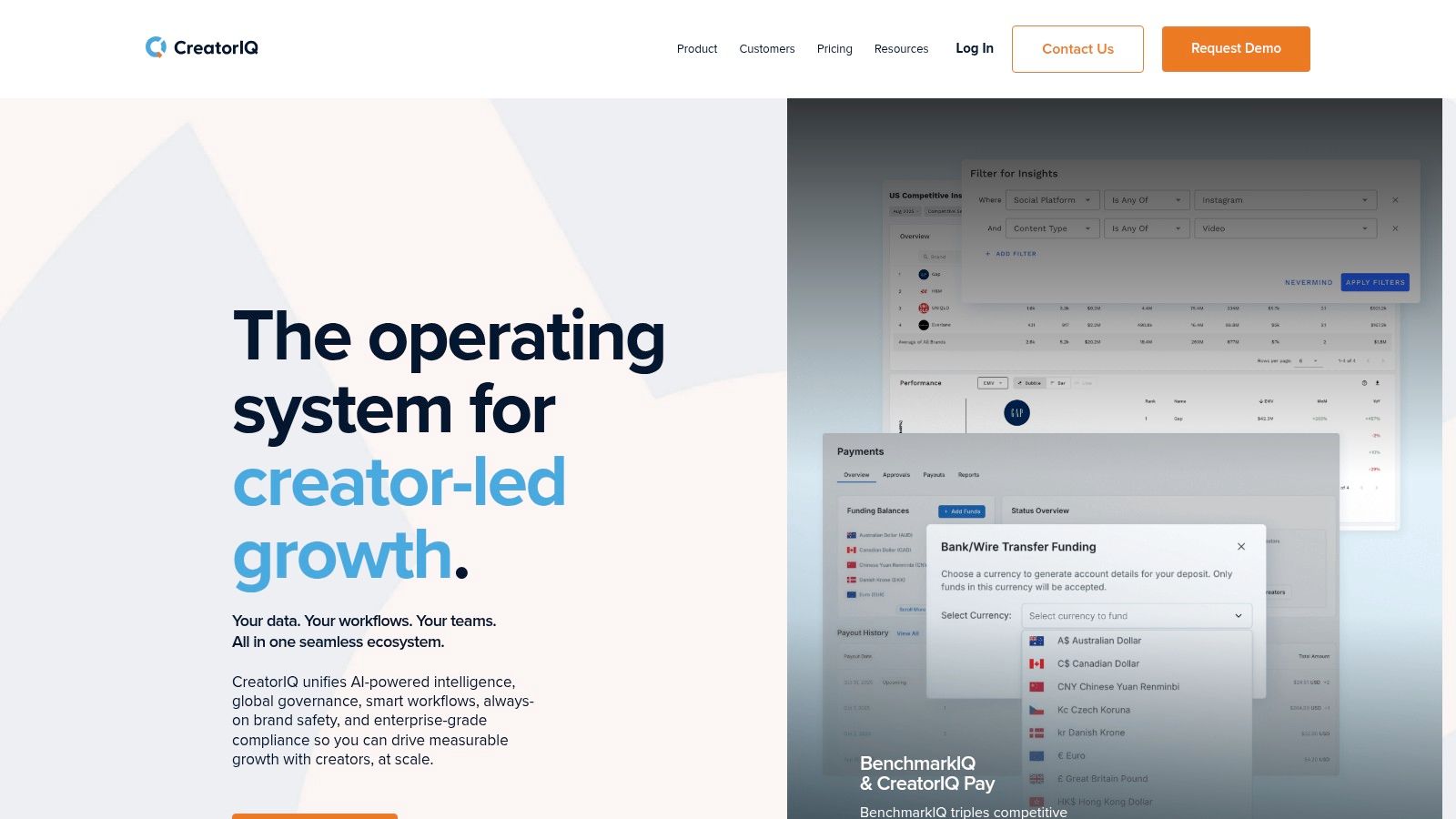
Its end-to-end workflow management covers everything from creator discovery and vetting to contracting, content approvals, and paid amplification. The level of control is a key differentiator; features like advanced brand safety checks, audience authenticity verification, single sign-on (SSO), and granular user permissions are designed for organizations where compliance and security are non-negotiable.
The platform also provides an API-first architecture, allowing for integrations with other business systems. This makes it a central command center for creator-driven commerce. While its power is undeniable, the onboarding process and pricing structure reflect its enterprise focus, which might be excessive for smaller businesses or those just starting with influencer marketing. For organizations that also manage affiliate partnerships, understanding the nuances of payment and tracking is key; you can find helpful resources on the best affiliate tracking software to complement your strategy.
Website: https://www.creatoriq.com/
Best For:
- Large, global enterprises with complex, multi-brand portfolios.
- Heavily regulated industries requiring strong governance and compliance controls.
- Teams focused on proving cross-channel ROI from creator content.
Pricing:
- Custom enterprise pricing. Expect a significant investment, with costs tailored to usage, number of users, and specific feature requirements. No public pricing is available.
| Pros | Cons |
|---|---|
| Excellent scalability for large teams and multiple brands. | Enterprise-focused pricing is a high barrier to entry. |
| Deep reporting capabilities and robust governance controls. | Can be overly complex for small to medium-sized businesses. |
| Strong API and integration options for a connected tech stack. | Onboarding process is intensive and requires dedicated resources. |
2. GRIN
GRIN is a creator management platform specifically designed for direct-to-consumer (DTC) and eCommerce brands. It approaches influencer marketing from a relationship-first perspective, treating creators as long-term brand partners rather than one-off campaign assets. The platform functions as a Creator CRM, enabling brands to manage their entire program lifecycle, from discovering new talent and outreach to product seeding, content management, and payment. Its core value is in building authentic, always-on creator communities.
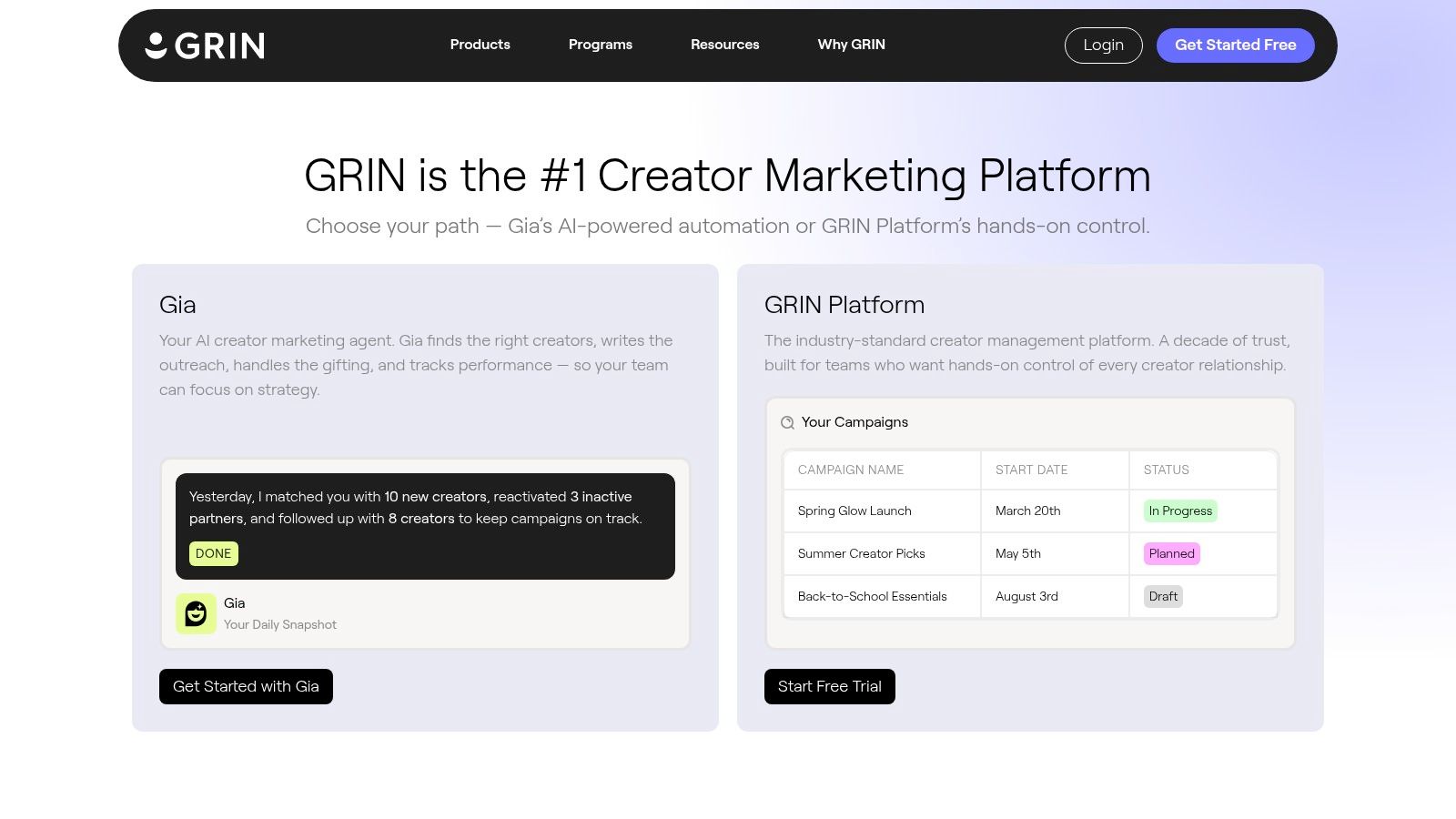
The platform’s feature set is deeply integrated with the eCommerce stack, offering connections to Shopify, WooCommerce, and Magento. This allows for seamless product seeding and generates unique discount codes and affiliate links to track creator-driven sales directly. GRIN stands out among influencer marketing platforms by focusing its reporting on commerce outcomes like revenue generated and conversion rates, giving marketing teams clear attribution for their efforts.
This focus on long-term management and commerce makes it a powerful tool for brands investing seriously in their creator programs. However, its comprehensive nature means it requires a commitment to adopting its workflows. The pricing structure is also aimed at businesses that view creator marketing as a primary growth channel, making it a significant investment compared to more basic tools.
Website: https://grin.co/
Best For:
- Direct-to-consumer (DTC) and eCommerce brands.
- Teams focused on building long-term creator relationships and communities.
- Marketers who need to track sales attribution and ROI from influencer and affiliate activities.
Pricing:
- Custom pricing based on the number of active creators managed and feature set. It is an enterprise-level investment, with no public pricing available.
| Pros | Cons |
|---|---|
| Built for long-term creator relationships, not just campaigns. | Pricing is geared toward established programs, not beginners. |
| Strong eCommerce integrations for product seeding and sales tracking. | Feature depth can require significant process adoption and training. |
| Combines influencer and affiliate-style attribution effectively. | Discovery features are less of a focus than relationship management. |
3. Upfluence
Upfluence merges the worlds of influencer marketing and affiliate management into a single, all-in-one platform. It's particularly strong for direct-to-consumer and eCommerce brands that want to track creator-driven sales directly. The platform's power lies in its massive creator database, AI-powered discovery tools, and integrated eCommerce functionalities that tie influencer activities directly to revenue.
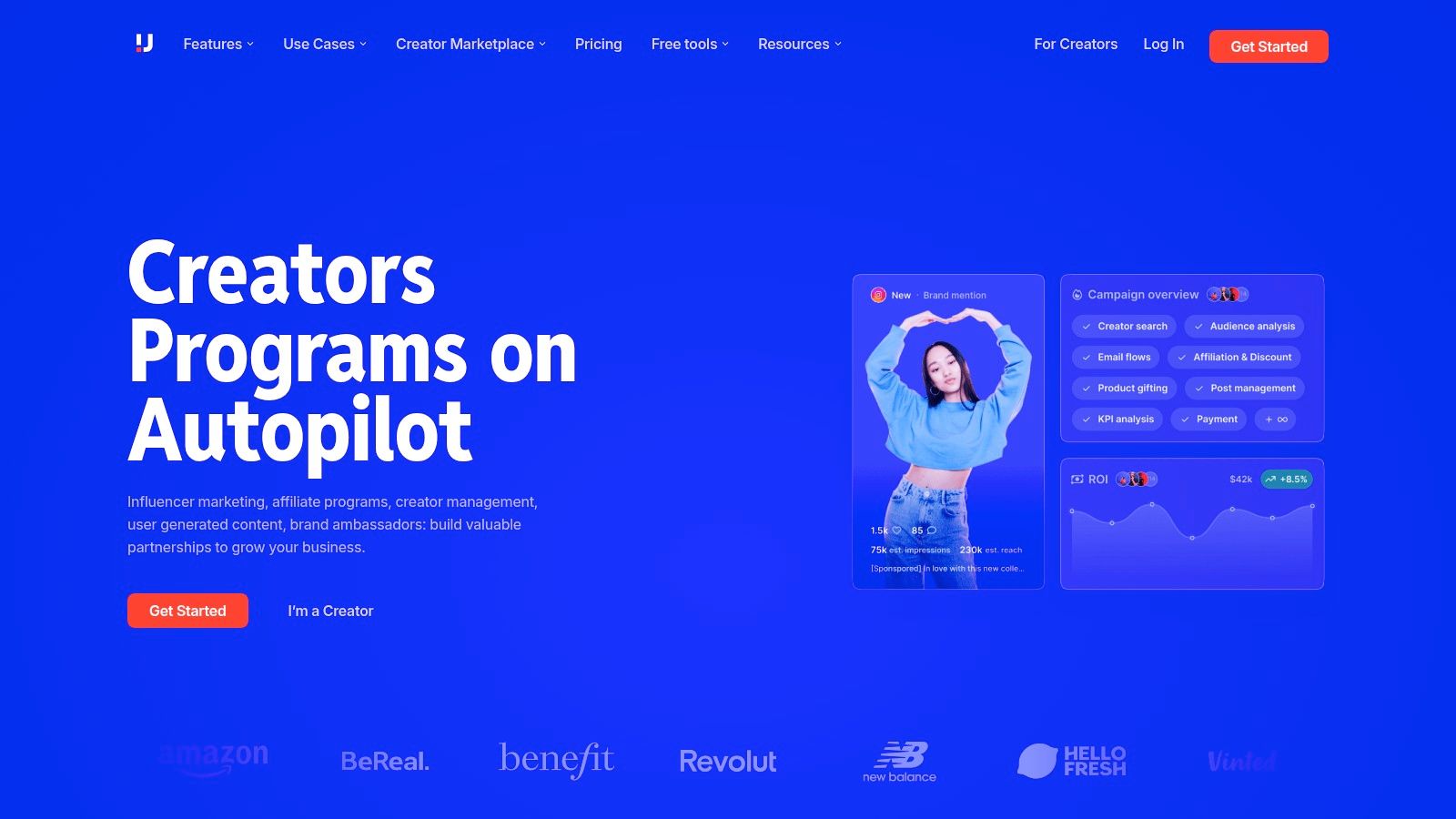
Its end-to-end workflow supports everything from finding creators across Instagram, TikTok, and YouTube to managing outreach, negotiating rates, and processing payments. A key differentiator is its ability to generate unique affiliate links, discount codes, and track conversions through native integrations with Shopify, WooCommerce, and other major eCommerce systems. This makes it one of the more performance-focused influencer marketing platforms available.
For brands new to performance-based partnerships, it’s important to understand the recruitment process; you can get more guidance on how to find affiliate partners to expand your program. While Upfluence offers deep functionality, the extensive feature set can present a learning curve for teams unfamiliar with such detailed analytics and campaign management tools. The pricing structure is also geared toward committed brands rather than casual users.
Website: https://www.upfluence.com/
Best For:
- eCommerce and DTC brands focused on tracking sales and ROI.
- Teams looking to combine traditional influencer marketing with affiliate programs.
- Companies that need a large, searchable database for creator discovery.
Pricing:
- Custom pricing based on modules and usage. Plans like "Growth," "Scale," and "Enterprise" are available, but you must contact sales for a quote. Expect a premium investment.
| Pros | Cons |
|---|---|
| Strong eCommerce integrations and sales tracking features. | Pricing can be a significant investment for smaller teams. |
| Excellent balance of creator discovery and performance tools. | The full suite of features has a notable learning curve. |
| Combines influencer and affiliate tactics in one platform. | Some users report the initial database search can feel overwhelming. |
4. Aspire (formerly AspireIQ)
Aspire stands out as a mature platform built for consumer brands managing influencer, creator, and user-generated content (UGC) programs. It combines powerful workflow automation with flexible service models, making it a strong contender among influencer marketing platforms. A key differentiator is its dual approach: brands can use the self-serve software or opt for Aspire’s managed services team for a more hands-off, done-for-you experience. This flexibility caters to teams with varying levels of internal resources.
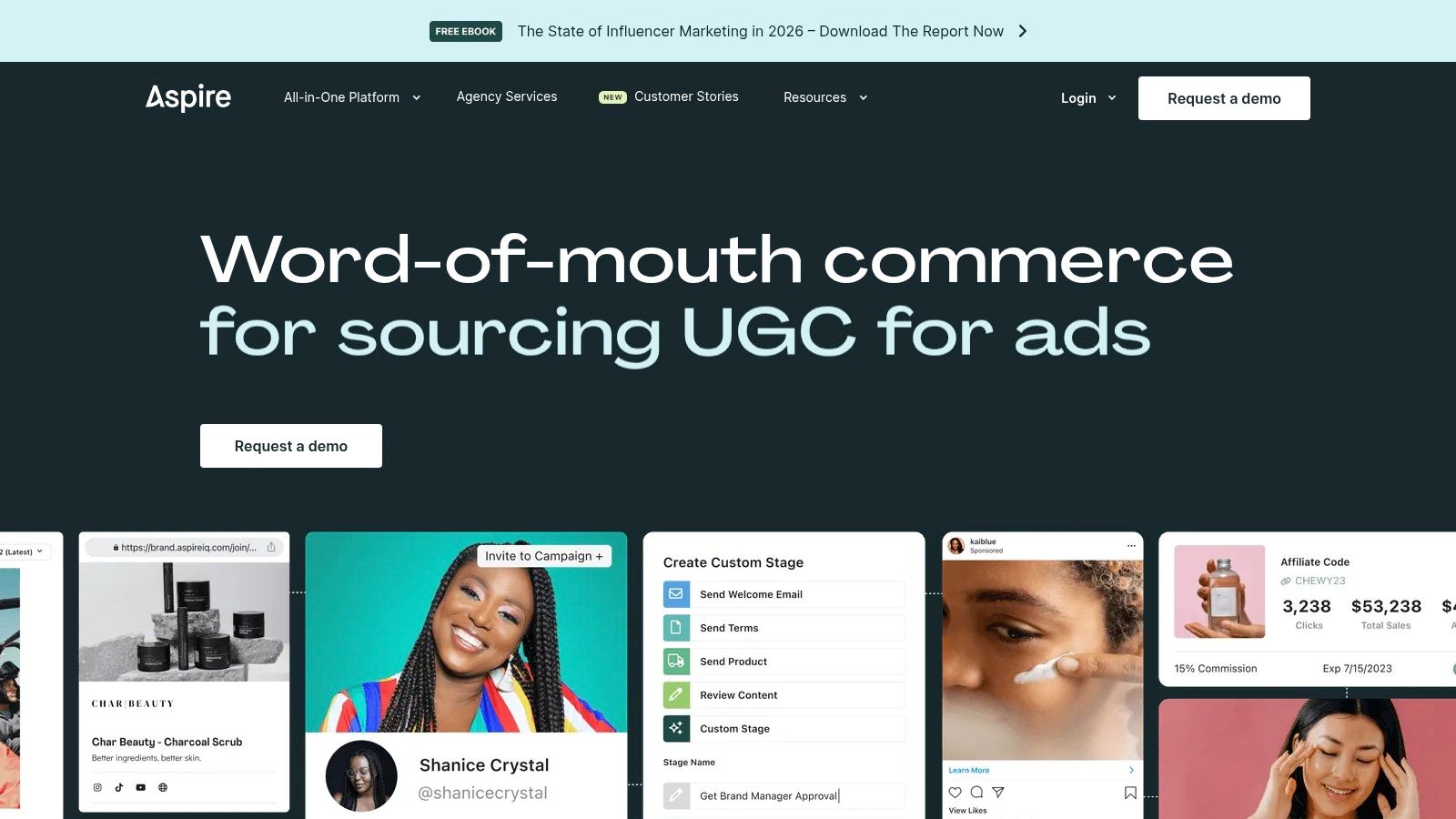
The platform’s Creator Marketplace is a notable feature, allowing brands to post campaign briefs and receive inbound applications from interested creators. This can significantly speed up the sourcing process compared to manual outreach. Aspire manages the full campaign lifecycle, including content approvals, product seeding, rights management, and payment. It also provides solid measurement and sales attribution tools, including affiliate links and promo codes, to help connect creator activities to real business results.
While the platform is robust, its pricing reflects its positioning for the mid-to-upper market, and there is no public pricing available. The effectiveness of the Creator Marketplace can also vary depending on the brand's niche and the specific type of creators it seeks. However, for established e-commerce and DTC brands looking for an efficient way to scale their creator relationships, Aspire offers a proven and comprehensive solution.
Website: https://www.aspire.io/
Best For:
- DTC and e-commerce brands wanting to scale creator and UGC programs.
- Teams that need the flexibility of a self-serve platform with an optional managed services layer.
- Marketers focused on efficient creator sourcing and relationship management.
Pricing:
- Custom pricing based on platform tier and service needs. It is typically positioned for mid-market to enterprise-level budgets with no public pricing information.
| Pros | Cons |
|---|---|
| Flexible model: Choose self-serve software or managed support. | No public pricing; typically a mid-to-upper market investment. |
| Efficient sourcing through a large, active creator marketplace. | Marketplace results and creator quality can vary by niche. |
| End-to-end workflow automation from sourcing to payment. | May be more platform than needed for very small-scale programs. |
5. Sprout Social Influencer Marketing (Tagger by Sprout Social)
Following its acquisition of Tagger, Sprout Social has integrated a powerful influencer marketing engine into its well-regarded social media management suite. This move positions the platform as a unified solution for brands that want to manage influencer campaigns alongside their organic and paid social activities. The core benefit is combining influencer discovery, campaign management, and ROI analytics within the same ecosystem used for content publishing, community management, and social listening.
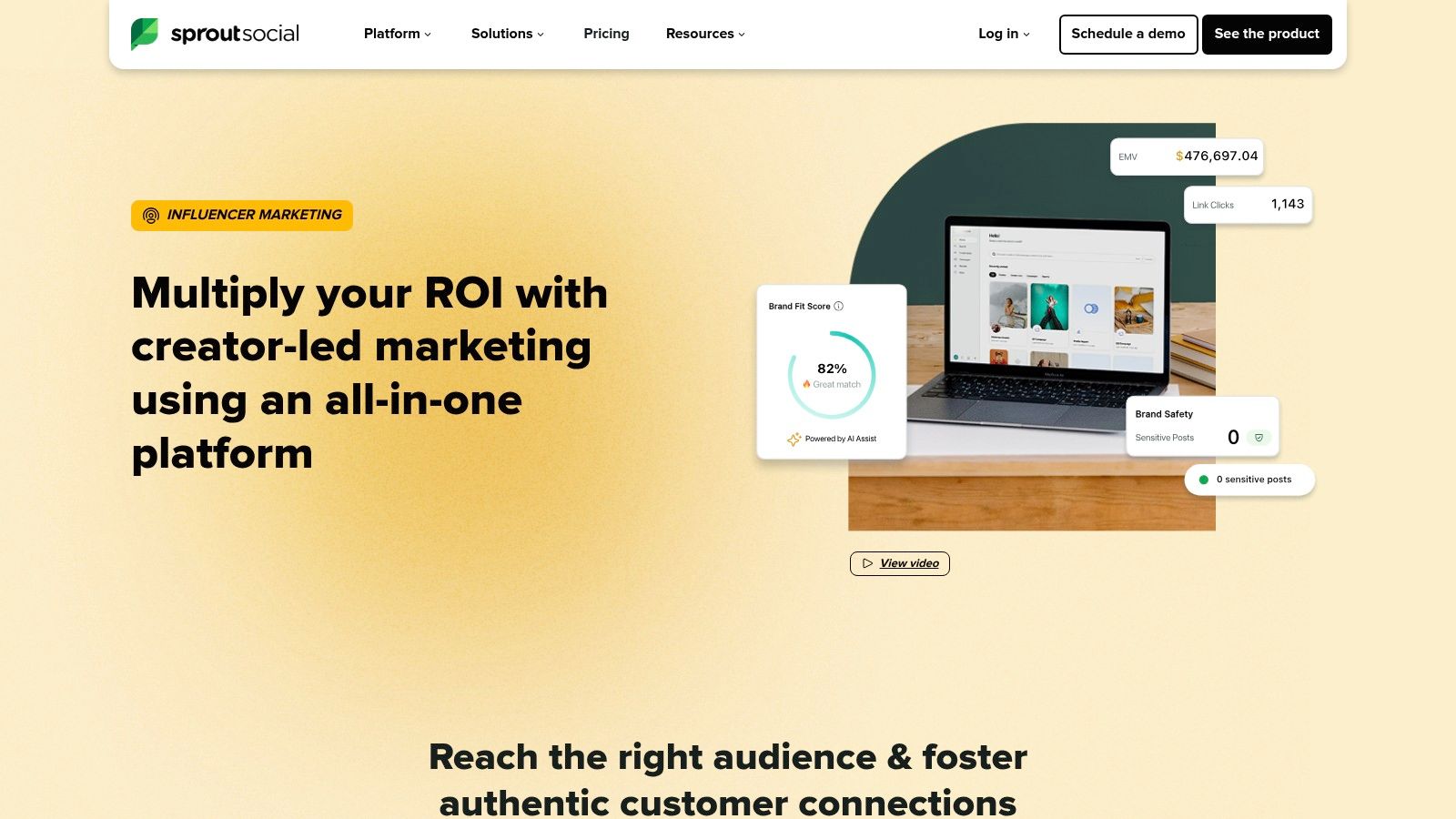
The platform enables teams to find creators, run campaigns, and directly boost influencer content as paid ads, all from one place. This integration provides a clear view of how organic creator content and paid amplification work together, a common blind spot for teams using separate tools. The unified workflow is a significant advantage for existing Sprout Social customers, as it eliminates the need to onboard and learn an entirely separate system for their influencer programs.
This consolidated approach is particularly useful for measuring total social ROI. For those also managing performance-based partnerships, understanding the differences between creator fees and commission-based payouts is important. Learning more about what is affiliate marketing can help clarify how these distinct but related strategies can coexist. While the integrated nature is its greatest strength, it also means the tool delivers maximum value when used as part of the broader Sprout platform, which may not be ideal for companies only seeking a standalone influencer solution.
Website: https://sproutsocial.com/influencer-marketing
Best For:
- Current Sprout Social customers looking to add influencer marketing capabilities.
- Marketing teams aiming to unify organic social, paid social, and influencer workflows.
- Organizations that value having a single source of truth for all social media performance data.
Pricing:
- Pricing is not public and is typically bundled with Sprout Social’s main platform plans. It's geared toward mid-market and enterprise clients, so expect a notable investment.
| Pros | Cons |
|---|---|
| Consolidates influencer marketing with social media management. | Best value is realized when paired with the full Sprout Social suite. |
| Unified workflows for organic, paid, and influencer activities. | Pricing is not public and trends towards the enterprise level. |
| Backed by a public SaaS company with continuous product development. | May be more than needed for teams solely focused on influencer outreach. |
6. Traackr
Traackr is a data-forward influencer marketing platform that excels in providing deep, actionable analytics. It's particularly favored by global brands in sectors like beauty, CPG, and luxury goods that require rigorous measurement and benchmarking. The platform’s core philosophy is built on treating influencer marketing as a science, offering tools to measure program performance, optimize spend, and model potential outcomes before launching a campaign.
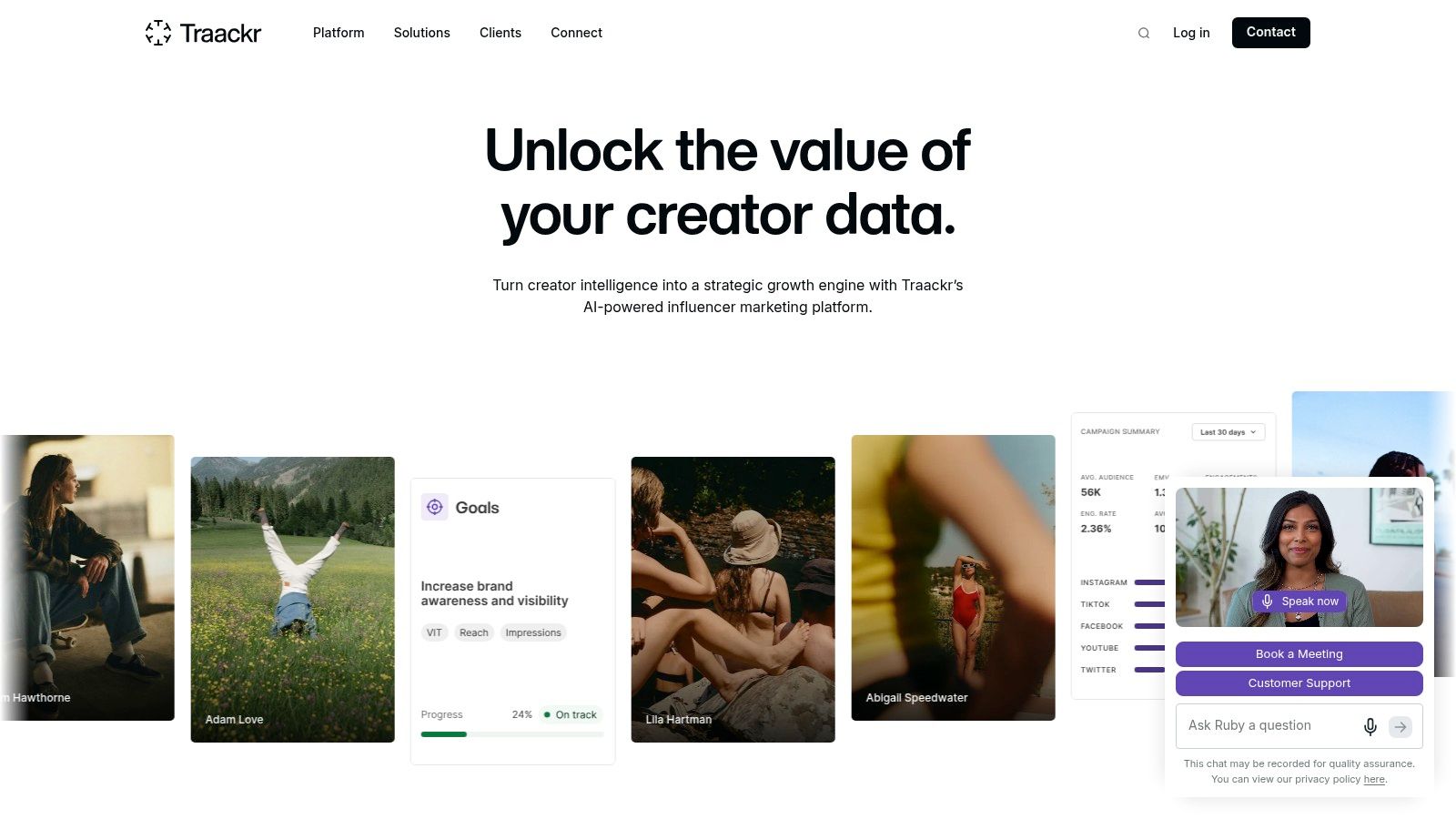
Its system is designed for data-driven teams that want to move beyond surface-level metrics. Traackr provides advanced features for brand safety, audience authenticity analysis, and competitor benchmarking, allowing marketers to understand their share of voice in the creator economy. The platform also offers global workflow management and compliance controls, making it suitable for complex, international organizations.
While its analytical capabilities are a major strength, this focus means it's priced for mid-market and enterprise clients. The user experience assumes a certain level of sophistication in influencer marketing strategy, which may be a steep learning curve for smaller businesses or those just starting out. For brands that prioritize proving ROI with granular data, Traackr is one of the top-tier influencer marketing platforms available.
Website: https://www.traackr.com/
Best For:
- Data-driven marketing teams focused on analytics and ROI measurement.
- Beauty, fashion, and CPG brands needing competitor and market benchmarking.
- Global organizations requiring brand safety and compliance across markets.
Pricing:
- Custom pricing based on usage and feature sets. It is geared towards mid-market and enterprise budgets, so it is a considerable investment.
| Pros | Cons |
|---|---|
| Excellent analytics and ROI clarity for data-driven teams. | Priced for mid-market/enterprise sophistication. |
| Strong market benchmarking and competitive analysis features. | Less SMB-friendly and can be complex for beginners. |
| Advanced brand safety and audience authenticity verification. | The focus on data can feel overwhelming for purely creative teams. |
7. impact.com Creator (within impact.com)
impact.com Creator stands out by unifying influencer marketing with the broader partnership economy, particularly affiliate marketing. Instead of treating creators as a separate channel, the platform integrates them directly into a mature ecosystem for managing, tracking, and paying all types of partners. This approach is ideal for brands that want to run both influencer and affiliate programs from a single dashboard, ensuring consistent measurement and eliminating channel overlap.
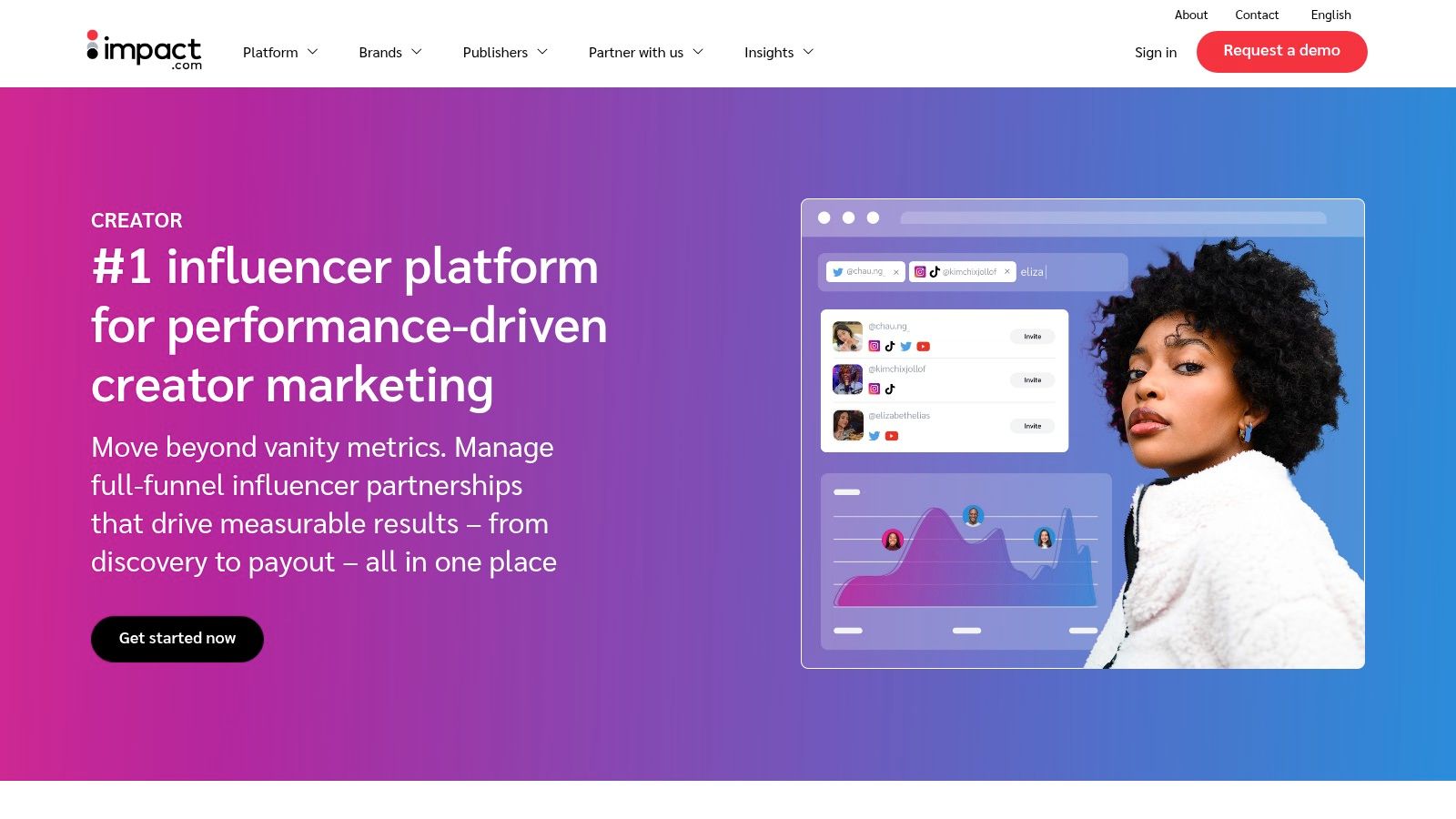
The platform provides a complete suite of tools, from a creator marketplace for discovery to contracting, automated payouts, and compliance management. Its core strength is in performance tracking. By using impact.com's established infrastructure, brands can achieve sophisticated cross-channel deduplication, accurately attributing conversions and understanding the true value each creator brings. This moves the conversation from simple engagement to tangible business results, making it one of the more robust influencer marketing platforms for performance-focused brands.
For smaller businesses, impact.com also offers a more accessible Shopify app, bringing its powerful partnership tools to a wider audience. However, the full enterprise suite comes with a significant setup and investment. Brands focused purely on performance metrics will find its capabilities compelling, and those wanting a deeper dive can learn more about the best performance marketing platforms to see how it compares.
Website: https://impact.com/creator/
Best For:
- Brands running both affiliate and influencer programs who need unified management.
- E-commerce businesses focused on performance-based creator compensation.
- Organizations requiring robust payment infrastructure and cross-channel tracking.
Pricing:
- Custom enterprise pricing based on usage and feature set; no public pricing is available. A Shopify app is available with more accessible pricing tiers.
| Pros | Cons |
|---|---|
| Natural bridge between influencer and affiliate channels. | Full enterprise pricing is not public and can be a high cost. |
| Mature partner and payments infrastructure for reliable payouts. | Setup for the full platform can be heavier than other tools. |
| Strong cross-channel tracking and attribution capabilities. | The quality of the creator discovery marketplace varies by niche. |
8. Later Influence (formerly Mavrck)
Later Influence, the platform formerly known as Mavrck, is designed for brands focused on building long-term, scalable creator relationships. It excels at managing always-on ambassador programs, product seeding initiatives, and user-generated content (UGC) campaigns. Following its acquisition by Later, it is now part of a broader suite of creator marketing tools, aiming to provide a full-funnel solution from awareness to conversion.
The platform’s strength is its workflow automation for high-volume creator activations. Brands can discover and recruit existing customers and fans into structured advocacy programs, send products at scale, and manage content rights for repurposing across other marketing channels. This makes it a practical choice for consumer brands that depend on a steady stream of authentic content and social proof.
Measurement capabilities are built to track both top-of-funnel awareness metrics and bottom-funnel conversions, connecting creator activities to tangible business goals. While it is a powerful tool for ongoing advocacy, its true value is realized through consistent use rather than for one-off campaigns. As one of the more established influencer marketing platforms, it offers a mature feature set for brands ready to move beyond transactional creator partnerships and invest in community-based marketing.
Website: https://www.mavrck.co/
Best For:
- Mid-market to enterprise CPG and e-commerce brands.
- Managing large-scale, ongoing ambassador and advocacy programs.
- Teams focused on product seeding and generating authentic UGC.
Pricing:
- Custom pricing for mid-market and enterprise clients. No public pricing is available, and it is positioned as a premium investment.
| Pros | Cons |
|---|---|
| Strong at scaling ongoing seeding and ambassador programs. | Pricing is not public and generally targets mid-market budgets and up. |
| Backed by Later’s broader creator marketing ecosystem. | Best results require consistent, always-on program management. |
| Excellent workflows for UGC collection and content rights. | May be too robust for brands only running occasional campaigns. |
9. Captiv8
Captiv8 offers a mature, end-to-end influencer marketing platform that merges data science with a full suite of campaign management tools. Now part of Publicis Groupe, it is positioned for deeper integration within large-scale media and advertising ecosystems. The platform excels at providing deep audience insights and managing workflows from creator discovery to content rights and paid amplification, making it a strong choice for brands that treat influencer marketing as an integrated media channel.
Its workflows cover the entire lifecycle of a campaign, from initial discovery and audience analysis across major social platforms to contracting and content approvals. A notable feature is its Creator Affiliate Suite, which provides a dedicated solution for performance-based partnerships. This allows brands to run both brand awareness and direct-response programs within a single environment.
The connection to a major advertising holding company suggests a future roadmap with enhanced integrations and services, particularly for enterprise-level clients. While the feature set is robust, the sales process and pricing model are geared toward larger organizations. The platform's full potential, especially its paid media boosting capabilities, is best realized when paired with a significant media budget, which may be a consideration for smaller teams.
Website: https://captiv8.io/
Best For:
- Large brands and agencies integrating influencer activity with paid media.
- Marketing teams focused on both brand awareness and performance-based affiliate goals.
- Organizations seeking a data-rich platform backed by a major advertising group.
Pricing:
- Custom pricing based on an enterprise sales model. No public pricing is available, but it is aimed at mid-market to large enterprise clients.
| Pros | Cons |
|---|---|
| Mature feature set covering brand and performance needs. | Enterprise-leaning sales cycle and pricing can be a barrier. |
| Strong data and analytics for audience vetting and measurement. | Some features are best realized alongside significant media budgets. |
| Backing from a global holding company may accelerate its roadmap. | Might be more complex than necessary for simple, small-scale campaigns. |
10. Meltwater Influencer Marketing (Klear by Meltwater)
Meltwater, a long-standing leader in media intelligence, has integrated the capabilities of Klear into its broader suite. This positions its influencer marketing platform as a component of a much larger ecosystem that includes social listening, media monitoring, and PR management. The key advantage is for brands that want to see how their influencer activities connect to earned media mentions, brand sentiment, and overall share of voice, creating a unified view across paid and earned channels.
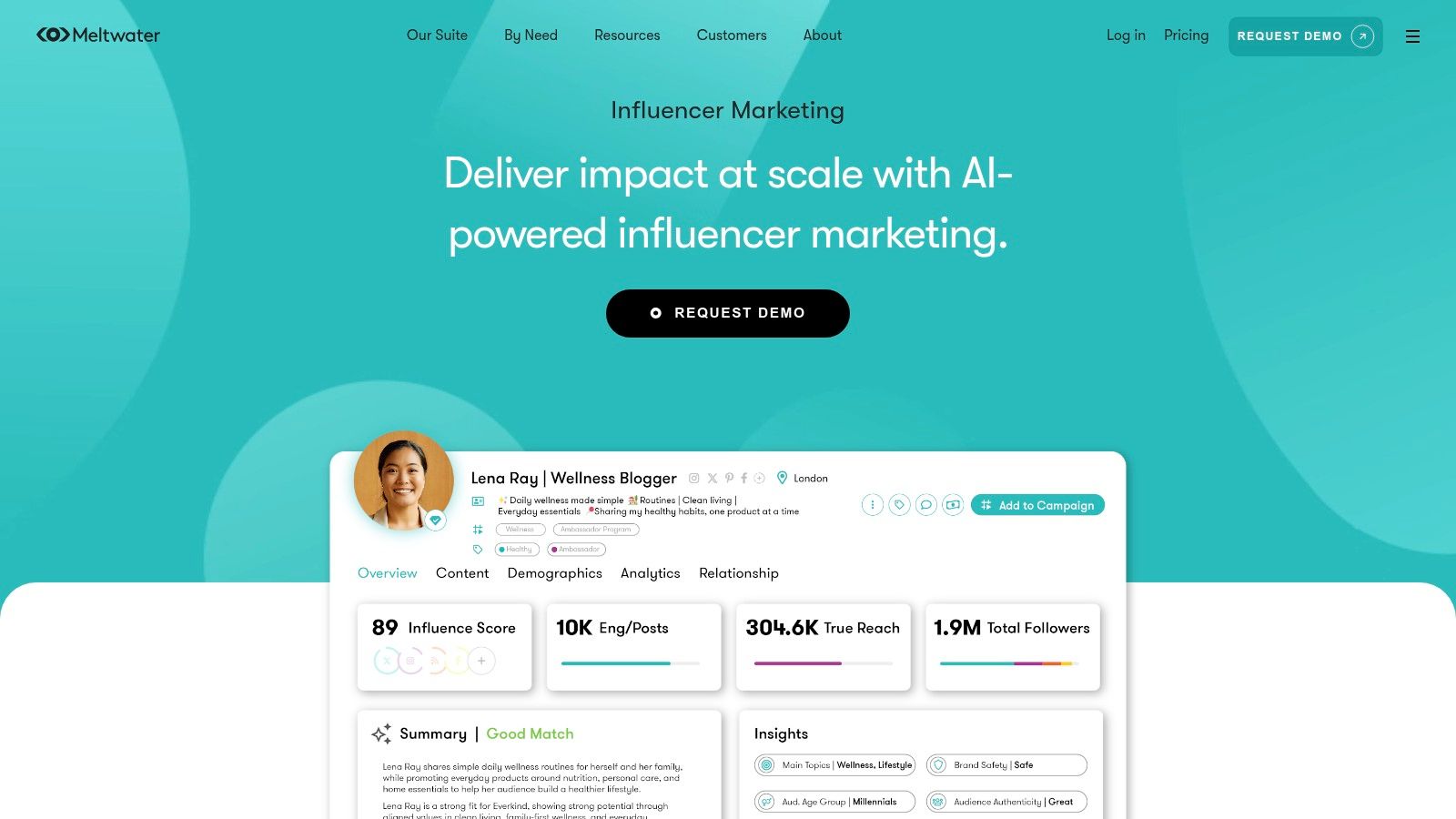
The platform offers a full set of influencer tools, from a discovery engine with advanced filters for audience authenticity and brand safety to campaign management and reporting. A standout feature is the Chrome extension, which allows teams to vet and analyze influencer profiles directly on social media platforms without switching contexts. This tight integration with the main Meltwater product means social and PR teams can work in tandem with influencer marketers within one system.
Because its strengths are tied to the wider Meltwater suite, it's an ideal choice for organizations already invested in their media intelligence tools or those looking for an all-in-one solution. However, for teams needing only a standalone influencer platform, the suite approach might offer more functionality than required, potentially affecting the price point and user experience. It's a powerful option for businesses that treat influencer marketing as an integrated part of their communications strategy.
Website: https://www.meltwater.com/en/suite/influencer-marketing
Best For:
- Existing Meltwater customers wanting to add influencer capabilities.
- PR and communications teams managing both media relations and creator partnerships.
- Organizations that need to connect influencer impact with broader brand health metrics.
Pricing:
- Custom pricing based on the full suite of Meltwater products. It's typically sold as part of a larger enterprise package, so expect a significant investment. No public pricing is available.
| Pros | Cons |
|---|---|
| Combines influencer data with extensive media and social intelligence. | Suite-based pricing can be a high barrier for standalone needs. |
| Unified toolchain for PR, social, and creator marketing teams. | The full platform may be more complex than some teams require. |
| Strong discovery tools including a useful browser extension for vetting. | Best suited for those who will use the broader Meltwater services. |
11. HypeAuditor
HypeAuditor specializes in analytics and discovery, positioning itself as an essential due diligence tool for brands and agencies. Its primary function is to vet influencers and analyze audience quality before a partnership begins. The platform is renowned for its AI-driven fraud detection, which identifies fake followers, inauthentic engagement, and other risks that can devalue an influencer marketing campaign. This focus on data integrity makes it a go-to for teams prioritizing authenticity and risk management.
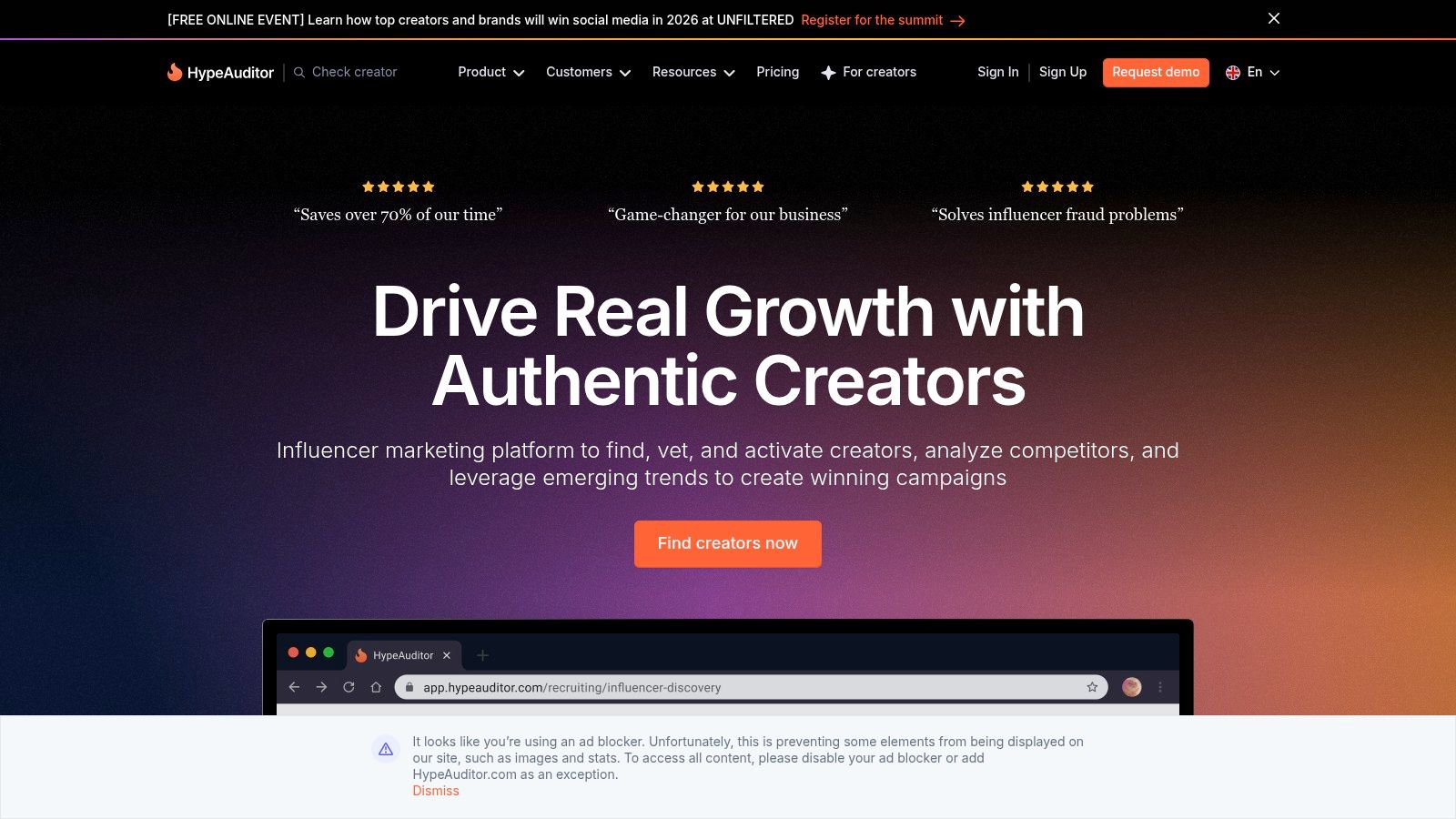
Unlike all-in-one solutions, HypeAuditor's core strength is not end-to-end campaign management but rather the deep, pre-campaign intelligence it provides. Users can analyze any influencer's audience demographics, check for brand safety concerns, and benchmark potential partners against competitors. It also offers market analysis tools to understand industry trends and identify top-performing creators in a specific niche. This makes it a powerful asset for the initial planning and selection phases.
While it has modules for campaign tracking and reporting, its workflow capabilities are lighter compared to full-suite platforms. Many teams use HypeAuditor for its robust vetting and then manage the campaign execution and payment in a separate system. Its detailed analytics are a key part of many influencer marketing platforms' strategies, ensuring they invest in genuine partnerships that reach real audiences. The pricing reflects its specialized, data-heavy nature and is tailored based on usage.
Website: https://hypeauditor.com/
Best For:
- Agencies and brands performing heavy pre-campaign vetting and risk assessment.
- Teams needing to conduct competitive analysis and market landscape research.
- Users who want to verify audience authenticity and detect follower fraud.
Pricing:
- Offers a free plan with limited features. Paid plans are custom and based on the volume of reports and features needed. No public pricing is available for advanced tiers.
| Pros | Cons |
|---|---|
| Excellent pre-vetting and fraud detection tools. | Workflow depth is lighter than full-suite campaign tools. |
| Strong for competitive and market landscape analysis. | Custom pricing can scale with usage and may be costly for some. |
| Provides deep audience insights and brand safety assessments. | Primarily focused on analysis, not end-to-end campaign execution. |
12. Influencity
Influencity offers a full-stack platform that strikes a balance between powerful features and accessible, transparent pricing. It is a strong contender for small-to-mid-market brands and agencies that need a complete tool for discovery, outreach, campaign management, and reporting without the heavy overhead and cost of enterprise-only solutions. Its global creator database is robust, providing detailed audience demographics, lookalike suggestions, and fraud detection.
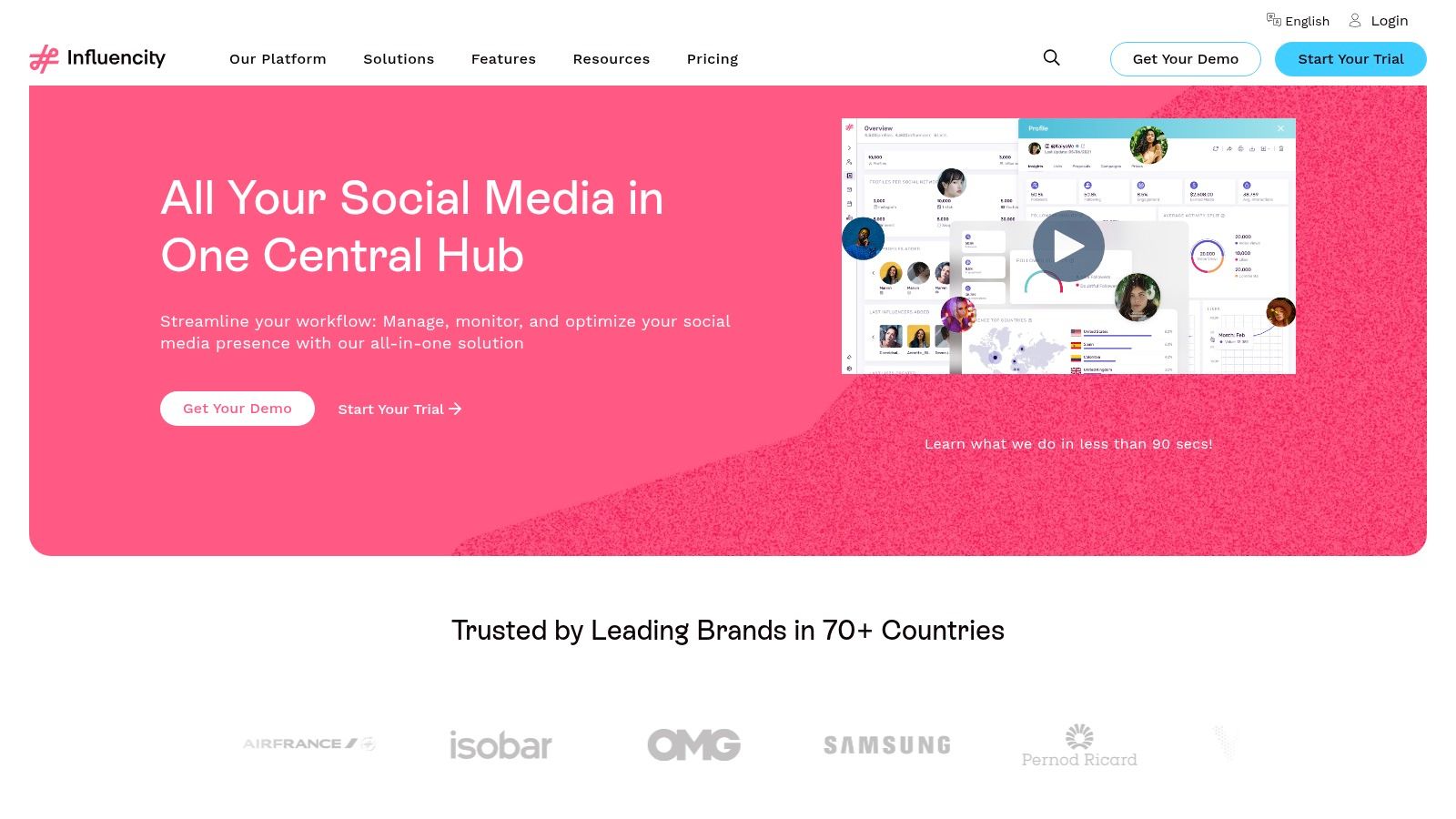
The platform centralizes the entire workflow, from initial influencer search and list building to managing outreach and tracking campaign performance. Key features include a built-in CRM for organizing creator relationships, shareable live reports for stakeholders, and a payments module to handle compensation. This makes it one of the more versatile influencer marketing platforms for teams that want end-to-end control in a single interface.
What sets Influencity apart is its public, tiered pricing model, which provides a clear entry point for smaller businesses while offering the scalability needed for growing programs. While it may not have the deep, custom API integrations or the stringent governance controls found in top-tier enterprise suites, its feature set is more than sufficient for the majority of marketing teams.
Website: https://influencity.com/
Best For:
- Small to mid-sized businesses (SMBs) and agencies needing an all-in-one solution.
- Teams that value transparent, predictable pricing tiers.
- Marketers who manage the entire campaign lifecycle, from discovery to payment.
Pricing:
- Offers public pricing tiers starting from around $168/month (Basic) up to $698/month (Business), with custom plans available for larger needs. Add-ons are available for specific features.
| Pros | Cons |
|---|---|
| Clear public pricing across multiple tiers. | Fewer native enterprise governance and security features. |
| Accessible for smaller teams but scalable to mid-market needs. | Creator database, while large, may not be as extensive as some top-tier incumbents. |
| Comprehensive workflow management in a single interface. | Advanced integrations may require a custom plan or workaround. |
Top 12 Influencer Marketing Platforms Comparison
| Platform | Core focus & features | Best for / Target audience | Key differentiator | Pricing & scale |
|---|---|---|---|---|
| CreatorIQ | Enterprise creator marketing: discovery, governance, end-to-end workflows, deep reporting | Large enterprises, multi‑market teams | Strong governance, SSO/data governance and customizable ROI dashboards | Enterprise pricing; high onboarding |
| GRIN | Creator CRM, product seeding, commerce attribution, storefront integrations | DTC/eCommerce brands running long-term creator programs | CRM-style relationship management + seeding workflows for commerce | Mid→enterprise pricing; geared to serious programs |
| Upfluence | Cross-network discovery, AI-driven insights, affiliate & sales tracking, eComm integrations | Brands combining influencer + affiliate tactics and eCommerce stores | Balanced discovery + performance forecasting and attribution | Custom/premium pricing; mid-market + |
| Aspire (AspireIQ) | Creator Marketplace, full lifecycle workflow, content rights, optional managed services | Consumer brands needing fast sourcing or managed support | Large inbound marketplace + optional done‑for‑you services | Mid→upper market; no public pricing |
| Sprout Social Influencer (Tagger) | Discovery, campaign mgmt, ROI analytics; integrates with Sprout Social suite | Social teams already using or adopting Sprout Social | Unified influencer + social publishing/listening + paid amplification | Enterprise-oriented; best value when bundled |
| Traackr | AI/data-forward discovery, audience authenticity, benchmarking, compliance controls | Data-driven global brands (beauty, CPG, regulated categories) | Rigorous analytics, market benchmarking and compliance features | Mid-market → enterprise pricing |
| impact.com Creator | Unified affiliate + creator marketplace, contracting, payouts, deduplication | Brands blending affiliate and influencer channels | Native bridge between affiliates and creators with mature payments | Enterprise pricing; setup can be heavier (Shopify app for smaller) |
| Later Influence (Mavrck) | Ambassador programs, product seeding, UGC activation, rights repurposing | Brands running always-on ambassador/UGC initiatives | Scales seeding & ambassador motions; part of Later ecosystem | Mid-market and up; pricing not public |
| Captiv8 | Discovery, data science, paid amplification, creator affiliate suite | Brands/agencies needing paid boost + advanced insights | Strong data science + paid media integration; Publicis backing | Enterprise-leaning pricing |
| Meltwater Influencer (Klear) | Discovery with audience checks, Chrome vetting, integrates with media intelligence | PR, social, and earned media teams | Combines influencer analytics with social listening and PR tools | Suite/enterprise pricing |
| HypeAuditor | AI-driven audience authenticity, fraud detection, brand safety, benchmarking | Agencies and brands needing deep vetting and risk reduction | Best-in-class pre-vetting and fraud analytics | Custom pricing; usage-scaled |
| Influencity | Global discovery, outreach/CRM, campaign tracking, shareable reporting | SMBs to mid-market teams needing affordable full-suite | Transparent public pricing and accessible tiers | Public tiered pricing; SMB‑friendly |
Final Thoughts
Navigating the extensive world of influencer marketing platforms can feel like a significant challenge. We've explored a dozen of the top solutions, from enterprise-level powerhouses like CreatorIQ and GRIN to specialized analytics tools like HypeAuditor. Each platform presents a unique combination of features, pricing models, and ideal use cases, highlighting that there is no single "best" option for everyone.
The core takeaway is that the right platform is deeply personal to your organization's specific needs, maturity, and goals. A direct-to-consumer brand focused on product seeding with micro-influencers will find GRIN or Aspire highly effective. In contrast, a global B2B enterprise managing long-term ambassador relationships across multiple regions will likely get more value from the robust, data-driven systems of Traackr or CreatorIQ.
Making Your Final Decision
Your selection process should be a strategic exercise, not just a feature comparison. Before committing, revisit the core questions that define your influencer marketing program.
- What is your primary goal? Are you focused on brand awareness, direct sales, content generation, or building a community? Platforms like impact.com Creator are built for performance-based partnerships, while others excel at content workflow and brand amplification.
- What is your budget? Be realistic. Many of the top-tier influencer marketing platforms represent a considerable financial commitment. If your budget is limited, focus on tools with more flexible or entry-level pricing, or consider if a more specialized tool like HypeAuditor for discovery and vetting is a better starting point.
- How large is your team? A small team might be overwhelmed by a platform designed for a large, multi-departmental organization. Look for intuitive interfaces and strong customer support. Platforms integrated within larger suites, like Sprout Social or Meltwater, might offer efficiencies if your team already uses their other services.
- What does your creator ecosystem look like? Do you work with a few high-profile celebrities or hundreds of nano-influencers? The scale and type of your creator relationships will dictate your needs for discovery, communication, and payment management.
Implementation and Beyond
Choosing a platform is only the beginning. Successful implementation requires a clear plan. Dedicate time for team training, establish standardized workflows within the new system, and set up your measurement dashboards to track the KPIs that truly matter to your business.
Remember that these platforms are tools, not magic wands. Their effectiveness is a direct result of the strategy behind them. The best influencer marketing platforms automate tedious tasks, provide critical data, and organize your program, freeing you up to focus on what humans do best: building authentic relationships with creators. As your program grows and your strategy adjusts, continuously re-evaluate if your chosen platform is still serving you effectively. The perfect tool today might not be the perfect tool two years from now, and that's a normal part of a growing marketing function.
Finding the right partners is the foundation of any successful program. While the tools listed here help you manage those creator relationships, the broader partnership ecosystem includes affiliates, brand ambassadors, and media publishers. To get a complete view of your potential partners and see how your program stacks up against competitors, check out the AffiliateLandscape competitive intelligence platform. It provides unparalleled data on affiliate and partnership programs, helping you discover new opportunities and optimize your strategy.
Ready to explore the affiliate landscape?
Discover networks, tools, and opportunities in our directory.
Explore Directory