
Recruiting the right affiliates is more than just finding people to push your product. It’s about building a powerful, performance-based sales force. This means identifying partners whose audiences perfectly match your brand, creating a commission structure they can't refuse, and using personalized outreach to build real, lasting relationships that fuel scalable growth.
Why Affiliate Recruitment Is Your Best Growth Channel

Stop thinking of affiliate marketing as just another item on your marketing checklist. For savvy businesses, it's a dynamic growth engine. You're essentially building a diverse, motivated, and incredibly cost-effective sales team that works purely on performance. You only pay for actual results, which makes it one of the most efficient channels out there.
Unlike traditional advertising, where you pay upfront for potential reach, affiliate partnerships are rooted in proven trust. These partners—whether they're niche bloggers, industry experts, or popular YouTubers—have already earned their audience's loyalty. So, when they recommend your product, it’s not seen as just another ad; it's a genuine endorsement from a source they trust. That's a level of authenticity paid ads can rarely touch.
Tapping Into New and Engaged Audiences
One of the biggest wins from a solid affiliate recruitment strategy is getting your brand in front of entirely new customer segments. A single, well-chosen partner can introduce you to a dedicated community you might have struggled to reach on your own.
Imagine a brand selling high-performance hiking gear. By partnering with a popular backpacking YouTuber, they can instantly connect with thousands of highly engaged, potential customers who are already looking for what they sell.
This approach helps you build a more resilient and scalable marketing ecosystem. Suddenly, your reach isn't capped by your ad budget or social media following. Instead, it grows with every quality partner you bring into the fold.
The core idea is simple but incredibly powerful: Leverage the trust and authority of others to build your own. An effective affiliate program turns influential voices into a natural extension of your marketing team, driving sales through genuine recommendations.
A Cost-Effective and Scalable Model
The numbers don't lie. The affiliate marketing industry has exploded, with U.S. spending skyrocketing by 49.8% from $9.1 billion in 2021 to a projected $13.62 billion in 2024. That growth is double the pace of e-commerce itself, underscoring just how critical recruiting affiliates has become. In fact, the channel is expected to drive $113 billion in e-commerce sales this year alone.
This performance-based model dramatically lowers your financial risk. You’re not gambling on ad campaigns that might flop. Instead, you're investing in proven sales. As your affiliates succeed, your business grows—it’s a truly symbiotic relationship where everyone wins, making it one of the most sustainable growth channels you can have.
If you're just getting started, you can learn more about the fundamentals in our guide explaining what is affiliate marketing.
Laying the Groundwork for a Winning Recruitment Strategy
Before you even think about sending that first outreach email, the fate of your affiliate recruitment is already being sealed. It all comes down to getting your own house in order. The best partners aren't interested in messy, ill-defined programs; they want to join opportunities that are crystal clear, compelling, and set up for their success from day one.
Think of it as aiming before you fire. Far too many program managers dive headfirst into mass outreach without a solid plan. This just wastes time and, worse, burns bridges with high-potential partners you can't get back. A little bit of thoughtful work upfront—defining who you're after and what you're bringing to the table—will make every recruitment effort that follows exponentially more effective.
Define Your Ideal Affiliate Profile
You can't find the right partners if you don't know who you're looking for. The very first thing to do is create what I call an Ideal Affiliate Profile (IAP). This isn't just about chasing big follower counts; it's about finding genuine alignment between an affiliate's audience and your product.
Your IAP should be a living document that gets specific about the traits of a perfect partner. Think about these factors:
- Content Niche: Do they live and breathe the topics related to your product? If you're selling a project management SaaS tool, you should be hunting for affiliates who are experts in productivity, team management, and business software.
- Audience Demographics: Who are they actually talking to? A direct-to-consumer (D2C) apparel brand trying to reach Gen Z will have a radically different IAP than a brand targeting middle-aged professionals.
- Content Quality and Style: Take a hard look at their content. Does it reflect your brand’s values? You're looking for professionalism, authenticity, and a voice that your ideal customer already trusts.
- Engagement Metrics: Don't get distracted by vanity metrics like subscriber numbers. Dive into their comment sections, see how people interact on their social posts, and ask about newsletter open rates if you can. High engagement is the real gold—it signals a loyal, trusting audience that is far more likely to convert.
For instance, a new B2B SaaS tool's IAP might prioritize bloggers with strong SEO rankings and a highly engaged email list. On the other hand, a D2C apparel brand should probably focus on Instagram influencers and TikTok creators who have high engagement rates and an authentic, personal brand that feels real.
Craft an Irresistible Value Proposition
Once you know who you’re looking for, you need to put an offer on the table they can't refuse. Remember, top-tier affiliates are selective. They get pitched all the time, and their first question is always, "What's in it for me?" Your value proposition has to be competitive, clear, and genuinely compelling.
Your offer is so much more than just a commission rate. It’s the entire package.
The most successful affiliate programs are built on a foundation of mutual benefit. Your offer should not only reward partners for sales but also empower them to create better content and grow their own brands.
Here are the key pieces of a killer offer:
- Competitive Commission Structure: Do your homework. See what your direct competitors are offering. Is a flat fee or a percentage of the sale the norm in your niche? A great move is to offer performance tiers that reward your top partners with higher rates as they grow.
- Cookie Duration: This is a bigger deal than you might think. A longer cookie duration, say 60-90 days, is a huge selling point. It shows affiliates you value their role in the entire customer journey, not just the last click.
- High-Quality Creative Assets: Make their job easy. Provide them with everything they need to hit the ground running—banners, high-res product images, email templates, and even pre-written copy. This not only reduces their workload but also ensures your brand looks good everywhere.
- Dedicated Support: This is a massive advantage. Let them know they’ll have a real person to talk to. A dedicated affiliate manager who can answer questions quickly and provide strategic advice is often the tie-breaker.
Ultimately, your goal is to make it as easy and profitable as possible for affiliates to promote you. When you’re piecing together your offer, don't forget the incredible return this channel can deliver. On average, businesses see a $6.50 return for every $1 spent on affiliate marketing, and some industries like travel can reach a staggering $19:1 ROI. Mentioning this potential can make your program incredibly attractive. You can find more of these powerful affiliate marketing statistics on Firstpromoter.
Before you kick off your recruitment campaign, it’s a smart move to make sure your entire program is structured for success from the ground up. You might find our guide on how to start an affiliate program helpful for that.
Finding and Vetting Your Ideal Affiliate Partners
Alright, you've laid the groundwork for your affiliate program. Now comes the fun part: moving from planning to action and finding the partners who will become genuine advocates for your brand. Think of yourself as a talent scout. You're on the hunt for those hidden gems who have already built the trust and captivated the exact audience you want to reach.
A lot of program managers make the mistake of stopping at affiliate networks, but that’s barely scratching the surface. Your absolute best partners—the ones who can truly move the needle—often aren't even looking for new programs. You have to go out and find them. This means getting a bit creative and knowing what to look for.
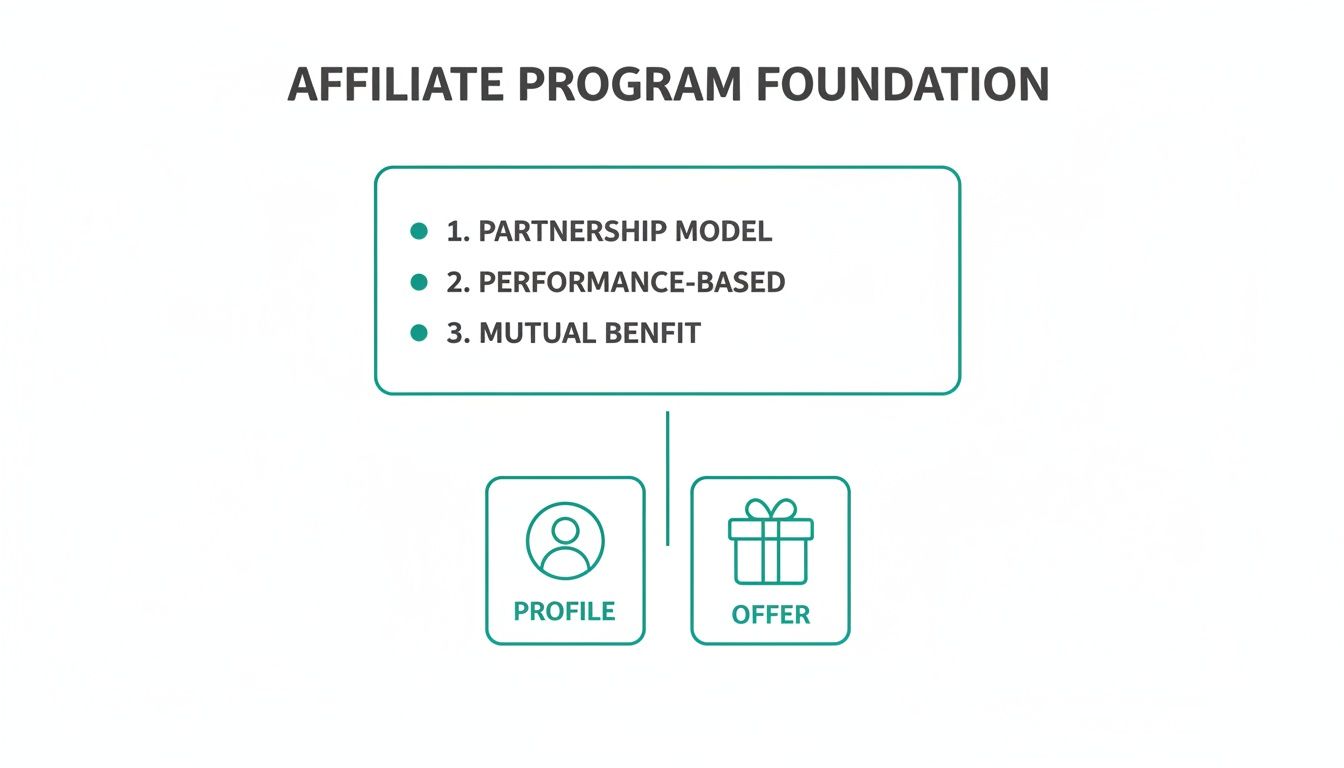
The image above really nails it: a strong program is built on having a crystal-clear affiliate profile and an offer that’s too good to ignore. Get these two pieces right, and your recruitment efforts will be laser-focused from day one.
Choosing Your Recruitment Channels
You can't just post your program on a network and expect A-listers to flock to you. A multi-channel approach is key to building a diverse and resilient partner base. Each channel has its own quirks, and knowing which one to use for what purpose is a skill that separates seasoned pros from beginners.
Here’s a quick breakdown of the most common channels to help you decide where to invest your time.
Affiliate Recruitment Channel Comparison
| Recruitment Channel | Pros | Cons | Best For |
|---|---|---|---|
| Affiliate Networks | Large, pre-vetted pool of publishers; simplifies tracking and payments. | Can be crowded and competitive; often attracts lower-quality partners. | Brands needing to scale quickly and access a wide variety of publisher types. |
| Direct Outreach | Build personal relationships; recruit top-tier partners not on networks. | Extremely time-consuming; lower response rates without a strong brand. | Brands targeting specific, high-value content creators and thought leaders. |
| Social Media | Find influencers and creators with engaged audiences in real-time. | Follower counts can be misleading; requires manual vetting. | D2C brands, especially in visual niches like fashion, beauty, and home goods. |
| Competitor Analysis | Discover proven partners who already understand your market and audience. | Partners may have exclusivity agreements; requires SEO tools and analysis. | Any brand looking for a competitive edge by poaching proven performers. |
| In-app/On-site | Turn your best customers into your most authentic advocates. | Limited to your existing customer base; requires technical setup. | SaaS, subscription services, and brands with a loyal, repeat-customer base. |
Ultimately, a mix is usually best. Start with one or two channels you feel most comfortable with, build out your process, and then expand as you gain momentum.
Uncovering Potential Partners in the Wild
Your best future affiliates are probably already talking about products just like yours. The trick is to find them systematically. Don't just sit back and wait for applications; get out there and build a pipeline of prospects.
Here are a few proven tactics for discovering top-tier talent:
- Spy on Your Competitors: Use SEO tools to see who’s linking to your competitors' affiliate pages or writing reviews about them. These creators have already shown they can drive qualified traffic for similar products.
- Master Google Search: Go beyond basic searches. Use advanced operators like
"best [your product category] tools"or"[competitor name] review"to unearth bloggers and niche sites that already rank for your most important keywords. - Listen to the Social Chatter: Set up alerts on platforms like X (formerly Twitter) and Reddit for conversations about your brand and industry. Who is giving recommendations? Who’s answering questions like an expert? These are your future partners.
- Explore Specialized Directories: Why reinvent the wheel? Platforms built for partner discovery can save you dozens of hours. A great place to start is the AffiliateLandscape leaderboards, where you can find publishers who are already successful in your niche.
How to Properly Vet Your Affiliates
Finding potential partners is only half the battle. The vetting process is where you protect your brand and separate high-value creators from low-quality traffic sources. Rushing this step is a classic mistake that always leads to headaches down the road.
Don't get starstruck by a huge follower count. A partner with 10,000 highly engaged, niche followers is almost always more valuable than one with 100,000 passive ones. Audience alignment and genuine engagement will always trump sheer reach.
Create a simple but non-negotiable checklist to evaluate every single potential partner. This keeps you objective and ensures you’re making data-driven decisions, not emotional ones.
Your vetting checklist should cover these bases:
- Content Quality and Relevance: Is their content well-researched, professional, and a natural fit for your product? A high-quality blogger writes detailed, helpful articles; a low-quality site just lists expiring coupon codes.
- Audience Engagement: Look at the comments on their blog and social posts. Are people asking smart questions? Is the creator actually responding? This is a huge sign of a healthy, trusting community.
- Brand Safety and Alignment: Does their tone and style mesh with your brand’s image? Do a quick scan of their recent content to make sure there are no red flags or weird associations you wouldn’t want your brand tied to.
- Traffic Sources and Methods: Be wary of anyone relying on sketchy promotional methods. You want partners who build real trust, not those who use spammy tactics just to get a click.
Imagine you're a sustainable skincare brand. A fantastic partner might be a blogger with a beautiful site full of in-depth articles on "clean beauty ingredients" and an active Instagram community. A bad-fit partner? A generic coupon aggregator with no original content that just scrapes deals from other sources.
The choice is obvious. By being selective, you build a program that doesn't just drive sales—it builds your brand's reputation.
Writing Outreach Emails That Actually Get Opened
An affiliate's inbox is a battlefield. It’s crowded, competitive, and merciless. If you're sending generic, copy-paste emails, you’re not just getting ignored—you’re getting deleted on sight.
Winning here means crafting outreach that feels like it was written by one human for another. It has to feel personal, offer real value right away, and make saying "yes" the easiest thing they do all day.
Ditch the "ready, fire, aim" spray-and-pray approach. True success in affiliate recruitment comes from a "ready, aim, fire" mindset. That means taking a minute to actually do your homework on a prospect before you ever hit send. It's what separates a welcome partner from a common spammer.
The 3 Ps of High-Converting Outreach
The most effective outreach emails I've ever seen all nail three simple things. Get these right, and I promise your open and response rates will climb.
Personalization: You have to prove you've actually seen their work. Mention a specific blog post, a video you genuinely enjoyed, or a social media update that caught your eye. This single detail proves you’re not a bot.
Proposition: Don't bury the lead. Get straight to what’s in it for them. Lead with the good stuff—your competitive commission rate, an unusually long cookie duration, or a unique perk they won't find elsewhere.
Path: Make the next step ridiculously simple. Don't ask them to fill out a ten-field form or read a dense PDF. Give them one, clear call-to-action, like a direct link to your program's landing page or an invitation for a quick 10-minute chat.
This framework flips the script. It stops being about what you want (a new affiliate) and becomes about what they get (a valuable partnership). That small shift in perspective makes all the difference.
Crafting a Subject Line That Stands Out
Think of your subject line as the gatekeeper. A weak one means your email never even gets a chance. The goal is to be intriguing without being clickbait.
Here are a few angles that consistently work for me:
- Direct & Value-Driven: "Partnership Idea for [Their Blog/Channel Name]"
- Personal & Specific: "Loved your review of [Competitor Product]"
- Question-Based: "Quick question about your work with [Brand Category]"
Whatever you do, avoid generic titles like "Affiliate Program Invitation" or "Collaboration Opportunity." They just scream "mass email."
A great subject line makes a promise that the email body keeps. If you mention their content in the subject, make sure the first line of your email expands on it. This builds instant trust and shows you're authentic.
Proven Email Templates for Different Scenarios
Look, templates are a fantastic starting point, but they're just that—a start. Think of them as a blueprint, not a script. The personalization you add is what breathes life into them.
Example 1: The Cold Outreach to a Top Creator
This is for that high-value blogger or YouTuber who probably gets dozens of pitches a week. You need to show respect for their time and be incredibly concise.
Subject: Partnership Idea for The Savvy Traveler
Body:
Hi Alex,I’m a big fan of your work at The Savvy Traveler. Your recent post on minimalist packing for Southeast Asia was fantastic—especially the tip about solid toiletries.
I'm reaching out because we just launched an affiliate program for our new anti-theft travel backpack, and I think your audience would love it. We offer a 20% commission on all sales and a 90-day cookie duration.
If you're interested, you can see all the details and sign up here: [Link to Affiliate Landing Page]
No pressure at all, but I thought it could be a great fit.
Best,
[Your Name]
Why does this work? It’s short, personal, and gives them everything needed to make a quick decision.
Example 2: The "Warm" Outreach After Engagement
This approach is money. Use it after you've already interacted with a potential partner on social media or in a forum.
Subject: Following up from Twitter
Body:
Hi Sarah,It was great chatting with you on Twitter yesterday about the latest project management tools.
It got me thinking—you mentioned how important team collaboration features are. Our tool, [Your Product Name], was built specifically for that, and we have an affiliate program that pays a 30% recurring commission.
Since your audience is so focused on productivity, it seems like a natural fit. You can check out the program details here: [Link]
Would love to partner up if it feels right to you.
Cheers,
[Your Name]
The Art of the Follow-Up
Here's a hard truth: most affiliates won't reply to your first email. That's completely normal. A smart follow-up strategy is non-negotiable for successful recruitment. The key is to be persistent without being annoying.
Give it 3-5 business days, then reply directly to your original email with a short, gentle nudge. Try to add a new piece of value, like mentioning a recent 5-star review or a new creative asset they could use. Sometimes, a simple, "Just wanted to bring this to the top of your inbox" is all it takes to get a response.
Onboarding Affiliates for a Fast Start
Getting that "yes" from a promising partner feels great, but it's not the finish line—it's the starting gun. The real work begins now. It's not about how many affiliates you sign up; it's about turning those signups into active, motivated partners who actually drive revenue. I've seen it a hundred times: a weak onboarding process is the number one reason new affiliates go quiet and never make a sale.
Those first 30 days are absolutely critical. This is your small window to build momentum, get them excited, and arm them with everything they need for a quick win. Your entire focus should be on one thing: shortening the time it takes for them to get their first click and, ultimately, their first commission check.
Build a Killer Welcome Kit
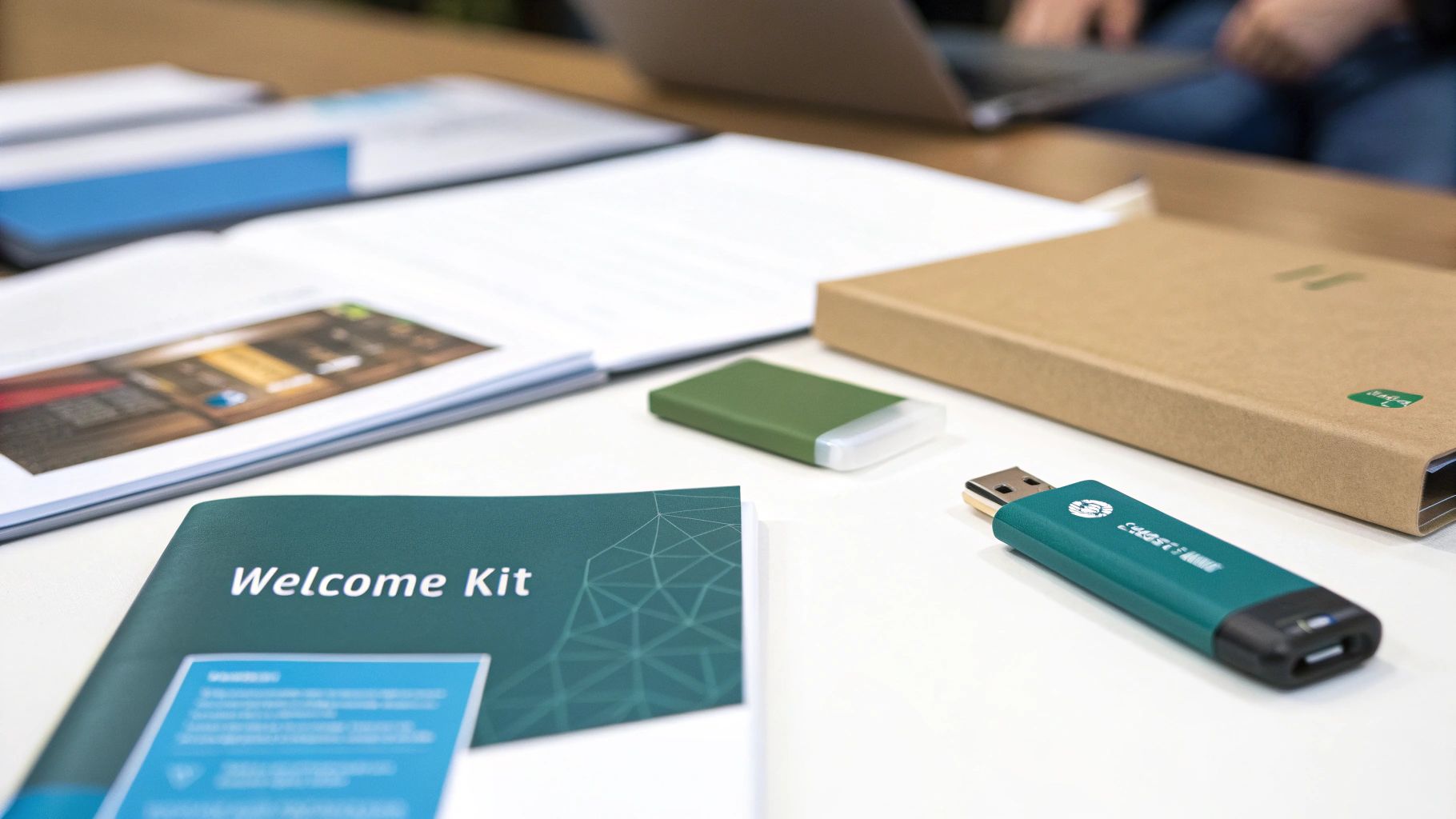
Please, don't just send a welcome email with a tracking link and call it a day. You have to arm your affiliates for success from the very first interaction. A comprehensive digital welcome kit isn't just nice to have; it's a non-negotiable tool for getting partners up and running fast. Think of it less like a folder of logos and more like a strategic asset.
Your welcome kit should be a one-stop shop for everything they could possibly need. Make it logical, clean, and incredibly easy to find what they're looking for.
Here’s what I always include:
- A Welcome Letter from the Affiliate Manager: A short, personal note makes a huge difference. Introduce yourself by name and let them know you're their dedicated point of contact.
- Brand Guidelines: This doesn't need to be a 50-page brand bible. A simple one-pager on your brand voice, logo usage, and key value props is perfect for keeping their messaging on point.
- Top-Performing Creative Assets: Don't make them guess what works. Hand them your best-performing banners, social media images, and email templates that are already proven converters.
- Key Talking Points and Product Info: Give them a cheat sheet. Summarize your product's main benefits, ideal customer, and what sets you apart from the competition. This helps them write compelling content right away.
Automate the First 30 Days
While a personal touch is key, you can't manually hold every new partner's hand. This is where a simple, automated email sequence becomes your best friend. You can set up a drip campaign in just about any affiliate platform that triggers the moment an affiliate is approved, guiding them through their first month.
Your onboarding emails shouldn't sound like a robot. Think of them as a friendly guide, nudging your new partner toward their first success. The goal here is activation, not just information overload.
A smart onboarding sequence prevents overwhelm by breaking the process into bite-sized, manageable steps. It also keeps your program top-of-mind and shows you're genuinely invested in helping them succeed.
Here's a sample four-week email flow that has worked well for me:
| Week | Email Focus | Goal |
|---|---|---|
| Week 1 | Welcome & Quick Start: Send their unique link and point them straight to the welcome kit. | Get them logged in and familiar with the basics. |
| Week 2 | Content Ideas & Top Products: Share a list of popular blog post topics or your best-selling items. | Spark an idea for their first piece of promotional content. |
| Week 3 | Success Story & Pro Tip: Showcase another affiliate's success and share a specific tactic they used. | Motivate with social proof and give actionable advice. |
| Week 4 | Personal Check-in: A simple, plain-text email asking, "How's it going? Any questions?" | Open the door for one-on-one communication and feedback. |
The Power of a Personal Welcome
Automation is for efficiency, but a personal touch is for building real relationships. As soon as a high-potential affiliate joins, their designated manager should send a one-to-one email or, even better, schedule a quick 15-minute welcome call. This single action can dramatically boost a partner's long-term engagement.
Use that call to answer their specific questions, learn more about their audience, and brainstorm a few campaign ideas together. It immediately transforms the relationship from transactional to a genuine partnership. This proactive approach signals that you see them as a valuable collaborator, not just another number in your dashboard. By investing this time upfront, you're setting the stage for a profitable, long-lasting relationship.
Scaling Your Recruitment Engine and Managing for Growth
Getting your first few dozen affiliates on board is one thing, but that initial hustle won't carry you forever. Real, sustainable growth comes from shifting your mindset from one-off recruitment campaigns to building a well-oiled machine. As your program grows, you have to move from manual, one-to-one outreach to creating systems that bring in quality partners on autopilot.
It’s about building a program that grows without you having to personally approve every single applicant.
From Manual Hustle to Automated Growth
One of the best ways I've seen this done is by turning your happiest customers into your best affiliates. Think about it—these are people who already know, love, and use your product. They're your most authentic advocates. You can set up an automated invitation right inside your product or on the post-purchase page that prompts loyal customers to join your program. This creates a powerful, self-sustaining loop fueled by genuine excitement for your brand.
Another key to scaling is tapping into the power of affiliate networks. While hunting down A-list partners yourself is great for building those key relationships, networks give you instant access to thousands of publishers who are actively searching for new programs. We've got a whole guide on the best affiliate marketing platforms that can help you find the right one for your niche. This strategy lets you pump up the volume while using the network's own vetting tools to maintain quality.
Keeping Your Partners in the Game
Signing up an affiliate is just the beginning. The real work is in keeping them active and engaged, because an affiliate who isn't promoting you is just a name on a list. Retention is what creates that steady, predictable revenue stream you're after.
A simple but surprisingly effective tool for this is a regular, value-packed newsletter. And I don't mean just sending out payment notifications. Make it something they actually want to open.
Here’s what to include:
- Fresh Creative: "Hey, we just dropped a new set of high-converting video ads you can use."
- Product News: Keep them in the loop about new features they can promote.
- Quick Wins: Share a performance tip or a case study they can learn from.
- Success Stories: Showcase a top-performing partner. This not only gives them props but also shows everyone else what's possible.
This kind of consistent contact shows you're invested in their success. It makes them feel like a real partner, not just a number.
I see this mistake all the time: program managers treat every affiliate the same. You can’t. Segment your partners. Your top 10% need a different kind of support and communication than the hundreds of smaller affiliates just getting started.
Motivate and Mobilize with Performance Tiers
If you want to truly scale your program's output, you need to build motivation right into its structure. Performance tiers are a brilliant way to do this. You basically gamify the whole thing.
Create a few levels—think Bronze, Silver, and Gold—and automatically reward partners with better commission rates or exclusive bonuses when they hit certain revenue or sales targets.
This structure does two things beautifully. It gives your newer affiliates a clear roadmap for what they can achieve, and it keeps your top dogs engaged by rewarding them for their hard work. It’s a classic win-win that encourages everyone to push a little harder, driving more revenue for your business with far less hands-on effort from you.
Affiliate Recruitment FAQs: Answering the Tough Questions
Even the best-laid plans run into real-world questions once you start recruiting. I've seen program managers get stuck on these same hurdles time and time again. Getting them right from the start can save you a ton of headaches and get your program growing faster.
Here are the answers to the questions that pop up most often.
What’s a Good Commission Rate to Offer?
There's no universal "right" answer here. The number that works for you is a balancing act between your industry, your profit margins, and what your competitors are doing. The first thing you should always do is some competitive intelligence to see what similar brands are offering.
As a general rule of thumb, digital products have the wiggle room for much higher rates, often in the 20-40% range. For physical products with tighter margins, you'll typically see commissions between 5-15%.
A competitive commission is your hook, but it's not the whole story. I've seen top affiliates choose a program with a slightly lower rate because it offered a longer cookie duration (60-90 days), had a killer conversion rate, and provided genuinely helpful support. The whole package matters.
How Many Affiliates Do I Really Need?
Forget about vanity metrics. It’s all about quality over quantity, especially when you're just getting off the ground. The 80/20 rule is almost always in effect here: you can bet that 80% of your affiliate-driven revenue will come from the top 20% of your partners.
Instead of chasing hundreds of signups, focus your energy on recruiting 10-20 fantastic, highly-aligned partners. Work closely with this core group, nail down your onboarding process, and figure out what makes them successful. Once that system is humming, you can confidently hit the accelerator on recruitment.
Should I Accept Every Affiliate Who Applies?
Definitely not. This is one of the biggest mistakes a new program manager can make. An open-door policy might fill your roster quickly, but it also invites brand safety risks and devalues your program in the eyes of serious affiliates.
Every single applicant needs to be measured against the Ideal Affiliate Profile you built earlier. Does their content align with your brand? Is their audience genuinely engaged? Rejecting partners who aren't a good fit isn't rude—it's a critical part of building a high-performing program that top-tier talent wants to join. It protects your brand and focuses your resources where they'll have the biggest impact.
Discover, vet, and connect with your next top-performing partners faster with AffiliateLandscape. Explore our definitive directory of the affiliate ecosystem at https://affiliatelandscape.com.
Ready to explore the affiliate landscape?
Discover networks, tools, and opportunities in our directory.
Explore Directory