

If you want to become a successful affiliate, you have to move beyond just grabbing links and hoping for the best. The real secret is a smart mix of picking the right niche, earning your audience's trust, and creating content that genuinely helps people. At the end of the day, you're a problem-solver, and your income is a direct result of how well you guide your audience to the right solutions.
Laying the Groundwork for Affiliate Success
Before you even think about earning your first dollar, the most important work happens behind the scenes. This isn't about chasing quick wins; it's about building a solid foundation for a real business. Forget the fuzzy advice to "follow your passion." A successful affiliate thinks like an entrepreneur, and that means focusing on two critical pillars: choosing a profitable niche and finding partners you can count on.
How to Choose the Right Niche
Your niche is your corner of the internet—the specific industry or topic you'll own. It dictates who you're talking to, what you'll promote, and every piece of content you create. While being interested in the topic keeps you from burning out, profitability is what keeps the lights on. The perfect niche is a sweet spot where your interest, audience demand, and money-making potential all meet.
Picking the right market is a huge deal. Just look at the data: the fashion industry alone makes up 23.7% of all affiliate niches. That tells you that zeroing in on high-demand areas can seriously pay off.
When you're vetting a potential niche, ask yourself these questions:
- Is anyone actually looking for this? You need a big enough audience actively searching for products or information. Use keyword research tools to see if the search volume is there.
- Can I actually make money here? A passionate audience is great, but if there are no quality affiliate programs or products to promote, it’s just a hobby, not a business.
- How crowded is the field? A little competition is a good sign—it means there's money to be made. But diving into a super-saturated market as a beginner is a tough climb. Look for a niche where you can bring a unique perspective.
This entire groundwork phase really boils down to three steps: find your niche, find your partners, and then start building your platform.
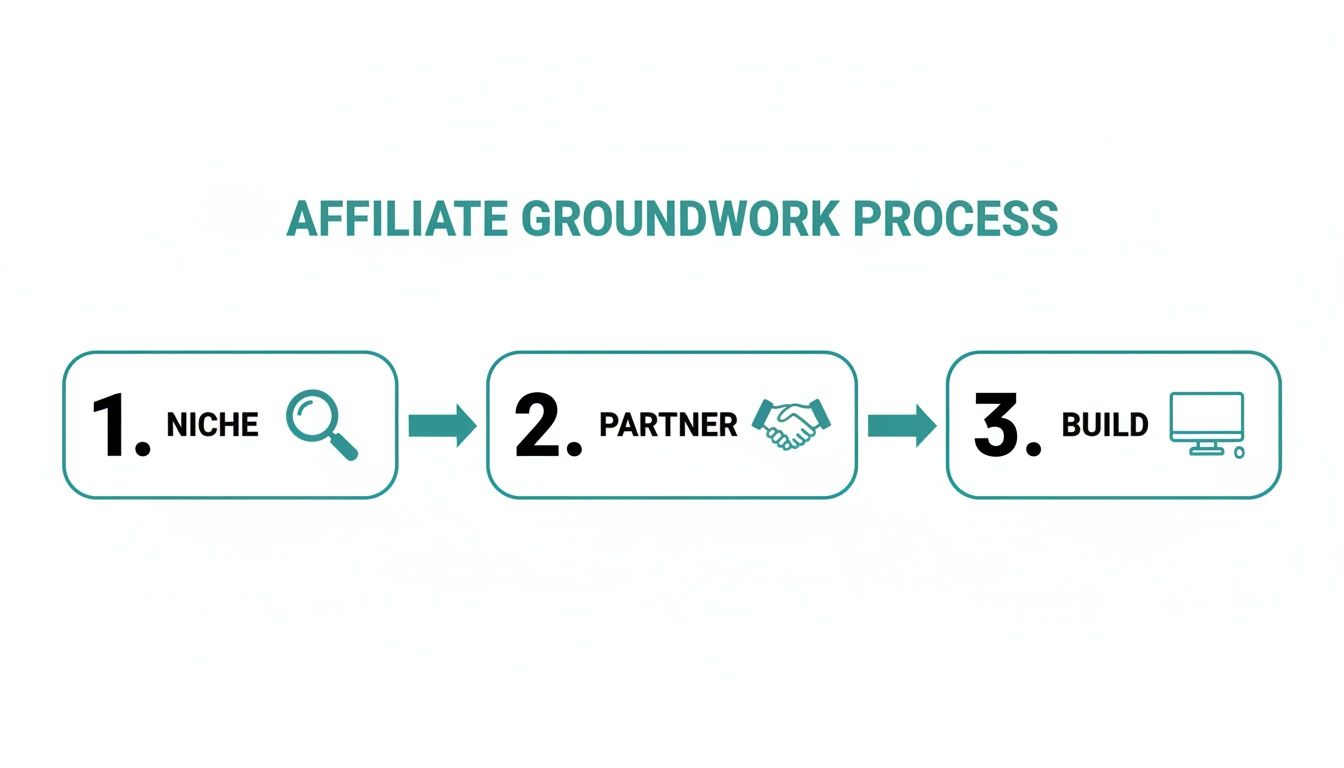
As the chart shows, each step builds on the one before it. That’s why getting these early decisions right is so crucial for your long-term success.
Finding and Evaluating Affiliate Partners
Once you've settled on a niche, it's time to find companies to team up with. You can discover affiliate programs through large networks, specialized platforms, or even by reaching out to your favorite brands directly. These partners are incredibly important because their products and their reputation are about to be tied to yours.
Choosing a partner is like choosing a business co-founder. Their reliability, product quality, and commission structure directly impact your bottom line and your audience's trust. A bad partnership can damage your reputation faster than a bad piece of content.
This is where a little research goes a long way. Before you jump into a partnership, it's a good idea to understand the fundamentals of the business model. You can get a solid overview by reading up on what affiliate marketing is and how the moving parts fit together.
When you’re ready to evaluate a potential partner, look past the flashy commission rate. The details are what matter. Here's what to dig into:
- Commission Structure: Is it a one-time payout or a recurring commission? Promoting a high-ticket software might give you a big one-time payment, but a subscription service could provide a steady, predictable income stream month after month.
- Cookie Duration: This is the time window after someone clicks your link where you're still eligible for a commission. A longer cookie duration—think 30, 60, or even 90 days—is always in your favor.
- Payment Reliability: A high commission means nothing if you have to chase down your money. Do some digging and check the program's reputation. Do they pay their affiliates on time, every time?
- Partner Support: Does the program give you the tools to succeed? Look for things like marketing assets, a dedicated affiliate manager, and clear communication. Good partners invest in your success because it’s also their success.
Thinking through your niche and potential partners with this level of detail is the difference between a hobby and a resilient business built for growth.
The table below breaks down how your thinking should shift when you're looking at your overall niche versus a specific program within it.
Niche vs. Program Selection Criteria
| Factor | Niche Selection (Your Focus) | Program Selection (Partner's Offer) |
|---|---|---|
| Audience | Broad interest, search volume, and demographic size | Alignment with your specific audience's needs and pain points |
| Profitability | Overall market size and average product price points | Specific commission rates, EPC (earnings per click), and payout terms |
| Competition | Your ability to stand out against established players | The number of other affiliates promoting the same offer |
| Longevity | Is the topic evergreen or a fleeting trend? | Company reputation, product quality, and long-term viability |
| Resources | Your personal expertise and ability to create content | The quality of marketing materials and support provided by the partner |
Ultimately, choosing a great niche gives you a field to play on, but picking the right partners gives you the all-star team you need to win. Both are essential for building a business that lasts.
Creating Your Home Base and Earning Trust
Think of your platform as your digital storefront. It's the space where you connect with your audience, share your expertise, and make recommendations. This isn't just about slapping affiliate links on a generic website; it's about building a genuine brand that people actually trust. Without a platform, your affiliate links are just random noise. With one, they become trusted advice from a go-to expert.

The platform you choose will shape your entire content strategy. The trick is to pick the medium that feels natural for your niche, matches your personality, and, most importantly, is where your ideal audience already hangs out. With over 80% of brands running affiliate programs, there's a massive opportunity on every channel if you just align your strengths correctly.
Choosing Your Primary Platform
Don't try to be everywhere at once. It's a classic rookie mistake. Becoming a master of one platform is way more powerful than spreading yourself thin across three or four.
Let's break down the big three options for affiliates:
A Blog or Niche Website: This is the ultimate long-term asset. You own it completely—the content, the design, the audience data. It’s perfect for detailed product reviews, in-depth "how-to" guides, and comparison articles that attract people who are actively searching for solutions and ready to buy. The SEO benefits can pay off for years.
A YouTube Channel: Video is a powerhouse for showing, not just telling. It's fantastic for product demonstrations, software walkthroughs, or anything where a visual makes all the difference. Building a personal connection is much easier on video, and YouTube's search engine is often less cutthroat than Google's, offering a solid path to getting discovered.
Social Media (Instagram, TikTok, Facebook Groups): These channels thrive on visual niches like fashion, home decor, or beauty. Success here is all about building a vibrant community and creating snappy, engaging content. The big catch? You don't own your audience. A simple algorithm change can crush your reach overnight, which is a risk you always have to keep in mind.
Your platform is more than a place to post links—it’s the foundation of your authority. Pick a medium you genuinely enjoy using. If you hate writing, don’t start a blog. If you’re shy on camera, YouTube will feel like a chore. That passion (or lack of it) will come through in your content.
Getting the Setup Right
Once you've picked your channel, nailing the initial setup is critical. Getting the technical stuff sorted out from day one will save you a world of headaches later on and lay a solid foundation for growth.
For a blog, this means picking solid web hosting and a clean, lightweight theme. Don't get bogged down with a million bells and whistles; speed and a simple user experience are what really matter. For a more detailed walkthrough, our complete guide on how to start affiliate marketing has you covered.
If you’re going the YouTube route, spend time optimizing your channel page. A sharp banner, a keyword-rich description, and organized playlists make you look professional from the start.
The Value-First Content Strategy
Here’s the biggest secret in affiliate marketing: it’s not about selling. The most successful affiliates know that commissions are a byproduct of trust, and trust is built by giving away massive value, for free, upfront.
Your content mix should be something like 90% pure value and only 10% direct promotion.
What does "value-first" actually look like?
Solve a Real Problem: Create content that directly answers your audience's most pressing questions. In the home coffee niche? Don't just post a review of the Breville Barista Express. Make a video titled "How to Pull the Perfect Espresso Shot" or write a guide on "5 Common Latte Art Mistakes and How to Fix Them."
Share Your Experience: People connect with stories, not spec sheets. Document your own journey with a product. Show the good, the bad, and the ugly. Sharing the results you got, the hurdles you faced, and your honest takeaway is incredibly persuasive.
Be Brutally Honest: Don’t be afraid to point out a product's flaws. Explaining who a product is perfect for—and who should absolutely avoid it—builds way more credibility than a gushing, one-sided review ever could. That honesty makes your final recommendation a hundred times more believable.
This approach transforms you from a pushy salesperson into a trusted advisor. When you consistently show up with helpful, honest information, your audience will want to support you by using your links when they’re finally ready to make a purchase. That’s the key to a sustainable, long-term affiliate business.
Creating Content That Actually Drives Clicks

Your content is the heart of your affiliate business, and the traffic it attracts is the lifeblood. It's not enough to just publish articles. You need to create pieces that genuinely help people, solve their immediate problems, and then guide them toward the right solution. This is how you shift from being just another site dropping links to becoming a trusted advisor whose recommendations actually mean something.
The most successful affiliates I know don't reinvent the wheel every time they write. They lean on a handful of proven content formats that align perfectly with what people are searching for when they're on the verge of buying something. Mastering these gives you a repeatable playbook for earning clicks and, ultimately, commissions.
Crafting High-Converting Content Formats
Instead of throwing spaghetti at the wall to see what sticks, focus your energy on content types with a track record of success. Each one plays a specific role in nudging a potential customer closer to a decision.
Here are a few of the heaviest hitters:
- In-Depth Product Reviews: This is your chance to go way beyond the manufacturer's spec sheet. Get personal. Share what you loved, what you hated, and who it's truly for. A brutally honest review that clearly states who shouldn't buy a product builds an incredible amount of trust.
- Comparison Posts: Pit two popular products head-to-head. "Product A vs. Product B" articles are gold for buyers who are stuck in the final stages of their decision-making process. I always use tables to compare features side-by-side—it makes the information easy to scan and digest.
- "How-To" Tutorials: Show, don't just tell. A step-by-step guide on how to solve a common problem is the perfect place to naturally recommend a product that makes the process easier. For example, a tutorial on "How to Set Up Your First Podcast" is the ideal spot to recommend a specific microphone or hosting service you've used and liked.
- Personal Case Studies: Nothing converts better than proof. Share your own journey and the tangible results you got from using a product. Showing how you used a particular software to achieve a specific, measurable outcome is far more powerful than any sales pitch.
The golden rule is simple: value first, promotion second. Your primary goal has to be solving the reader's problem. When you do that well, recommending a product as part of the solution feels helpful and organic, not pushy.
Think about it: if you're in the WordPress hosting niche, an article titled "Why Is My Website So Slow?" can naturally lead into a recommendation for a faster hosting provider. You’ve addressed their pain point head-on before ever mentioning a product. This approach is what separates the top 1% of affiliates from everyone else.
Driving Targeted Traffic to Your Content
Creating brilliant content is only half the job. Now, you have to get it in front of the right eyeballs. Relying on a single source of traffic is a recipe for disaster. A smart affiliate builds a resilient business by diversifying their channels from the start.
Pick one or two of these to master first, then branch out as you gain confidence.
- Search Engine Optimization (SEO): SEO is all about getting your content to the top of Google. It’s a long-term strategy, for sure, but it delivers the best kind of traffic—people who are actively looking for the very solutions you’re offering.
- Social Media Engagement: Don't just blast your links into the void. Find relevant Facebook Groups, subreddits, or niche communities on platforms like Instagram. Answer questions, offer real advice, and become a familiar, helpful face.
- Email Marketing: Your email list is the single most valuable asset you can build because you own it. Offer a genuinely useful freebie, like a checklist or a short ebook, to encourage sign-ups. This gives you a direct line to your most engaged audience, completely independent of any platform's algorithm.
A Foundational Approach to SEO
For most affiliates, SEO is the key to sustainable, long-term traffic. It can feel overwhelming, but the fundamentals are straightforward and incredibly powerful.
- Keyword Research: First, you have to figure out what your audience is actually typing into the search bar. Focus on "solution keywords" like "how to fix a leaky faucet" instead of just product names. These terms attract people who have a problem and are actively seeking a solution you can provide.
- On-Page Optimization: This is just about making it obvious to Google what your page is about. Make sure your main keyword shows up naturally in your post title, in the first paragraph, and in a few of your subheadings.
- User-Friendly Content: Write for humans, not robots. Use short paragraphs, clear headings, bullet points, and images to break up the text. When people stick around on your page longer, it sends a strong signal to Google that your content is valuable, which can give your rankings a nice boost.
By combining high-value content with a smart, multi-channel traffic strategy, you build a far more stable and profitable affiliate business. You stop waiting for clicks and start creating a system that attracts the right people and earns their trust. This is the blueprint for long-term success.
Turning Your Traffic Into Real Revenue
Getting people to your site is one thing. Actually making money from that traffic? That's a whole different ballgame. This is where you stop being just a content creator and start thinking like a conversion specialist.
The goal is to turn your recommendations into the obvious next step for your audience, not a pushy sales pitch. This whole process is often called Conversion Rate Optimization (CRO), and it’s how you squeeze every last drop of value out of the traffic you’ve worked so hard to get. Honestly, it's the single biggest difference between making pocket change and building a real, sustainable business.
Where You Place Your Links Matters (A Lot)
You can't just sprinkle affiliate links around and hope for the best. Where and how you place them can make or break your click-through rates. It needs to feel natural and genuinely helpful to the reader.
Think strategically about where a link makes the most sense.
- Up Top and Obvious: Someone landing on your page is looking for a solution now. Don't make them dig for it. Place a link in the first couple of paragraphs to catch those ready-to-buy visitors.
- Woven into the Story: Integrate links right into your sentences. Instead of a generic "click here," make your anchor text descriptive. For example, "my go-to choice is this lightweight tent for solo hiking."
- Clickable Visuals: People's eyes are naturally drawn to images. Make your custom product photos or graphics clickable affiliate links—they get a ton of action.
- The Power of Tables: Comparison tables are conversion gold. Lay out the features of a few products side-by-side and include a clear "Check Price" or "See on Amazon" button (with your link!) for each one.
Your call-to-action (CTA) needs to be just as thoughtful. Weak CTAs get ignored. Be direct and show the reader what’s in it for them. Skip "Buy Now" and try something like, "See Today's Price and User Reviews" instead. It tells them exactly what to expect and feels much less aggressive.
Trust Is Everything, So Be Transparent
In this business, your reputation is your most valuable asset. A huge part of that is being upfront about your affiliate relationships. It's not just good ethics; the Federal Trade Commission (FTC) legally requires it.
An affiliate disclosure isn’t just a legal box to tick—it’s a trust signal. When you’re open about earning a commission, you’re telling your audience you have nothing to hide and you stand by your recommendations.
Pop a clear, simple disclosure right at the top of any page with affiliate links. Something as straightforward as, "Heads up: This post contains affiliate links. If you buy something through one of these links, I may earn a small commission at no extra cost to you." That one sentence builds massive credibility. When people know you're being straight with them, they're far more likely to trust your advice.
Know Your Numbers: The KPIs That Drive Growth
If you want to earn more, you have to know what's working. Successful affiliates treat their sites like a business, and that means tracking Key Performance Indicators (KPIs).
You don't need a thousand different metrics, but you absolutely have to watch these two:
- Conversion Rate: This is simply the percentage of people who click your link and then complete an action (usually, making a purchase). If 100 people click and 3 of them buy, your conversion rate is a solid 3%.
- Earnings Per Click (EPC): This is your bottom line. It shows you, on average, how much money you make every single time someone clicks one of your affiliate links. Just divide your total commission earned by the total number of clicks.
Tracking these numbers is like getting a report card for your content. You might discover that a super-detailed review post has an EPC that's five times higher than a simple listicle. That’s your sign to double down on what’s actually making you money.
Thankfully, most of the best affiliate marketing platforms give you a dashboard to monitor all of this. Getting comfortable with this data is how you stop guessing and start systematically growing your income.
Scaling Your Affiliate Business for the Long Term
There's a point where your affiliate work stops feeling like a side hustle and starts looking like a real business. This is where your thinking has to shift. You're no longer just chasing individual commissions; you're building sustainable systems for long-term growth.
This is the transition from content creator to CEO. Your focus moves to strategic decisions that expand your reach and secure your financial future. The secret? Intelligently reinvesting your profits back into the business. Those early earnings aren't just for you—they're the fuel for your growth engine.
Smart Ways to Reinvest Your Profits
So, where do you put that hard-earned cash for the biggest impact? It's simple: find your biggest bottlenecks and pay someone else to handle them. This frees you up to work on the business, not just in it.
Here are a few of the most effective places to reinvest:
- Outsourcing Content Creation: You can't write, film, and edit everything yourself forever. Bringing on skilled freelance writers or video editors lets you pump out way more content without hitting burnout.
- Investing in Premium Tools: That free SEO plugin got you started, but professional-grade tools for analytics, SEO, and email marketing provide the kind of data and efficiency that give you a serious leg up on the competition.
- Running Paid Ad Campaigns: Have a piece of content that converts like crazy? Pouring some money into targeted Facebook or Google ads can be like throwing gasoline on a fire, driving a massive amount of qualified traffic exactly where you want it.
Reinvesting isn't an expense; it's an investment in your own efficiency and growth. Every dollar you put back into your business should be aimed at buying back your time or accelerating your results.
Diversify to Protect Your Income
Relying on a single affiliate program is one of the biggest—and most common—mistakes you can make. What happens if they slash their commission rates, discontinue a popular product, or just shut down their program overnight? Suddenly, your income vanishes.
A smart affiliate business is built on a diverse portfolio of income streams. Make it a priority to partner with several non-competing brands in your niche. Not only does this protect your revenue, but it also gives your audience more options, which builds your authority.
You can explore our directory of affiliate networks and platforms to find thousands of potential partners to add to your roster.
Negotiate for Higher Commissions
Once you're consistently driving high-quality traffic that actually converts, you’re no longer just another affiliate. You’re a valuable partner. This is when you've earned the right to ask for a raise.
Don't be shy about approaching your affiliate manager, but come prepared with a data-backed case.
- Gather Your Data: Pull a report showing your monthly traffic, conversion rates, and total sales volume. Numbers don't lie.
- Highlight Your Value: Point to the quality of your content and the engagement of your audience. Show them why your traffic is so good.
- Make a Specific Ask: Propose a concrete commission increase based on your performance. For example, asking for a bump from 10% to 15% is a perfectly reasonable request for a top performer.
The worst they can say is no. But if they say yes, you've just increased your revenue without needing a single extra click. Brands are often more than willing to offer better payouts to keep their top affiliates happy—and to keep them from promoting a competitor instead.
New Affiliates Always Ask...
If you're just getting into affiliate marketing, you've probably got a ton of questions. That’s completely normal. The path isn't a straight line, and it's smart to wonder about how long it takes, what you can earn, and where the common landmines are hidden. Let's tackle the questions I hear most often from people starting out.
What's a Realistic Income?
This is always the first question, and the honest answer is: it's all over the map. There's no "average" salary in a performance-based world. Your income is a direct result of the niche you choose, the quality of your audience, and how well you connect the two.
A beginner, after getting their feet wet and finding some traction, might see a few hundred dollars a month. Affiliates who have put in the time to build a real audience and a solid system can absolutely pull in several thousand. And yes, the top-tier folks, the ones who treat this like a real business, can hit five or even six figures a month.
The most important thing to remember is that every single one of those top earners started at zero. Your income is just a reflection of the trust you've built and the value you provide. Nail those, and the money follows.
Ultimately, your earning potential is tied directly to the results you drive. No more, no less.
How Long Until I Actually Make Money?
If there’s one skill new affiliates need, it's patience. Building a real, sustainable income from affiliate marketing is a marathon, not a sprint. If you're going the organic route with SEO and content, you should realistically give yourself a good 6 to 12 months of consistent effort before you see any kind of predictable income.
Why so long? A few reasons:
- You need an audience. People don't just show up. It takes time to attract a loyal group who actually listens to what you have to say.
- Content is an asset. A deep library of genuinely helpful content is what fuels your business, and that simply can't be created overnight.
- Authority isn't given, it's earned. It takes time for search engines like Google to see your site as a credible resource worth ranking.
Sure, you can try to shortcut this with paid ads, but that's a different game entirely. It comes with a hefty price tag and a steep learning curve. The organic approach is slower, but you're building a real, long-term asset that can pay dividends for years.
What are the Biggest Mistakes People Make?
I see new affiliates fall into the same traps time and time again. If you can sidestep these common mistakes, you'll be miles ahead of the pack.
One of the biggest blunders is picking a niche based only on personal passion, without checking if people actually spend money there. Another classic mistake is promoting a random jumble of products. This just confuses your audience and makes you look like a walking billboard, not a trusted advisor.
Many newcomers also get the formula backward—they try to sell, sell, sell instead of helping first. But maybe the most critical error is not building an email list from day one. Relying 100% on Google or a social media platform means your entire business can be torpedoed by a single algorithm update. Your email list is the only traffic source you truly own. Oh, and failing to disclose your affiliate links? That’s a huge one. It destroys trust and can get you in hot water with the FTC.
Is a Website Absolutely Necessary?
The classic blog or niche website is still the gold standard for a reason, but it's not the only way to win. I know plenty of successful affiliates who have built their entire business on other platforms.
- YouTube: Perfect for anyone who can demonstrate products, do tutorials, or create visual reviews.
- Social Media: If you're in a visual niche like fashion, home decor, or fitness, channels like Instagram or TikTok can be incredibly effective.
- Email Newsletters: Some of the sharpest affiliates I know run their entire operation from a highly-focused, value-packed newsletter.
The right platform is wherever your audience hangs out. That said, a website gives you the ultimate control. You own the asset, you control the user experience, and you're not at the mercy of another company's rules. It's the most stable foundation you can build on.
Ready to find the perfect partners for your new affiliate business? AffiliateLandscape is the definitive directory for discovering thousands of networks, platforms, and brands. Start building your partnership portfolio today.
Ready to explore the affiliate landscape?
Discover networks, tools, and opportunities in our directory.
Explore Directory