

You’re in one of two situations.
You’ve either inherited an affiliate channel and keep hearing “let’s launch on cj affiliate,” or you’re a publisher trying to understand whether CJ is a serious revenue opportunity or another dashboard to learn. Both situations create the same problem. The platform sounds established and important, but the mechanics can feel opaque until you’ve seen how the pieces fit.
That’s normal.
Most first-time explanations of cj affiliate jump straight into feature lists. They tell you there are links, tags, reports, and publishers. They don’t explain why those tools matter strategically, or how a merchant and a publisher experience the same ecosystem from opposite sides.
A better way to think about CJ is this. It’s not only software. It’s a structured marketplace with tracking, rules, partner discovery, and payment workflows built in. If you’re a brand, it gives you a way to recruit and manage partners without building the whole system yourself. If you’re a publisher, it gives you access to advertisers, tracked links, and a standard process for earning commissions.
That combination is why cj affiliate keeps showing up in serious program discussions.
Your Introduction to the CJ Affiliate Ecosystem
A new ecommerce manager is asked to grow revenue without adding more paid media spend. At the same time, a publisher with a loyal audience wants brand partners, reliable tracking, and a payment process that does not depend on a dozen separate contracts. They are solving different problems, but they need the same system.
Affiliate networks sit in the middle of that relationship. They provide the shared infrastructure: partner applications, tracking links, approval workflows, commission rules, and payment handling. If you are still getting oriented, this guide to how affiliate networks work gives useful context before you evaluate CJ specifically.
CJ has played that role for years, which is why it appears so often in serious partner program discussions. For merchants, a mature network can shorten the time it takes to find partners, set terms, and start measuring results. For publishers, it can widen access to advertisers across multiple categories without rebuilding the same process for each brand relationship.
That scale matters strategically. A larger network does not automatically mean a better program, but it does change your options. A merchant can be more selective about publisher recruitment and commission design. A publisher can compare programs, approval standards, and earnings models inside one ecosystem instead of treating each advertiser as a separate sales process.
This is also the point where marketers new to the channel get confused.
They hear "affiliate" and assume the whole model revolves around coupon sites or last-click conversions. In practice, CJ can support several partner types, including editorial publishers, creators, loyalty partners, review sites, and technology partners. The actual task isn't joining the network and turning everything on. Instead, it's choosing which partner mix fits your margin structure, sales cycle, and customer acquisition goals.
That is the lens for the rest of this article. The question is not only what CJ includes. The more useful question is what those features let a merchant or publisher do, where the tradeoffs show up, and how to verify whether CJ is the right fit by using a discovery platform to assess the network and identify partners inside its ecosystem.
What Is CJ Affiliate and How Does It Work
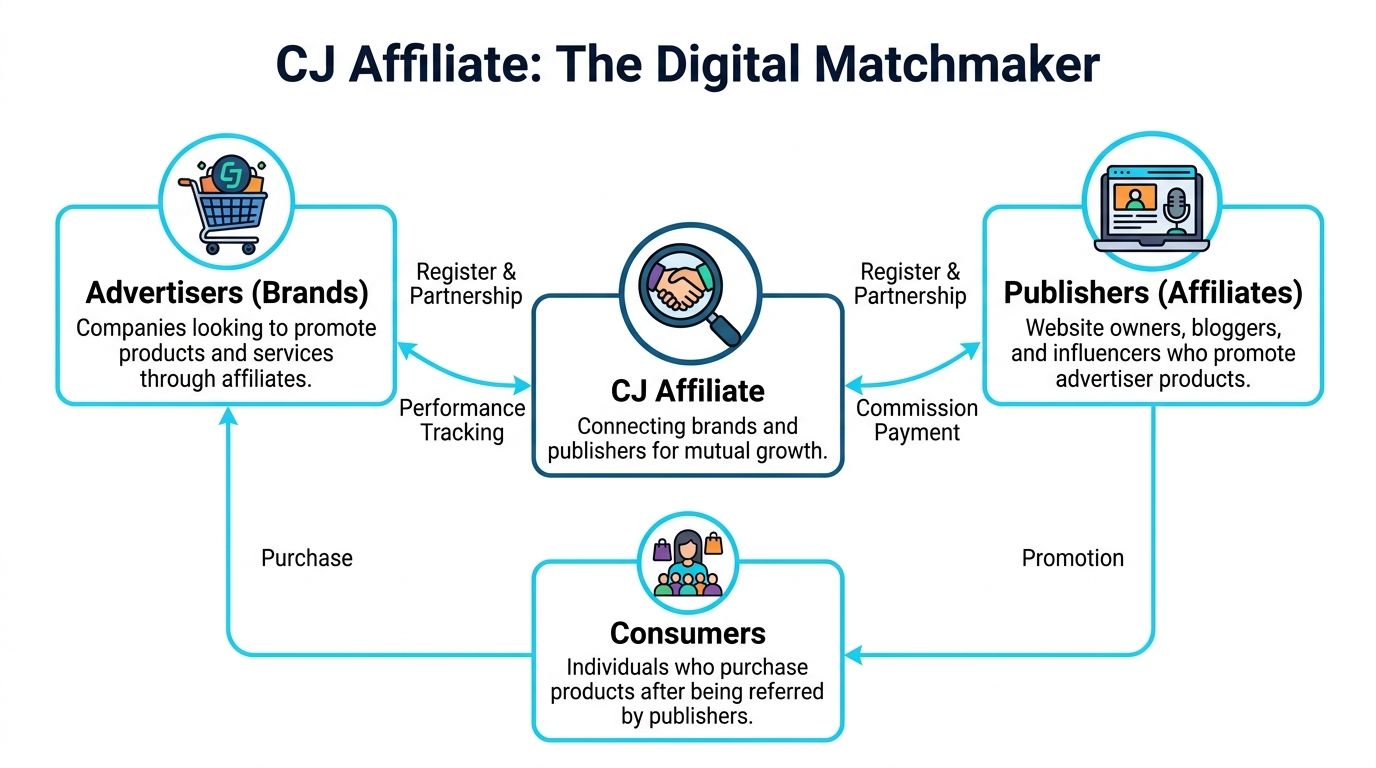
CJ Affiliate is the system that connects advertisers with approved publishers, tracks the actions those publishers influence, and helps make sure commissions are recorded and paid correctly.
A merchant joins CJ to recruit partners and define the rules of its program. A publisher joins to find brands it can promote, get approved, and use trackable links or other promotional assets. CJ sits between them as the shared infrastructure for relationship management, tracking, attribution, reporting, and payment processing.
The simple version of the workflow
At the practical level, the process has three parts.
The advertiser creates a program
The merchant sets commission rules, defines which actions qualify for payout, adds creative assets, and decides what types of publishers it wants to approve.The publisher applies to that program
A content site, creator, loyalty partner, review publisher, or technology partner finds the offer inside CJ and requests access. The advertiser can approve, decline, or review that application based on fit.CJ tracks the referred action
Once approved, the publisher uses CJ tracking links or placements. If a user clicks and completes an eligible action, CJ logs the event, attributes it according to the program setup, and routes the commission data into reporting and payout workflows.
That sounds simple, but the strategic value is in the standardization. Without a network, a merchant would need separate contracting, tracking, and payment processes for each partner. A publisher would face the same setup work over and over with every brand relationship.
What CJ is doing behind the scenes
New affiliate marketers often focus on the link because it is the visible part of the process. The harder job happens underneath.
CJ has to recognize the publisher, capture the click or event, connect that activity to a conversion, apply the advertiser’s commission rules, and surface the result in reports both sides can trust. If any one of those steps is weak, the program becomes hard to scale. A merchant starts questioning partner quality. A publisher starts questioning whether credited sales are being missed.
That middle layer matters for another reason. It creates a common operating environment. Merchants can manage many partner relationships inside one system instead of building custom tracking arrangements for each publisher. Publishers can work with multiple advertisers without learning a different process every time. If you need broader context on where that model fits, this guide to affiliate network types and how they operate helps frame CJ against other network options.
Why this matters strategically
For merchants, CJ is not only a place to "find affiliates." It is a control system. The platform affects who you can recruit, how you can structure commissions, how thoroughly you can review partner contribution, and how much operational overhead your team carries.
For publishers, CJ is not only a source of links. It is an access layer. The quality of the network affects how many advertiser relationships you can build, how fast you can launch campaigns, and how clearly you can monitor earnings across programs.
That is also where evaluation gets more interesting. A feature list tells you what CJ includes. A better question is whether those features support your business model. Merchants may care most about partner vetting, reporting depth, and program controls. Publishers may care most about advertiser quality, approval friction, and payout reliability. Using a discovery platform to verify CJ and research partners inside its ecosystem helps both sides assess fit before they commit.
The cleanest mental model is straightforward. The merchant provides the offer, the publisher provides the audience, and CJ provides the operating system that keeps the relationship measurable.
Key Features for Merchants and Publishers
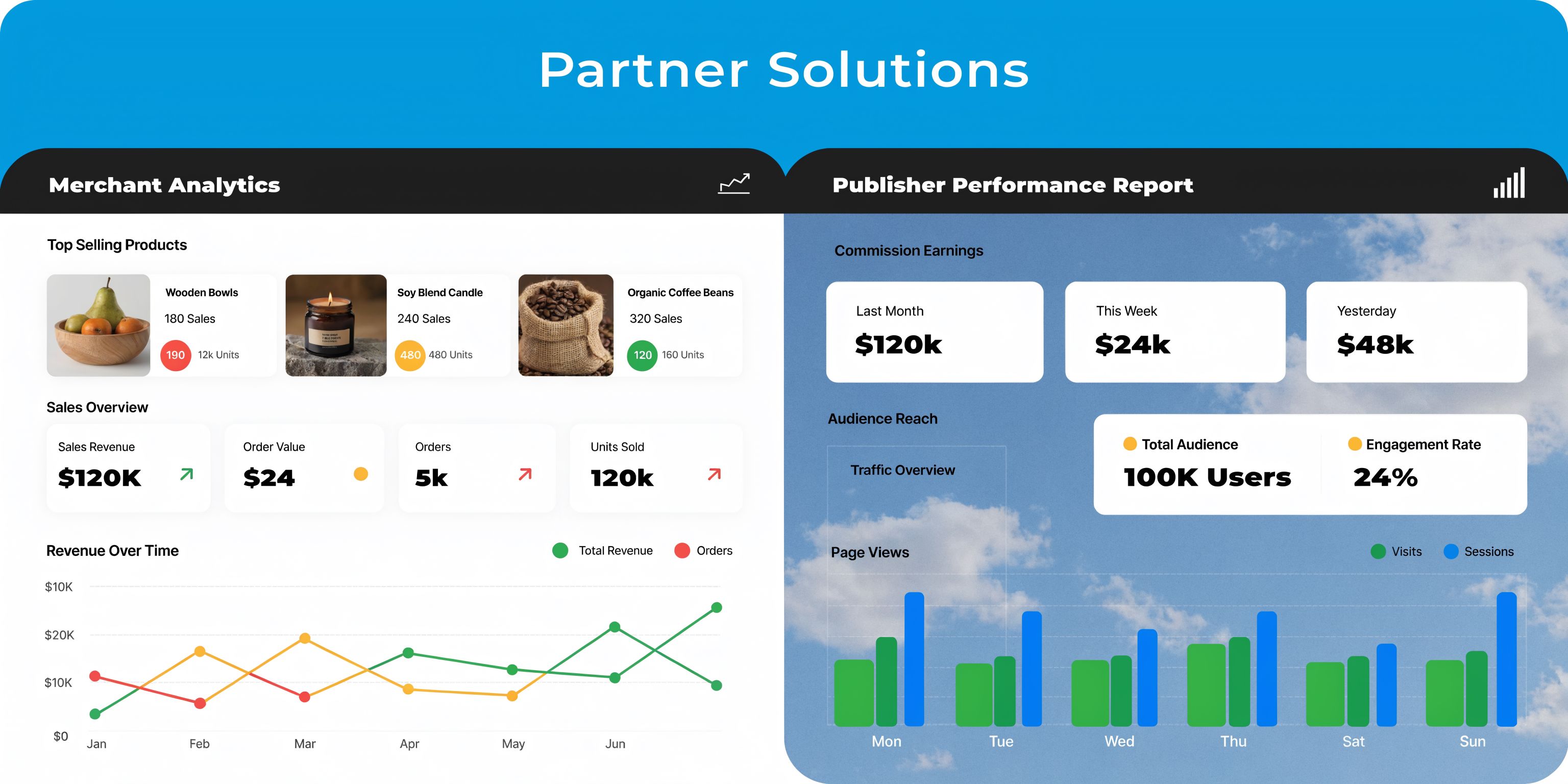
Inside cj affiliate, the same platform feels very different depending on which side you’re on. A merchant opens the dashboard looking for recruitment, program controls, and reporting. A publisher opens it looking for advertiser access, usable links, and earnings visibility.
That difference is strategic. Tools only matter when they support the decisions each side has to make every day.
What merchants care about most
A merchant team starts with three operational questions.
- Who should we recruit
- What terms should we offer
- How do we know which partners add value
CJ supports that workflow with advertiser-side discovery and reporting features. You can review publisher candidates, structure program terms, and monitor performance with greater granularity than a spreadsheet-and-email process would allow.
That matters because not all affiliates play the same role. A content partner that introduces new buyers near the start of the journey is different from a loyalty partner that closes demand at the end. If you treat them the same, you’ll misprice one of them.
What publishers care about most
Publishers need speed and clarity.
They want to find advertisers that fit their audience, apply without a lot of manual back-and-forth, generate trackable links, and check whether their placements are producing commissions. CJ’s publisher tools support that loop.
In plain terms, publishers use the platform to answer questions like these:
- Is this advertiser relevant to my audience
- Can I link directly to a specific product or landing page
- Are my clicks and conversions showing up when they should
A strong network experience for publishers reduces guesswork. That is the difference between a partner testing your brand once and building repeat coverage into their editorial or creator workflow.
The tracking features have strategy baked into them
One of CJ’s more important advantages is that its tracking stack isn’t only about counting conversions. It’s about helping both sides understand the customer journey more accurately.
CJ states that its Universal Tag and Cross-Device tracking provide real-time performance metrics and can reveal up to 30% in previously untapped channel value by mapping customer journeys across devices, according to CJ’s article on tracking tools.
That’s easy to underestimate until you see a real-world pattern. Someone discovers a product on mobile during lunch, then buys later on desktop after work. Without cross-device visibility, the partner that influenced the sale can appear weaker than it is.
What experienced managers know: Bad tracking doesn’t just create reporting problems. It changes partner behavior because publishers optimize around what gets credited.
For merchants comparing network infrastructure with standalone platforms, this guide to affiliate software helps frame the differences.
A merchant view and a publisher view
| User type | Most useful CJ capability | Strategic implication |
|---|---|
| Merchant | Publisher discovery and reporting | Better partner selection and payout decisions |
| Merchant | Program terms and tracking controls | Cleaner incentives across partner types |
| Publisher | Advertiser search and applications | Faster path to relevant offers |
| Publisher | Deep links and performance reporting | Easier testing of content and landing pages |
If you’re managing the channel, don’t evaluate features as a checklist. Evaluate them by the quality of decisions they enable.
Getting Started with CJ Affiliate Onboarding
The onboarding experience is where enthusiasm meets reality.
A brand signs up and realizes affiliate isn’t “set it and forget it.” A publisher applies and learns that approval depends on profile quality, traffic fit, and the advertiser’s own standards. That’s not a flaw. It’s part of how CJ maintains a more curated ecosystem.

If you’re a merchant
The merchant setup process is part commercial, part technical.
You’ll submit business details, define your program, and prepare tracking. The practical work looks like this:
Complete the advertiser application
Your website, business model, and offer quality need to be clear. If your site is confusing, affiliate recruitment gets harder later.Set program terms
Decide what counts as a payable action. Keep rules understandable. Complicated terms create publisher hesitation.Plan recruitment before launch
Don’t assume partners will appear automatically. Build a target list by publisher type, not just by brand familiarity.Install tracking correctly
This is the operational hinge point. If attribution is shaky, every optimization conversation becomes messy.
CJ’s server-to-server tracking is an important option here because it bypasses some browser-based limitations such as ad blockers and cookie restrictions. According to the stape.io guide to CJ server-to-server tracking, this approach can improve tracking accuracy by up to 20%.
That matters most when your customer journey is fragmented across devices, browsers, or privacy-constrained environments.
If you’re a publisher
Publishers tend to focus on the application itself, but profile quality is what frequently changes approval rates.
A practical setup approach looks like this:
Make your profile specific
Describe your traffic sources, audience type, and content model in plain language.Apply selectively at first
Start with advertisers that clearly match your site or channel. Relevance beats volume.Use deep links thoughtfully
Product-specific or category-specific links make more sense than sending everyone to a homepage.Read program terms before publishing
Some advertisers are strict about paid search, coupon use, or promotional language.
This walkthrough can help if you’re still learning the application side of the process: how to join affiliate programs.
A visual walkthrough can also make the platform less abstract:
Where new teams get stuck
Most onboarding issues fall into a few predictable buckets.
| Common issue | What is happening |
|---|---|
| No early publisher traction | The offer, terms, or outreach isn’t compelling enough |
| Tracking discrepancies | Implementation needs validation before scaling recruitment |
| Slow advertiser approvals | The publisher profile doesn’t communicate fit clearly |
| Weak early results | Partner mix and landing page alignment need work |
A clean launch beats a fast launch. In affiliate, bad tracking and vague terms can poison partner trust early.
Understanding CJ Affiliate Pricing and Payouts
This is the part many buyers want first, and it’s where public information gets thin.
If you’re a merchant evaluating cj affiliate, you’ll notice that there isn’t much publicly documented detail about pricing tiers, commission structures, setup costs, or expected ROI ranges. CJ’s own solution pages don’t provide broad public benchmarks for those items, and that lack of transparency is a real limitation for teams trying to compare networks before entering a sales process, as noted on CJ’s affiliate solution page.
What merchants should expect conceptually
Even without public rate cards, most network evaluations still follow the same commercial logic.
A merchant needs to understand:
Platform costs
What access to the network and tooling requires financially.Publisher commissions
What the brand pays partners for valid actions.Network economics
What the intermediary charges for enabling the relationship and infrastructure.
The key point isn’t to guess the numbers. It’s to go into evaluation with a full checklist. Ask for examples of how costs vary by vertical, partner type, and program structure. Ask how invoicing works. Ask what services are bundled and what requires additional support.
What publishers should focus on instead
For publishers, the pricing question is less about platform fees and more about payout reliability and program terms.
The practical questions are:
- How quickly are transactions reflected
- When does commission become payable
- Which advertisers fit your traffic and content style
- How much manual relationship management is required after approval
If you’re a publisher, don’t get distracted by trying to reverse-engineer network economics. Your job is to understand whether the advertisers on the platform match your audience, whether the tracking is dependable, and whether your workflow fits their rules.
Merchants buy infrastructure and access. Publishers buy opportunity with their time and audience attention.
That’s why pricing opacity affects the two sides differently. For merchants, it slows vendor comparison. For publishers, it matters less than advertiser quality and payout mechanics.
Evaluating CJ Affiliate Pros and Cons
CJ is a strong fit for some teams and the wrong fit for others. The answer depends less on “is CJ good” and more on “good for whom, at what stage, with what operating model.”
A large retailer with internal affiliate support staff sees one platform. A solo creator sees another.
Where CJ stands out
CJ’s advantages are mostly structural.
Established scale
It’s a long-running network with a broad mix of brands and publishers across major categories.Serious tracking capabilities
The platform has invested in tracking options and customer-journey visibility that matter for mature programs.Partner ecosystem depth
Merchants can recruit from a large base, and publishers can explore offers across many verticals.
Those strengths tend to matter more as program complexity rises. If you’re managing multiple partner types, dealing with cross-device journeys, or trying to standardize operations across regions, infrastructure matters.
Where the friction shows up
The tradeoffs are also predictable.
A common concern for smaller affiliates is support depth. Reports indicate that smaller affiliates may not receive the same personalized attention as larger partners, according to this CJ review on Strackr.
That doesn’t mean smaller publishers can’t succeed on CJ. It means they may need to be more self-directed, more selective about applications, and more disciplined about profile quality and outreach.
For merchants, the challenge is typically complexity. A large network can be powerful, but it can require stronger internal ownership. If no one on the team understands tracking, publisher segmentation, and program governance, a premium network won’t solve that by itself.
CJ Affiliate pros and cons at a glance
| Pros | Cons |
|---|---|
| Large, established affiliate ecosystem | Public pricing transparency is limited |
| Strong tracking and attribution options | Can feel complex for newer teams |
| Useful for brands that want broad partner access | Competitive environment for publishers |
| Suitable for varied publisher types | Smaller affiliates may get less personalized support |
Some teams need a wide network with mature infrastructure. Others need simplicity more than breadth. The right answer depends on your operating maturity.
A quick fit check
CJ is typically a better fit when:
- The merchant has resources to manage recruitment, compliance, and tracking
- The publisher has a defined audience and can present a clear value proposition
- The program needs strong attribution rather than minimal setup
CJ may be a tougher fit when:
- The merchant wants instant transparency on public pricing before any conversation
- The publisher expects hands-on support without already having traction
- The team is still learning basics and would benefit from a simpler starting environment
Find and Verify CJ on AffiliateLandscape
When you’re evaluating a network like cj affiliate, the hard part isn't finding the brand name. It’s verifying context around the ecosystem. You want to know how it fits with agencies, tools, platforms, and potential partners you may already be reviewing.
That’s where a discovery layer becomes useful.

A practical research workflow
Use a directory view to do three things in sequence.
Locate CJ’s profile
Confirm you’re looking at the correct company entry, not a mention in a list or a secondary article.Review verification and profile signals
A claimed or verified profile gives you more confidence that the company is actively managing how it appears.Map the surrounding ecosystem
Look at adjacent categories such as agencies, tracking tools, or other networks you may want to compare.
A structured affiliate directory is useful here because it shortens the research loop. Instead of searching company by company, you can compare the ecosystem in one place.
Why this matters strategically
For merchants, this kind of research helps with network selection and partner vetting.
For publishers, it helps answer a different question. Not just “is CJ legitimate,” but “what kinds of companies and partnership models surround this network, and where do I fit best?”
That context can save a lot of wasted outreach.
Frequently Asked Questions About CJ Affiliate
Is CJ Affiliate a network or a PRM platform
CJ is best understood as an affiliate network with tracking, discovery, and payout infrastructure. A PRM platform usually gives a brand software to run partner relationships more directly, frequently with more ownership over the environment. If you’re comparing the two, the main distinction is whether you want access to a built-in network ecosystem or software to manage partnerships more independently.
Can publishers join CJ and other networks at the same time
Yes, many publishers work with multiple networks and direct programs. The main issue isn’t exclusivity. It’s workflow discipline. You need clean tracking practices, clear placement logic, and a good understanding of each advertiser’s rules.
Is CJ good for beginners
It can be, but beginners should expect a learning curve. Merchants need to understand program terms, recruitment, and tracking. Publishers need a credible profile, a relevant audience, and patience during approvals.
How should merchants judge whether CJ is worth the effort
Look at fit, not reputation alone. Ask whether your team can support recruitment, partner management, and technical setup. A strong network helps, but it doesn’t replace channel ownership.
What’s the biggest mistake new publishers make on CJ
They apply too broadly without showing fit. Advertisers want to understand why your audience is relevant. A focused profile and selective applications work better than sending generic requests everywhere.
What’s the biggest mistake new merchants make on CJ
Launching with unclear terms and weak tracking. If the rules are fuzzy and the data is unreliable, publishers lose confidence fast.
Affiliate marketing gets easier when your research process is organized. If you want to compare networks, vet tools, explore agencies, and see how companies fit across the performance ecosystem, visit this resource. It’s a practical way to discover partners faster and make better decisions before you commit time or budget.
Ready to explore the affiliate landscape?
Discover networks, tools, and opportunities in our directory.
Explore Directory