
Last updated: 28 August 2026
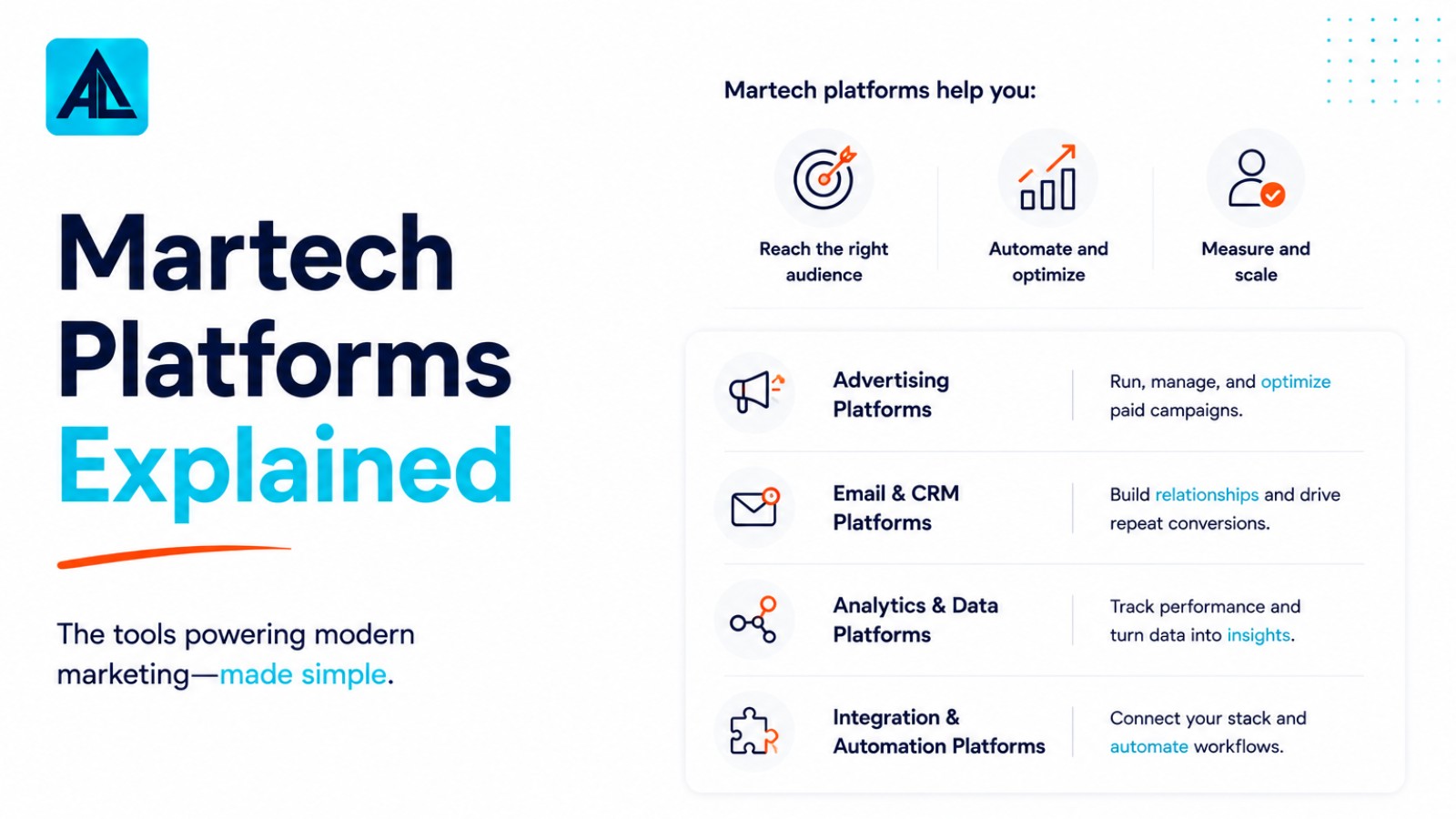
Martech platforms consolidate campaign planning, customer data management, audience automation, and performance measurement into a single system, replacing fragmented point tools that create data silos. Instead of toggling between email software, analytics dashboards, and CRM systems, your team works from one coordinated environment where customer information stays consistent across channels. This integration reduces manual data entry, speeds up campaign launches, and surfaces insights that isolated tools miss entirely.
Word count: 74
What Martech Platforms Are and Why They Exist
Martech platforms are integrated software solutions that help marketing teams plan campaigns, manage customer data, automate customer journeys, and measure what actually drives revenue. They exist because modern marketing runs across too many channels to coordinate manually. A single customer touchpoint might pass through paid search, email, a CRM, a CDP, and a retargeting pixel before converting, and without a platform layer connecting those signals, the picture stays incomplete.
The scale of the category makes that coordination challenge concrete. Scott Brinker's 2024 Marketing Technology Landscape counted 14,106 distinct martech solutions, up from roughly 150 in 2011. That number reflects genuine market demand: teams kept buying point tools to solve specific problems, and the stack kept growing. Improvado's martech overview frames the core purpose well, describing these platforms as tools designed to optimize marketing performance and enable data-driven decision-making, not just automate tasks.
The central problem they solve is data fragmentation. When your email tool, ad platform, CRM, and analytics suite each hold a separate slice of customer behavior, no single report tells you what is working. Campaigns get measured in silos. Attribution breaks. Budget decisions rely on gut feel because the numbers do not reconcile. A martech platform, or a tightly integrated stack, consolidates those sources into a unified view so you can act on the full picture rather than fragments of it.
That fragmentation problem is also why the category shifted from an IT concern into a CMO budget line. Technologychecker reports that CRM leads platform deployment at 72% of organizations, ahead of digital advertising tools at 61% and data management platforms at 54%. Marketing leaders are now the primary buyers, not infrastructure teams. When revenue attribution, customer lifetime value, and campaign ROI all depend on the platform layer functioning correctly, you have a direct financial stake in getting the stack right.
One honest caveat: a larger stack does not automatically mean better outcomes. Many teams accumulate tools without a clear integration strategy, which recreates the fragmentation problem at a higher cost.
Core Functions Across the Martech Stack
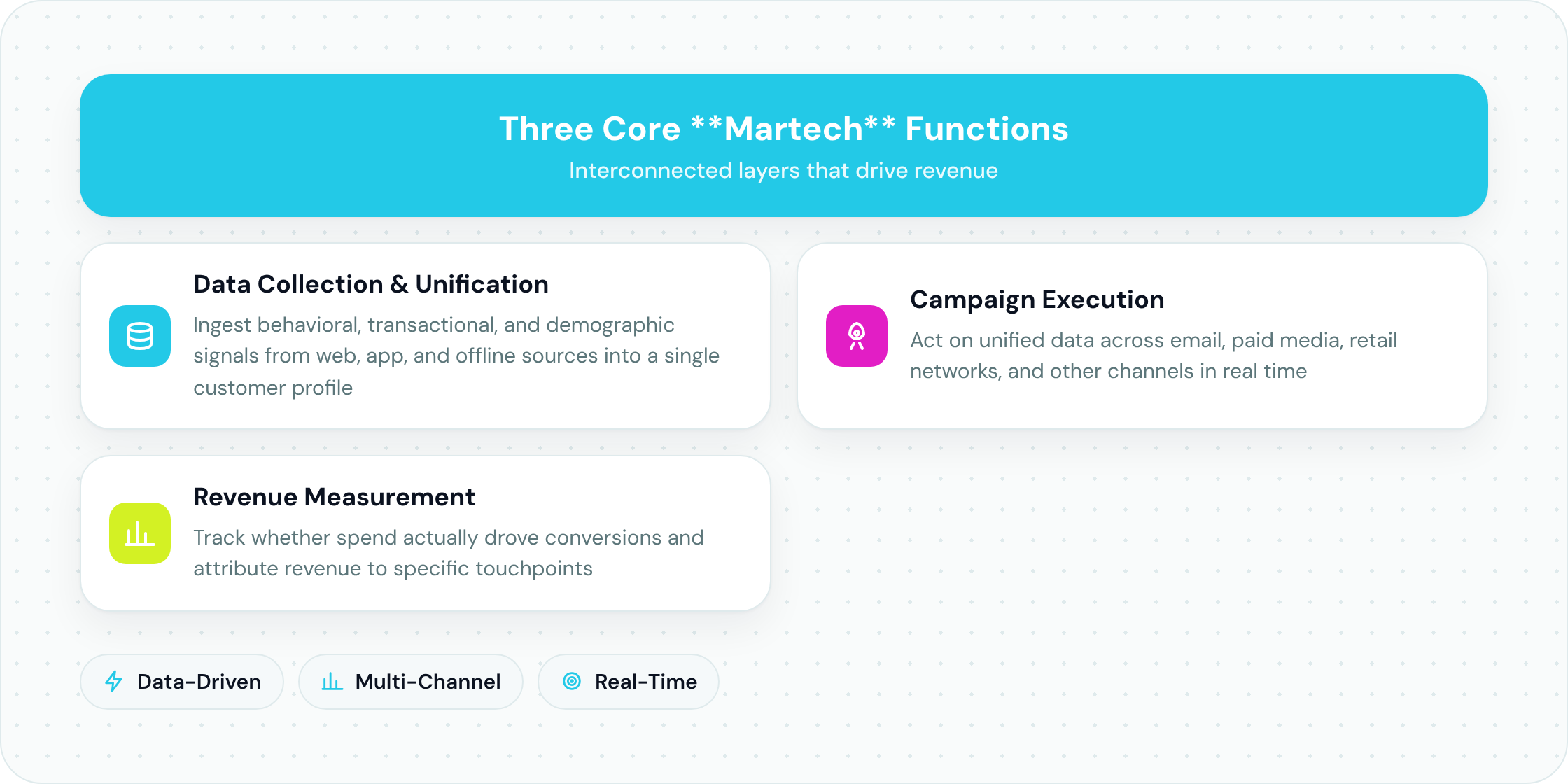
A martech platform handles three core jobs: collecting and unifying customer data from disparate sources, executing campaigns across channels like email, paid media, and retail networks, and measuring whether that spend actually drove revenue. These functions are interdependent. A platform that executes well but measures poorly leaves you guessing. One that collects data but cannot act on it in real time is just an expensive data warehouse.
Data Collection and Unification: CDPs, CRMs, and Identity Resolution
The foundation of any martech stack is a clean, connected view of the customer. Customer Data Platforms (CDPs) ingest behavioral, transactional, and demographic signals from web, app, and offline sources, then stitch them into a single profile. CRMs handle the relationship layer: contact history, deal stages, support tickets. Identity resolution sits between the two, matching anonymous signals (a cookie, a device ID, a hashed email) to known individuals.
Gartner reports that many organizations struggle to maximize martech ROI precisely because data unification remains incomplete, with tools purchased but not properly integrated across the stack.
The trade-off here is real. CDPs are expensive to implement and require ongoing data governance work. For smaller teams without a dedicated data engineer, a full CDP deployment can take six to twelve months before it produces usable segments. In those cases, a well-configured CRM with native integrations often delivers more practical value faster.
Campaign Execution: Email, Paid Media, and Retail Media Network Integrations
Once data is unified, the execution layer takes over. Email automation platforms use behavioral triggers to send messages at the right moment, not on a fixed schedule. Paid media integrations push audience segments directly to Google, Meta, or programmatic DSPs, keeping targeting consistent with what the CRM actually knows about a customer.
Retail media network integrations are the newer piece. Brands running campaigns on Amazon Ads, Walmart Connect, or Kroger Precision Marketing need their martech stack to pull those signals back into a central view. Aidigital's breakdown of marketing technology describes this orchestration function as the core reason teams adopt martech in the first place: planning campaigns, managing data, and automating journeys across every channel from one place.
Execution tools also vary significantly in how they handle personalization at scale. Most platforms offer dynamic content blocks and conditional logic, but the quality of the output depends entirely on the data feeding it. Garbage segments produce irrelevant messages, regardless of how sophisticated the sending platform is.
Measurement and Attribution: Closing the Loop Between Spend and Revenue
Attribution is where most stacks show their weakest seams. Multi-touch attribution models (linear, time-decay, data-driven) each tell a different story about which channel deserves credit. The Wedia Group's 2026 martech stack guide highlights robust analytics as a defining feature of mature stacks, specifically the ability to connect content performance back to downstream revenue outcomes.
The practical challenge is that no attribution model is neutral. Last-click attribution systematically overvalues paid search and undervalues upper-funnel channels like display or content. Data-driven attribution requires significant conversion volume (typically 3,000 or more conversions per month) before the model produces statistically reliable outputs. Teams below that threshold are often better served by simpler models applied consistently than by sophisticated ones applied to thin data.
Closing the loop also means connecting martech measurement to finance. Revenue attribution only becomes actionable when it maps to actual margin, not just gross revenue, and that requires integrations between the martech stack and ERP or finance systems that many organizations still have not built.
How Martech Platforms Integrate With Your Workflow
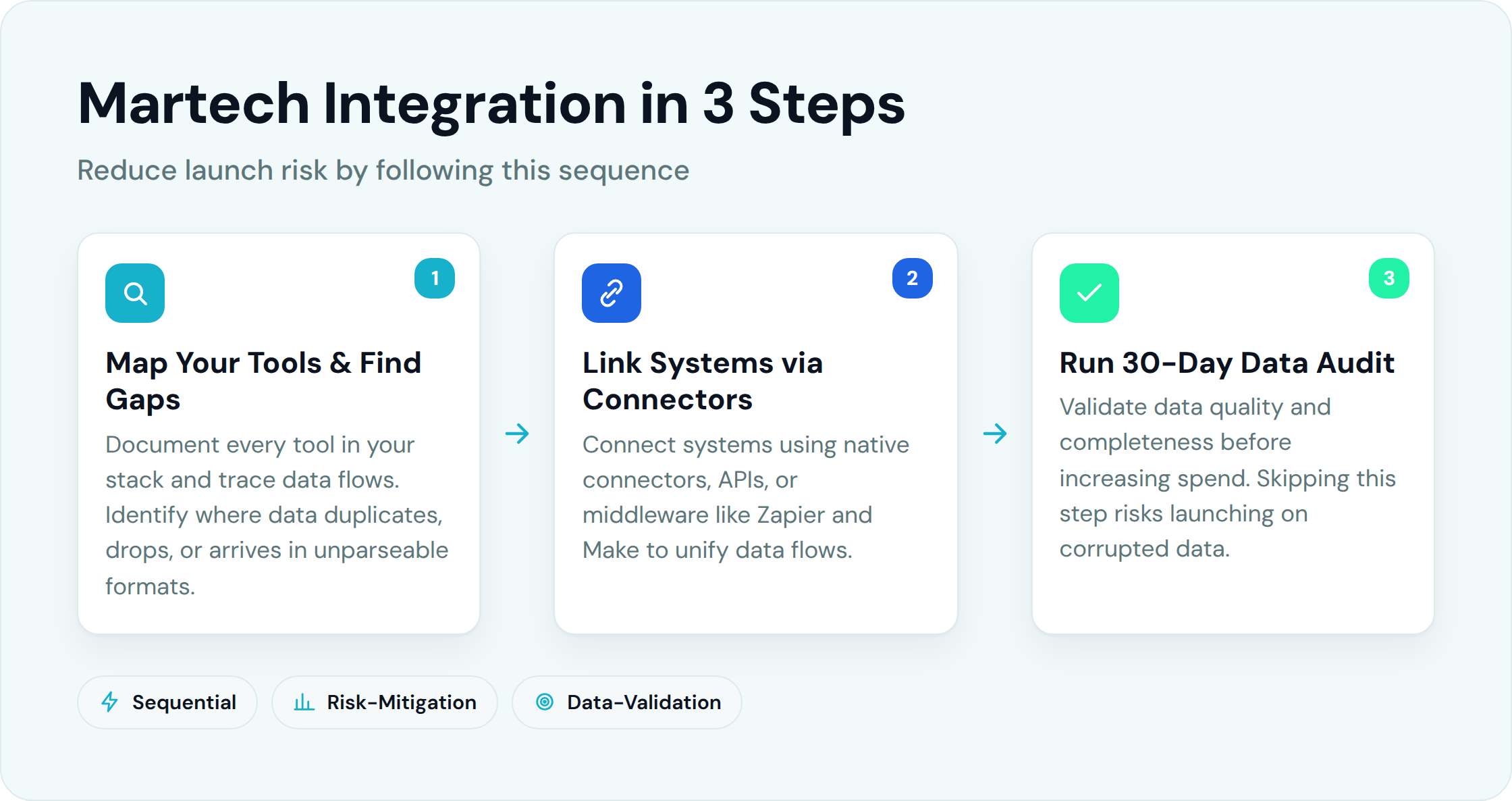
Martech platforms connect to your existing tools through three sequential steps: mapping current data flows to find gaps, linking systems via native connectors, APIs, or middleware like Zapier and Make, and then running a 30-day data audit before increasing spend. Done in order, this process reduces the risk of launching campaigns on corrupted or incomplete data. Skipping any step typically means discovering the problem after budget has already been committed.
Step 1: Map Your Tools and Find the Gaps First
Before touching a single integration setting, document every tool in your current stack and trace how data moves between them. Which system owns the customer record? Where does lead data enter, and where does it stop flowing? Most teams find at least one handoff point where data either duplicates, drops, or arrives in a format the receiving system cannot parse.
The numbers here are not flattering. Research from Martech.org on stack complexity shows companies are accumulating integration debt by avoiding platform migrations rather than solving the underlying connectivity problems. A simple spreadsheet listing each tool, its data outputs, and its expected inputs is enough to surface most of the gaps before you start connecting anything.
Step 2: Connect via Native Integrations, APIs, and Middleware
Once you know where the gaps are, you have three connection options. Native integrations are the fastest path: most major martech platforms ship with pre-built connectors for Salesforce, HubSpot, Shopify, and Google Analytics. If a native connector exists, use it. The maintenance burden is lower and the vendor handles breaking changes when APIs update.
When a native connector does not exist, REST APIs give you precise control over what data moves and when. This is the right choice for custom attribution layers or proprietary data warehouses. The trade-off is engineering time. A direct API build can take two to four weeks depending on documentation quality, and someone on your team needs to own it long-term.
Middleware tools like Zapier and Make sit in the middle: faster to configure than a custom API build, slower and less reliable than a native connector. They work well for lower-volume data flows (syncing a form submission to a CRM row, for example) but tend to break under high transaction volumes or when either connected platform updates its schema. Use them as a bridge, not a foundation.
Step 3: Run a 30-Day Audit Before Scaling Spend
Connecting systems is not the same as validating them. Before you increase ad spend or expand campaigns that depend on the integrated data, run a 30-day parallel audit: compare the numbers your martech platform reports against the source-of-truth records in your CRM or data warehouse.
Look specifically for three failure modes: event duplication (the same conversion counted twice), attribution lag (conversions recorded in the wrong time window), and field mismatches (a revenue figure in one system that does not match the same figure in another). Any of these will distort your ROI calculations and lead to budget decisions built on bad inputs.
This step has a real limitation worth naming. Thirty days is enough to catch systematic errors, but it will not surface problems that only appear at scale or during seasonal traffic spikes. A stack that validates cleanly on 10,000 monthly events may still fail when volume jumps to 100,000. Teams with highly variable traffic patterns should plan a second audit after their first major campaign push, not just at initial setup.
The State of Martech in 2026: Key Trends
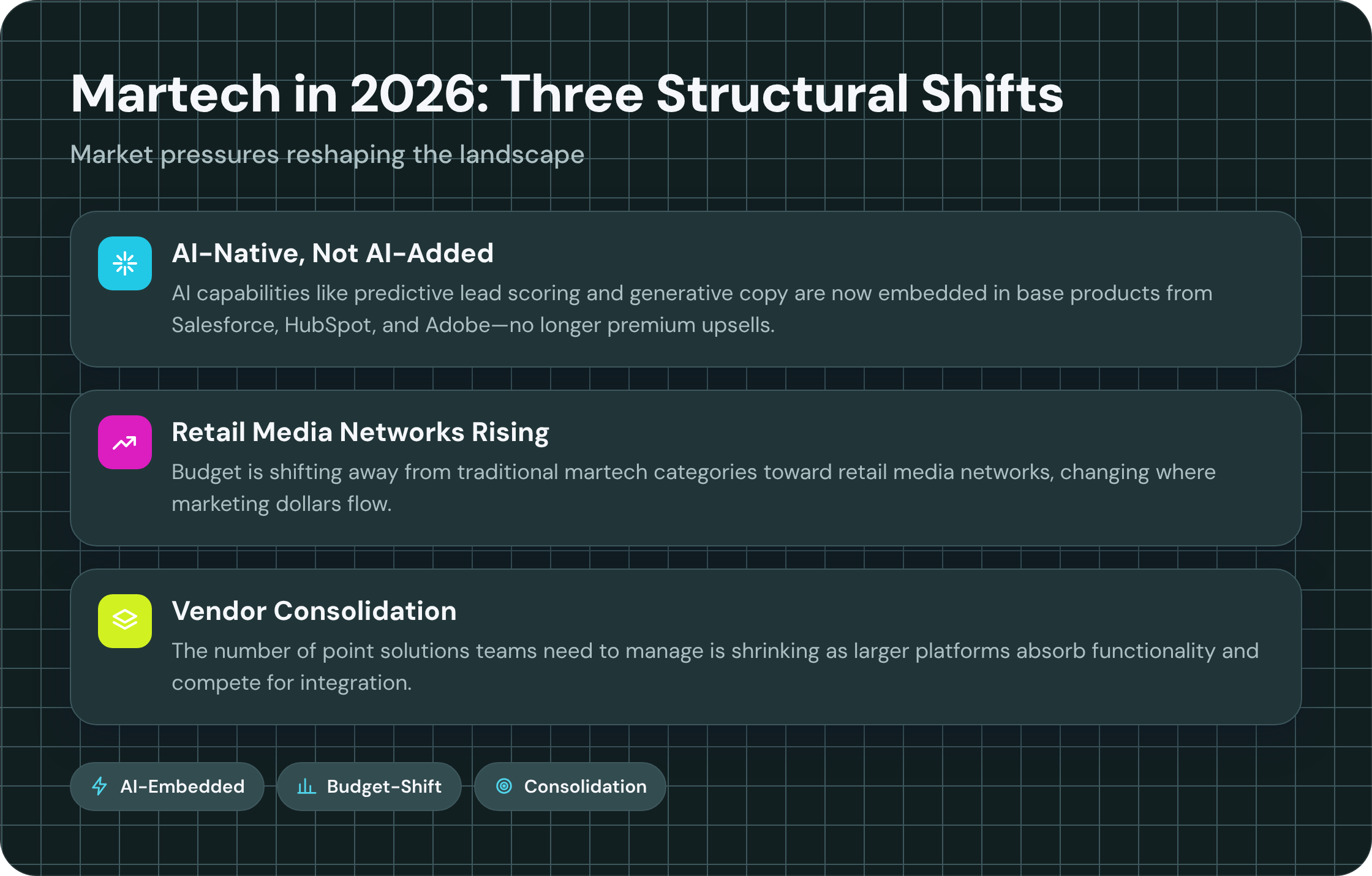
The martech landscape in 2026 is defined by three converging pressures: AI capabilities are being built into core platforms rather than added as separate tools, retail media networks are pulling budget away from traditional martech categories, and vendor consolidation is shrinking the number of point solutions teams need to manage. The net result is a market that looks stable on the surface but is shifting structurally underneath.
AI-Native, Not AI-Added
The clearest shift is where AI lives inside the stack. A year ago, predictive lead scoring and generative copy were typically third-party add-ons sitting on top of a CRM or MAP. In 2026, those capabilities are embedded in the base product. Salesforce, HubSpot, and Adobe have all moved their AI features into core licensing tiers, which means you are now evaluating AI functionality as a platform criterion, not a premium upsell.
The trade-off is real, though. Embedded AI features tend to be optimized for the vendor's own data model. Teams with complex, multi-source data pipelines often find that native AI scoring underperforms a purpose-built solution trained on their specific signals. Consolidation gains in simplicity; it can lose in precision.
Retail Media Is Redirecting Budgets
Retail media networks, including Amazon Ads, Walmart Connect, and a growing list of retailer-owned inventory sources, are pulling significant budget away from traditional programmatic channels. For brands selling through retail partners, this creates a new integration requirement: your martech stack needs to ingest retail media performance data alongside owned-channel data, or your attribution picture will have a growing blind spot.
Most legacy MAPs and CDPs were not built with retail media APIs in mind. Vendors are adding connectors, but the coverage is uneven. Before committing to a platform in 2026, verify specifically which retail media networks it supports natively and what the data latency looks like on those connections. A 48-hour reporting lag on Amazon Ads data is not acceptable if you are optimizing bids daily.
Vendor Consolidation Is Changing the Buying Decision
The number of standalone point solutions is shrinking as larger platforms acquire niche tools and fold them into suite offerings. Adobe, Salesforce, and HubSpot have each made acquisitions in the last 18 months that reduce the number of separate vendors a mid-market team needs to manage.
For buyers, this cuts both ways. Fewer vendors means fewer contracts, fewer API maintenance headaches, and a simpler data model. It also means less negotiating leverage and a higher switching cost once you are deep inside a single vendor's ecosystem. Teams evaluating martech platforms in 2026 should model the three-year total cost of ownership across both a best-of-breed and a suite scenario before signing anything.
Frequently Asked Questions
What is the difference between a martech platform and a martech stack?
A martech platform is a single software product, such as a CRM, a CDP, or a marketing automation tool. A martech stack is the full collection of platforms and point solutions your team uses together. Most organizations run a stack of five to fifteen tools, with one or two platforms serving as the connective layer.
How much does a martech platform typically cost?
Pricing varies widely by category and company size. Entry-level marketing automation tools like Mailchimp or ActiveCampaign start below $100 per month. Mid-market platforms like HubSpot Marketing Hub run from roughly $800 to $3,600 per month depending on contact volume and features. Enterprise platforms from Salesforce or Adobe can exceed $100,000 per year before implementation costs. Implementation and integration work often adds 50% to 100% on top of licensing fees, which many buyers underestimate.
Do small businesses need a martech platform?
Small businesses with fewer than 5,000 contacts and a single primary channel (email, for example) often get adequate results from a single tool rather than a full platform. The overhead of integrating and maintaining a multi-tool stack can outweigh the benefit at low volume. A well-configured email service provider with basic CRM functionality is a reasonable starting point, with additional tools added only when a specific gap becomes measurable.
How long does it take to implement a martech platform?
A basic CRM or email automation setup can go live in two to four weeks. A full CDP implementation with identity resolution and multi-source data ingestion typically takes three to nine months, depending on data complexity and internal engineering resources. The most common delay is not the platform itself but the data cleanup required before the platform can produce reliable outputs.
What should I look for when evaluating martech platforms?
Start with three criteria: native integrations with the tools you already use, data latency (how quickly events flow from source to reporting), and the vendor's track record on API stability. A platform with 200 integrations is only useful if the specific connectors you need are maintained and current. Ask vendors for their API changelog and look for how frequently breaking changes are introduced without advance notice.
How do martech platforms handle data privacy compliance?
Most enterprise martech platforms offer built-in consent management features, data residency options, and tools for honoring deletion requests under GDPR and CCPA. The compliance burden does not disappear with a platform purchase, though. Your team still needs to configure consent flows correctly, audit data retention policies, and ensure that third-party integrations do not create unintended data sharing. Platforms reduce the technical complexity of compliance; they do not eliminate the legal responsibility.
If you are working through a martech platform decision and want a clearer picture of how affiliate and partner channels fit into your stack, visit Affiliatelandscape to see how they approach the integration and attribution questions that most platform vendors leave unanswered.
Ready to explore the affiliate landscape?
Discover networks, tools, and opportunities in our directory.
Explore Directory