
Last updated: 1 September 2026
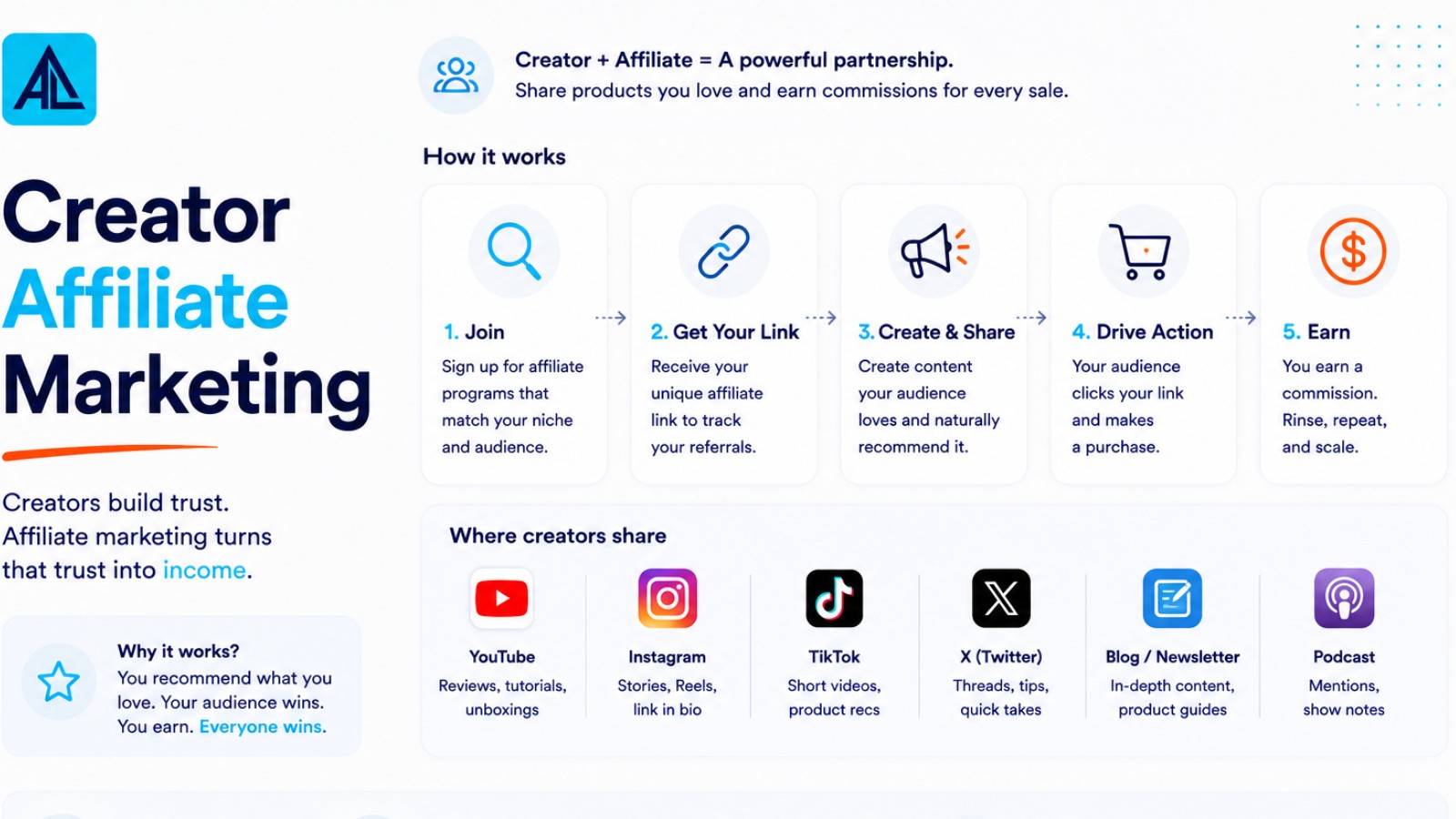
Creator affiliate marketing is a performance-based partnership where influencers and content creators promote a brand's products using unique tracking links or codes. When their audience makes a purchase through that link, the creator receives a commission, typically ranging from 5 to 30 percent depending on the product category and agreement terms. Brands benefit because they pay only for actual sales, eliminating upfront marketing costs and attribution uncertainty. This model works across platforms: YouTube, Instagram, TikTok, and blogs. The structure creates alignment between creator incentives and business results, but success depends heavily on audience trust and product fit.
What Creator Affiliate Marketing Actually Is
A creator promotes a brand's product using a tracked link or code. When a follower buys, the creator earns a commission. The brand pays only for results: no guaranteed fees, no upfront spend, no guesswork on attribution.
That performance-based structure explains why the channel has scaled so fast. The global affiliate marketing industry now sits at $18.5 billion, and a meaningful slice of that growth traces directly to creators replacing traditional coupon and cashback sites as the primary traffic source.
This article covers how creator affiliate marketing works in practice: the commission structures brands use, how creators get recruited and tracked, what makes a partnership perform, and where the common friction points are. Whether you are a brand evaluating the channel or a creator trying to understand what you are signing up for, the sections below cover each piece in order.
Creator Affiliate Marketing at a Glance
Creator affiliate marketing is a performance-based channel where brands pay creators a commission on sales they drive through tracked links. Brands get measurable ROI. Creators earn without managing inventory. Both sides benefit when the product fits the audience.
Four things worth knowing before you go deeper.
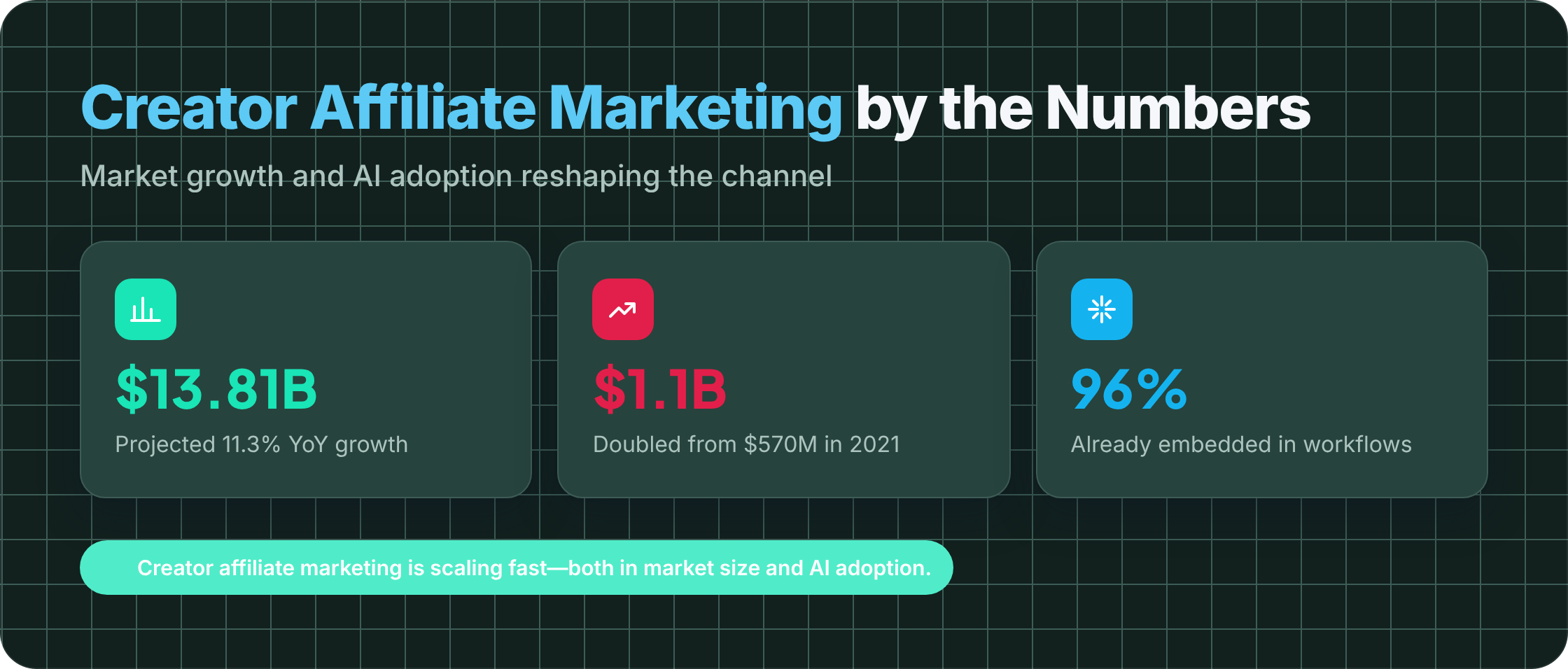
The market is real and growing. US affiliate spend is projected at $13.81 billion in 2026, up 11.3% from $12.42 billion the prior year, per Coupon Affiliates' 2026 benchmarks. Creator-driven revenue specifically doubled from $570 million in 2021 to $1.1 billion in 2024.
AI is already embedded in the workflow. A recent Impact report found 96% of affiliate creators have adopted AI tools, as Travelpayouts documented in their 2025 trends roundup. Brands are moving at nearly the same pace.
Commission structure shapes everything. A 5% flat rate on a $30 product is a very different proposition than a 30% recurring commission on a $100 SaaS subscription. Model your expected earnings before committing time to any program.
The trade-off is real. Affiliate revenue is variable by nature. A creator who builds content around one brand's program takes on concentration risk if that brand cuts rates or closes the program. Spreading across two or three programs in the same niche reduces that exposure without diluting content focus.
Creator Affiliate Marketing vs. Influencer Sponsorships
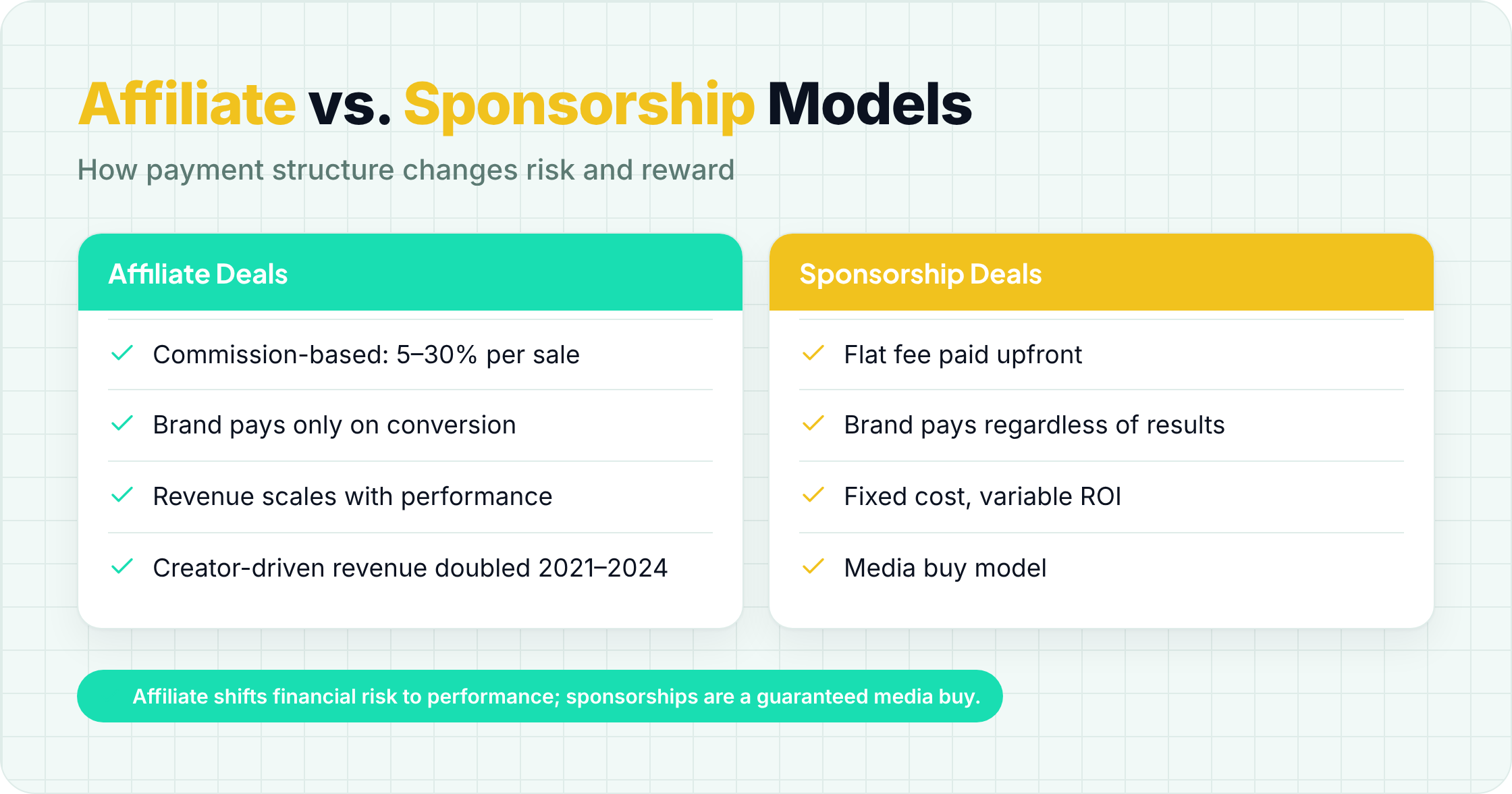
The core difference between these two models is who carries the financial risk. Affiliate deals pay creators a commission only when a sale or conversion happens, so the brand's cost scales with results. Sponsorships pay a flat fee upfront, regardless of whether a single viewer clicks or buys. Both structures are legitimate and both are growing, but they serve different goals for brands and creators.
How Payment Structure Separates the Two
Flat-fee sponsorships are essentially a media buy. A brand pays for access to an audience, the post goes live, and the transaction is complete. Affiliate deals work more like a revenue share: the creator gets a cut, often 5% to 30% of the sale price, every time their link or code converts.
The numbers reflect how much this distinction matters in practice. Creator-driven affiliate revenue doubled from $570 million in 2021 to $1.1 billion in 2024, as tracked by eMarketer and reported by Digiday. Flat-fee sponsorship budgets have grown too, but the affiliate side is accelerating faster precisely because brands can tie spend directly to outcomes.
When Brands Choose Affiliate Over Sponsored Posts
Brands tend to favor affiliate structures when their margins allow for commission payouts and when they want measurable ROI at the campaign level. A direct-to-consumer skincare brand with a 60% gross margin can afford to give a creator 15% per sale and still come out ahead. A brand selling low-margin electronics probably cannot.
Sponsored posts make more sense when the goal is awareness rather than immediate conversion. Launching a new product category, entering a new market, or rebranding all benefit from flat-fee deals because the metric is reach and perception, not clicks.
Attribution is where things get complicated. Affiliate links and promo codes are trackable, but they only capture conversions that happen through that specific path. A viewer who sees a sponsored post, searches the brand name later, and buys through Google gets counted as organic, not influencer-driven. This narrows the apparent performance gap between the two models and is one reason some brands run both simultaneously.
Why Creators Prefer One Model Over the Other
Established creators with large, highly engaged audiences often prefer sponsorships because the income is guaranteed. A flat fee of $10,000 for one video is predictable in a way that affiliate commissions are not, especially for content formats where purchase intent is low, such as entertainment, humor, or lifestyle.
Creators in niches with strong buying intent, including personal finance, software reviews, and fitness equipment, frequently prefer affiliate deals because the upside is uncapped. A well-placed affiliate link in a YouTube video can generate commissions for years after the upload date.
The data supports this split: 42% of influencers worldwide now monetize through affiliate links in addition to brand sponsorships, suggesting most working creators treat the two models as complementary rather than competing. Newer creators with smaller audiences often have no choice. Brands rarely offer meaningful flat fees to accounts under 50,000 followers, so affiliate programs become the default entry point into brand partnerships.
How Creators Earn From Affiliate Partnerships
Creators earn affiliate income by embedding tracked referral links into content their audience already consumes, then collecting a commission each time a viewer or reader completes a qualifying purchase. Most programs pay between 5% and 30% of the sale value, depending on the vertical and the brand's margin structure. The three main payment models are flat cost-per-action (CPA), revenue share, and hybrid arrangements that combine both.
Commission Structures: CPA, Revenue Share, and Hybrid
A flat CPA pays a fixed dollar amount per conversion regardless of order size. A $15 CPA on a software signup is predictable and easy to track, but it leaves money on the table when a referred customer buys a $500 plan. Revenue share solves that by tying the creator's cut to actual sale value, which is why it dominates categories like fashion, beauty, and SaaS. Hybrid deals layer a smaller flat fee on top of a percentage, giving creators a floor while preserving upside on larger orders.
Digitalapplied's 2026 affiliate data compilation puts average commission rates between 5% and 25% across major verticals, with software and subscription products trending toward the higher end. Physical goods typically land in the 5% to 10% range because margins are thinner.
Revenue share sounds better on paper, but a creator sending high volume on low average-order-value products can earn less than a flat-CPA deal would have paid. Hybrid structures help, but they require more negotiation and are less common at the entry level.
Where Affiliate Links Actually Live
Placement determines conversion rate as much as commission rate does. Common surfaces include:
- Link-in-bio tools (like Linktree or a custom landing page) that consolidate multiple affiliate links for social audiences who cannot click through from a post directly.
- Video descriptions on YouTube, where a pinned affiliate link sits below tutorials, reviews, and comparison videos.
- Email newsletters, which consistently outperform social for affiliate click-through because the audience is opted-in and the context is editorial rather than algorithmic.
- Creator storefronts on platforms like Amazon or LTK, where products are curated and shopping intent is already high.
Each surface has a different conversion profile. Newsletter clicks tend to convert at higher rates than social traffic, but a YouTube video description can accumulate clicks for years with no additional effort.
The Compounding Effect of Evergreen Content
A tutorial published today can still generate commissions in 2028 if it targets a stable search query and the affiliate program stays active. This is the structural advantage creators have over paid media: the asset keeps working after the production cost is sunk.
Wecantrack's affiliate performance data shows that affiliate programs grow at an average annual rate of 15%, which means the pool of available programs and commission budgets keeps expanding. A creator who builds a library of evergreen reviews and how-to content is compounding into a growing market.
This breaks down when programs change terms or shut down. A creator who built significant income around a single program's 8% commission rate and then watched it drop to 3% (as happened with Amazon Associates in 2020) understands the risk of concentration. Diversifying across multiple programs and content formats is the practical hedge.
Finding and Recruiting Creator Affiliates: A Step-by-Step Approach
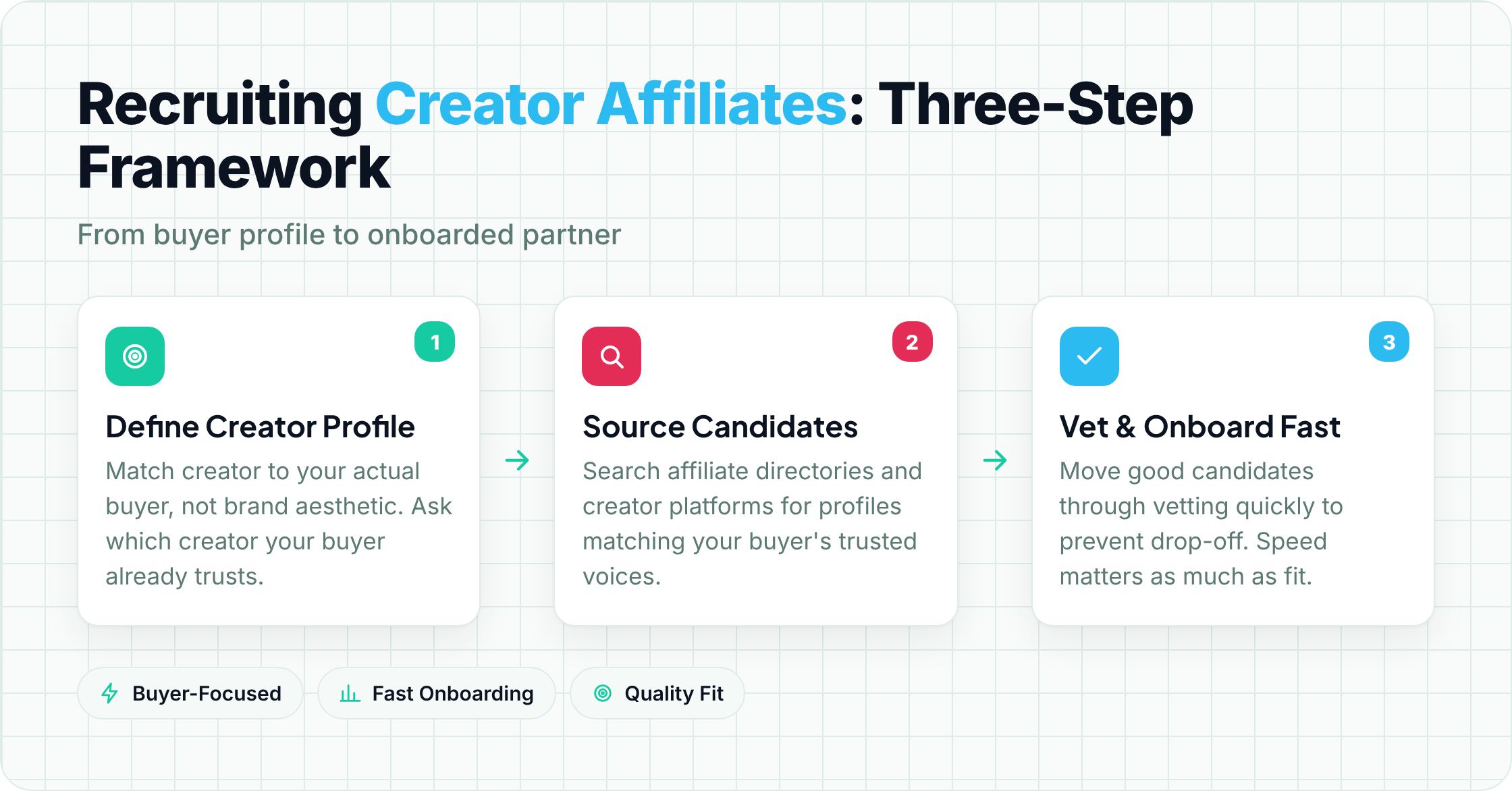
Finding the right creator affiliates starts with a clear profile of your buyer, not a mood board of your brand. From there, you source candidates through affiliate directories and creator platforms, then move them through a vetting and onboarding process that is fast enough to keep good candidates from dropping off. Most programs that struggle with creator recruitment skip step one entirely, which makes steps two and three much harder.
Step 1: Define the Creator Profile That Matches Your Buyer
Before you open any directory or send a single outreach email, write down who buys your product and why. Then ask which creator that buyer already trusts.
This is a different exercise than brand aesthetic matching. A skincare brand might gravitate toward polished beauty creators, but if its actual buyers are women over 40 researching ingredients for sensitive skin, the better affiliate is a mid-size creator who posts detailed product breakdowns, not aspirational lifestyle content. Audience demographics, content format, and purchase intent all matter more than follower count or visual style.
Set a minimum engagement rate threshold before you start sourcing. A creator with 40,000 followers and a 6% engagement rate will typically drive more conversions than one with 400,000 followers and 0.4%. LinkedIn research on affiliate program performance shows 74% of brands attribute 11 to 30% of their total revenue to affiliate marketing, which means getting creator selection right carries real stakes.
Step 2: Use Affiliate Directories and Creator Platforms to Source Candidates
Once you have a written profile, you can search with intent instead of browsing at random. Affiliate directories let you filter by niche, traffic type, and promotional method. Creator marketing platforms add audience demographic data on top of that.
Look for creators who already produce content in your category, have demonstrated purchase intent in their audience (comments mentioning buying decisions, product questions, or price comparisons are good signals), and have a track record of disclosing affiliate relationships correctly. The last point matters for FTC compliance and for your brand's credibility.
Platforms worth evaluating include ShareASale, Impact, and CJ Affiliate for directory-style sourcing. For creator-specific discovery, tools like Grin, Aspire, and Creator.co layer in social metrics and audience data that pure affiliate networks do not provide.
Step 3: Vet Candidates Before You Invite Them
Sending a program invite to every creator who matches your niche profile wastes both parties' time. A short vetting checklist keeps quality high without slowing the process down.
Check engagement rate against follower count. Review the last 10 to 15 posts for content quality and audience interaction. Look at whether the creator has promoted similar products before and how they handled the disclosure. Run the account through a basic audience authenticity check using a tool like HypeAuditor or Modash to flag accounts with inflated follower counts.
One thing to watch: a creator with a spotless engagement rate and no prior brand partnerships is not automatically a better choice than one with a few mediocre past promotions. Prior experience with affiliate programs means the creator already understands cookie windows, attribution, and disclosure requirements. That reduces your onboarding burden.
Step 4: Onboard Quickly and Give Creators What They Need to Perform
The fastest way to lose a good creator affiliate is a slow, confusing onboarding process. If a creator has to wait two weeks for link approval and another week for creative assets, they will move on to a program that is easier to work with.
Prepare a one-page program brief that covers commission rate, cookie window, payment schedule, content guidelines, and FTC disclosure requirements. Include two or three product talking points the creator can adapt, not a script they are expected to read verbatim. Provide high-resolution product images and any discount codes upfront.
Set a 30-day check-in after the first piece of content goes live. Review click and conversion data together, ask what friction the creator encountered, and adjust if needed. Creators who feel like partners rather than vendors produce better content and stay in programs longer.
What Makes a Creator Affiliate Partnership Actually Perform
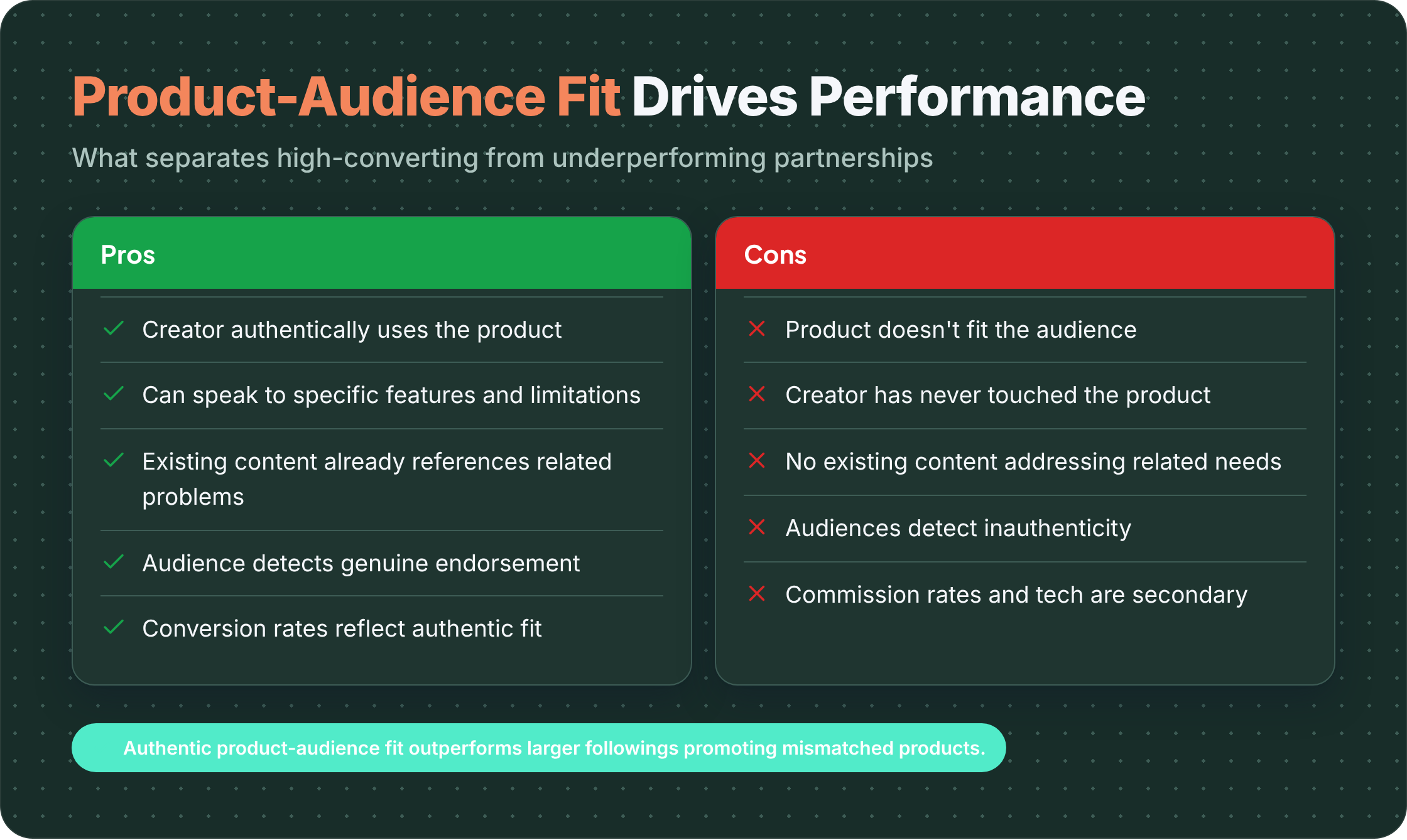
Most underperforming affiliate partnerships share the same root cause: the product does not fit the audience, or the creator does not genuinely use it. Commission rates and tracking technology matter, but they are secondary to product-audience fit.
Product-Audience Fit Comes First
A creator who authentically uses a product and can speak to specific features, limitations, and use cases will outperform a creator with twice the following who is promoting something they have never touched. Audiences are good at detecting the difference, and conversion rates reflect it.
The practical test: before you recruit a creator, ask whether their existing content already references problems your product solves. A personal finance creator who regularly discusses budgeting tools is a natural fit for a budgeting app affiliate program. A gaming creator who has never mentioned productivity software is not, regardless of audience size.
Cookie Windows and Attribution Windows Matter More Than Most Brands Admit
A 24-hour cookie window (standard for Amazon Associates) means a creator only earns commission if the referred visitor buys within one day of clicking the link. A 30-day or 90-day window gives the creator credit for purchases that happen after the viewer has had time to research and decide.
For considered purchases, a short cookie window systematically underpays creators and underreports the channel's true contribution. If your program uses a 24-hour window and your average purchase decision takes a week, you are measuring the wrong thing and paying accordingly. Extending the window to 30 days is a straightforward change that often improves creator retention and content quality without increasing your cost per acquisition.
Transparency on Performance Data Builds Better Partnerships
Creators who can see their click-through rates, conversion rates, and earnings in real time make better content decisions. A creator who knows that their YouTube description link converts at 3.2% but their newsletter mention converts at 8.7% will shift effort toward the newsletter. That benefits both parties.
Most affiliate platforms provide this data, but brands sometimes restrict access or delay reporting. Giving creators full visibility into their own performance data is low-cost and high-return. It also reduces the support burden on your affiliate team because creators can self-diagnose underperformance instead of emailing you to ask why their commissions dropped.
Common Friction Points in Creator Affiliate Programs
Even well-designed programs run into predictable problems. Knowing where they tend to appear lets you address them before they cost you good creators.
Payment delays. Creators who wait 60 to 90 days for their first commission check often disengage before they see results. Net-30 payment terms are standard; net-60 is acceptable for larger programs with return windows to account for. Anything longer than that is a retention problem.
Unclear content guidelines. Vague instructions like "create authentic content" leave creators guessing about what the brand will approve. Specific guidance, including which claims are supported, which competitors cannot be mentioned, and what disclosure language satisfies FTC requirements, reduces revision cycles and protects both parties.
Rate changes without notice. Dropping commission rates mid-program without advance notice is the fastest way to lose creator trust. If you need to adjust rates, give creators 30 days' notice and explain the reason. Most creators will accept a rate change if they understand the context. Few will accept finding out after the fact.
Tracking gaps. iOS privacy changes and browser cookie restrictions have reduced the accuracy of last-click attribution across the board. Brands that rely entirely on cookie-based tracking are undercounting creator contributions. Supplementing with promo codes, UTM parameters, and post-purchase surveys gives a more complete picture.
Frequently Asked Questions
How much do creators typically earn from affiliate marketing?
Earnings vary widely by niche, audience size, and commission structure. A creator in a high-intent niche like software reviews or personal finance with 50,000 engaged subscribers can realistically earn $2,000 to $10,000 per month from affiliate commissions alone, assuming a diversified portfolio of programs. Creators in lower-intent niches or with smaller audiences typically earn less, often in the $200 to $1,000 range monthly, until their content library grows.
What is a good commission rate for a creator affiliate program?
For physical goods, 8% to 15% is competitive. For digital products and SaaS, 20% to 30% is standard, and some programs offer 50% or more on the first sale. The right rate depends on your margin structure: a program that pays creators well enough to prioritize your product over competitors will outperform a stingy one even if the product is comparable.
Do creators need a large following to make money with affiliate marketing?
No. A creator with 10,000 highly engaged followers in a specific niche, say, woodworking tools or vegan baking, can outperform a general lifestyle creator with 500,000 followers. Conversion rate is a function of audience trust and content relevance, not raw reach. Many successful affiliate creators built meaningful income before they crossed 25,000 followers by focusing on search-optimized content with clear purchase intent.
How do brands track creator affiliate sales?
Most programs use a combination of unique tracked URLs (with UTM parameters), browser cookies with defined expiration windows, and unique promo codes. Some brands add post-purchase surveys asking customers how they heard about the product. Each method has gaps: cookies get blocked, promo codes get shared beyond the creator's audience, and surveys have low completion rates. Using two or three tracking methods together gives a more accurate picture than relying on any single one.
What platforms do brands use to run creator affiliate programs?
The most widely used affiliate platforms include Impact, ShareASale, CJ Affiliate, and Rakuten Advertising for network-based programs. Brands running direct programs often use Rewardful, PartnerStack (especially for SaaS), or Tapfiliate. Creator-specific tools like Grin and Aspire add influencer relationship management on top of basic affiliate tracking, which is useful when you are managing dozens of creator relationships simultaneously.
Is creator affiliate marketing regulated?
Yes. In the United States, the FTC requires creators to clearly disclose any material connection to a brand, including affiliate relationships where they earn a commission. The disclosure must be clear and conspicuous, meaning it cannot be buried in a caption or hidden behind a "more" button. Most major platforms (YouTube, Instagram, TikTok) have built-in disclosure tools, but using the platform's tag does not automatically satisfy FTC requirements. Creators and brands share responsibility for compliance.
If you are building or scaling a creator affiliate program and want to see how other brands in your category are structuring commissions, recruiting creators, and tracking performance, visit Affiliatelandscape to explore the data and get a clearer picture of where your program stands.
Ready to explore the affiliate landscape?
Discover networks, tools, and opportunities in our directory.
Explore Directory