

Big affiliate networks process huge sales volume during peak retail periods. That scale is one reason teams put Awin on the shortlist early.
Scale, however, is only the first filter. A large network can give affiliates more programs to apply to and give merchants faster access to partner types such as content publishers, coupon sites, loyalty partners, and creators. It can also create more operational work than new users expect. Approval rules vary by advertiser. Tracking setup can take real coordination. Fees affect margins. Fraud controls matter because volume attracts both strong partners and low-quality activity.
That is the practical reality of an awin affiliate setup. The platform can help both sides find each other and transact at scale, but results depend on due diligence, clean integration, and realistic expectations about compliance and program management.
A useful way to view Awin is as infrastructure, not magic. For affiliates, that means checking whether the merchants on the network fit your traffic and promotion model. For merchants, it means asking harder questions before launch: what will setup cost, how will transactions be tracked, which partner types are allowed, and how will invalid leads or suspicious conversions be handled.
Those questions matter more than feature lists. They are also why many teams conduct thorough research, so they can compare networks with a clearer view of fees, risk controls, integration demands, and fit before committing.
An Introduction to the Awin Affiliate Network
Affiliate programs can generate a meaningful share of online revenue for some brands, but the results rarely come from joining a network and waiting. With Awin, the practical question is simpler: does this platform fit how you recruit partners, track sales, control risk, and protect margin?
Awin connects merchants that want sales or leads with publishers that can influence buying decisions. Those publishers include bloggers, editorial sites, creators, cashback platforms, loyalty partners, coupon sites, and other traffic sources.

That sounds straightforward. In practice, Awin works more like shared operating infrastructure. It gives both sides a place to form partnerships, track referred actions, validate transactions, and route commission payments through one system. For a new team, that matters because it reduces one kind of work while adding another. You spend less time building direct relationships from scratch, but more time on approvals, tracking setup, program rules, fraud checks, and reporting.
That tradeoff is where new users often get stuck.
Beginners sometimes expect a dashboard full of links and instant earnings. Merchants sometimes expect fast partner recruitment and clean attribution on day one. Awin can support both goals, but only if the underlying setup is sound. If tracking is misconfigured, commissions can be disputed. If program terms are vague, the wrong partner types may join. If fraud controls are weak, invalid leads or low-quality conversions can eat into budget quickly.
Awin is useful to two groups in particular:
- Affiliates who want access to many advertisers in one place. That can save time, but approval standards, payout terms, and conversion potential still vary by program.
- Merchants who want a structured way to run an affiliate program. That structure helps with tracking and payments, but fees, integration work, and compliance reviews need attention before launch.
Awin works like a marketplace with rules, not a shortcut to growth. Affiliates still need offers that match their audience. Merchants still need partner vetting, clear commission logic, and a plan for handling declined transactions and suspicious activity.
If you need context before comparing Awin to other platforms, this guide to how affiliate networks work is a useful starting point.
A good introduction to Awin should leave room for both upside and friction. The upside is scale, partner access, and established infrastructure. The friction is real too: setup fees, technical integration, approval delays, and fraud prevention all affect outcomes. That balanced view is why teams often conduct detailed research, so they can compare networks with a clearer view of fit before committing.
What Is Awin and How Does It Function
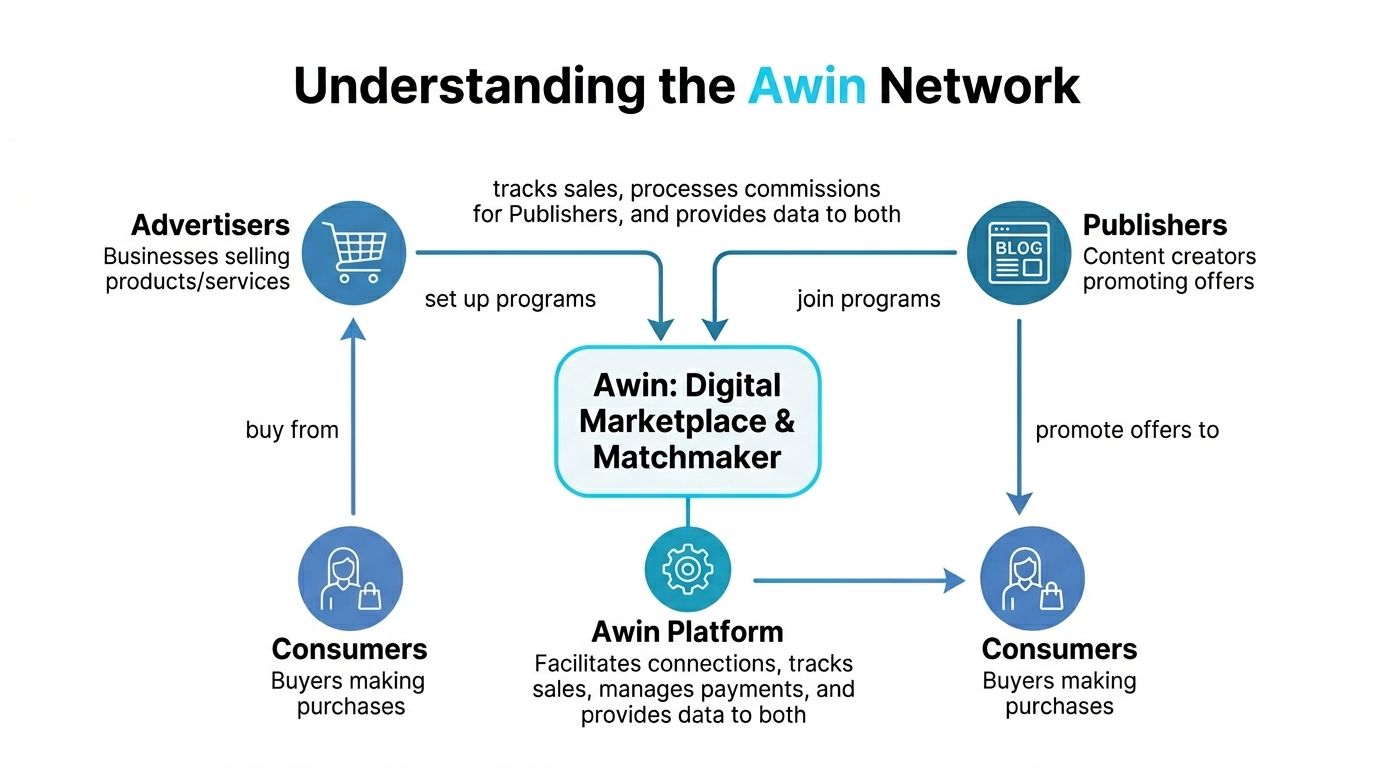
The simplest way to explain Awin is this. It’s a digital marketplace and matchmaker for affiliate partnerships.
A merchant joins because it wants outside partners to promote its products. A publisher joins because it wants access to offers it can promote. Awin provides the environment where those relationships can be formed, tracked, and paid.
If you’ve looked at other platforms, this overview of affiliate networks helps place Awin in the broader affiliate environment.
The four players in the transaction
Every awin affiliate transaction has four moving parts.
| Player | Role | What they care about |
|---|---|---|
| Merchant | Sells the product or service | Sales quality, margin, partner fit |
| Affiliate | Promotes the offer | Earnings, approval rates, conversion potential |
| Customer | Clicks and buys | Price, trust, timing, offer clarity |
| Awin | Tracks and manages the partnership layer | Attribution, reporting, commission processing |
That sounds straightforward, but new teams often miss one important detail. Awin doesn’t create demand by itself. The merchant still needs a good offer. The affiliate still needs an audience and a traffic source that matches the product.
What happens after a click
A basic transaction flow usually looks like this:
- The affiliate joins a merchant program
- The affiliate creates a tracked link
- A customer clicks the link
- The customer lands on the merchant site and makes a purchase
- Awin records the action
- The merchant validates the transaction
- The affiliate receives commission if the action is approved
The key word there is validated.
A sale being tracked doesn’t automatically mean it will be paid. Orders can be reviewed, cancelled, returned, or declined based on the merchant’s program rules. That’s one of the first points that trips up new publishers.
Why networks exist in the first place
Without a network, every merchant would need to build direct tracking, contracting, partner payment workflows, and fraud controls for every publisher relationship. Some large brands do parts of that internally, but for many teams it’s too inefficient.
Awin reduces that friction by centralizing the mechanics. It gives publishers one environment for discovering offers and merchants one environment for recruiting and managing partner types that may range from content creators to loyalty sites.
A network doesn’t remove complexity. It organizes it.
That distinction matters. If your team expects Awin to work like a simple ad platform, you’ll misread what the platform is for. It’s not buying media in the usual sense. It’s managing relationships where compensation depends on tracked outcomes.
The practical takeaway
When someone asks, “What is Awin?”, the useful answer isn’t “an affiliate network.” The useful answer is this:
It’s the operating layer between merchants and publishers. It helps them find each other, track actions, review performance, and settle commissions in a structured way.
That’s why understanding the mechanics early saves time later. It helps affiliates avoid unrealistic payout expectations, and it helps merchants build a program that partners want to join.
Getting Started on Awin for Affiliates and Merchants
Joining Awin looks different depending on which side of the marketplace you’re on. That’s where many beginner guides fall short. They talk about “signing up” as if one process fits everyone.
It doesn’t.
Awin onboarding at a glance
| Aspect | For Affiliates | For Merchants |
|---|---|---|
| Primary goal | Get accepted into programs and start promoting | Launch a trackable program and recruit partners |
| Main hurdle | Approval, setup cost, early payout timing | Integration, program structure, partner quality |
| First practical task | Complete profile and apply to relevant advertisers | Configure tracking and define commercial terms |
| Common early mistake | Applying broadly without a traffic angle | Launching without clear recruitment or compliance rules |
If you want a broader walkthrough of publisher applications before you pick specific programs, this guide on how to join affiliate programs gives useful context.
For affiliates
Most affiliates start with the wrong question. They ask, “How many programs can I join?” The better question is, “Why would a merchant approve me?”
Awin advertisers want signals that you can promote responsibly. That usually means a real website, content channel, email property, or promotional method that fits the merchant’s brand.
What your application needs to communicate
Your profile should make three things obvious:
- Traffic source clarity: Explain whether you run content sites, social channels, newsletters, loyalty communities, or another model.
- Promotional fit: Show that your audience overlaps with the products you want to promote.
- Professional setup: A complete profile reduces uncertainty for advertisers reviewing your application.
A vague application creates friction. If your description says little more than “marketing online,” many advertisers will skip it.
The fee and payout reality
This is one of the least glamorous parts of Awin, but it matters. Awin charges new affiliates a one-time sign-up fee, such as $5 in the US, and has a minimum payment threshold, such as $20, which can delay initial payouts for smaller publishers (Awin guide to affiliate networks and online marketing).
That doesn’t make the platform bad. It means very small publishers can feel the friction early.
If you only expect occasional commissions, you may wait longer than you hoped for your first payout. If you already have traffic and a clear promotional plan, the issue is less severe because you can build volume faster.
Don’t treat the sign-up fee as the main decision point. Treat payout timing as a significant operational issue if your traffic is still small.
A practical affiliate starting sequence
A solid first month usually looks like this:
- Pick a narrow vertical: Don’t apply to everything. Start with offers that match your existing audience.
- Join fewer programs well: A handful of relevant merchants beats a long list you never promote properly.
- Build tracked content early: Product comparisons, gift guides, tutorials, and resource pages tend to create cleaner context than random link placement.
- Watch approval behavior: If a merchant regularly declines your application or doesn’t fit your channel, move on.
For merchants
Merchants have a different onboarding path. Your first challenge isn’t application approval. It’s building a program that can track correctly and attract the right partners.
What merchants need before launch
You should have answers to these questions before the program goes live:
What action are you paying for
Sales are the common model, but your internal team should still define which transactions qualify and which don’t.
Who are you trying to recruit
Content partners, coupon sites, loyalty partners, creators, and tech partners all behave differently. If you don’t know your target mix, recruitment becomes reactive.
What are your rules
Brand terms, voucher policies, approval criteria, and communication standards need to be clear from day one.
The technical side
Merchants also need working tracking implementation. In Awin environments, that usually means tag or server-side setup that allows clicks and conversions to be captured correctly.
Affiliate teams often underestimate the workload here. A program with weak integration doesn’t just create reporting problems. It creates distrust. Publishers notice when tracking feels unreliable, even if they can’t diagnose the root cause.
Merchant launch priorities
- Write a usable program description: Tell publishers what you sell, who converts best, and what promotional methods you accept.
- Prepare creative assets: Banners matter less than they used to, but clean links, clear copy, and current offers still help.
- Define your validation workflow: Someone on your team must review transactions and handle publisher communication.
- Set realistic recruitment expectations: Launching a program doesn’t guarantee partner activity. Recruitment is ongoing work.
The key difference between the two paths
Affiliates join to find monetization. Merchants join to build a channel.
That difference shapes everything. Affiliates are trying to get in. Merchants are trying to create an environment worth joining. Once your team understands that split, Awin starts to make more operational sense.
Navigating Key Awin Platform Features
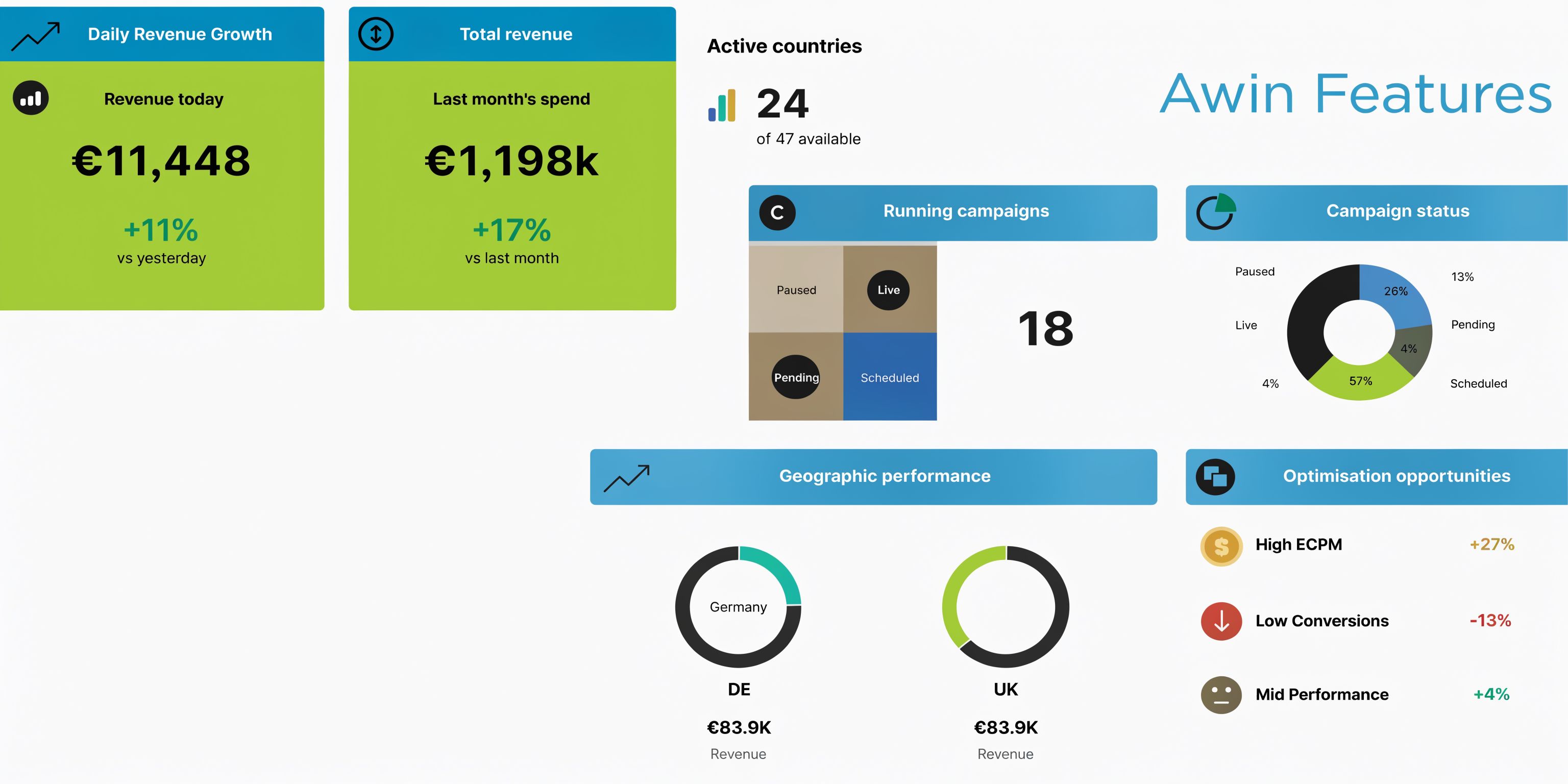
Awin becomes more useful once you stop seeing it as a login screen and start seeing it as a control system. The most important features aren’t the flashy ones. They’re the ones that protect attribution, improve partner management, and help you spot bad data before it costs you money.
If your team is comparing tracking capabilities across platforms, this roundup of best affiliate tracking software is a useful reference point for the tracking software market.
Dashboards and reporting
For both merchants and affiliates, the dashboard is where daily judgment happens.
Affiliates usually care about approved transactions, pending transactions, merchant performance, and the promotional materials they can access. Merchants focus more on publisher activity, transaction quality, recruitment progress, and whether specific partner types are driving useful sales.
A dashboard only helps if your team asks the right questions.
- Affiliates should ask: Which merchants convert consistently, and which ones look active but don’t validate well?
- Merchants should ask: Which publishers are driving incremental value, and which ones are capturing demand that would have happened anyway?
That distinction matters more than raw top-line activity.
Publisher discovery and program management
For merchants, one of the most practical Awin functions is partner discovery. You can recruit across different publisher models instead of relying on whoever happens to apply.
That’s important because publisher type affects how your program grows. A coupon partner behaves differently from a content creator. A loyalty site behaves differently from a niche editorial publisher. The platform helps organize those relationships, but it’s still up to the affiliate manager to decide who belongs in the program and who doesn’t.
Why tracking technology matters more now
Affiliate managers used to get away with basic browser-dependent setups. That world has changed.
Awin’s Conversion Protection Initiative uses server-to-server tracking to bypass browser restrictions and has recovered over $250 million in lost revenue for brands by ensuring up to 100% accurate attribution (coverage of Awin CPI and attribution gaps).
That sounds technical, but the business impact is easy to understand. If browser restrictions interrupt your tracking, legitimate partner sales can go unattributed. Then publishers get underpaid, merchants get distorted performance data, and budget decisions get worse.
Reliable affiliate tracking isn’t a reporting convenience. It’s the basis of trust between the merchant and the publisher.
Fraud controls and compliance signals
Fraud prevention sits in the same category. Teams often treat it as a side issue until they start seeing suspicious click patterns, odd approval behavior, or publishers whose numbers don’t make sense.
Awin’s proactive fraud detection uses device fingerprinting and behavioral analysis to flag irregularities such as conversion approval rates below 20%, and these systems can block over 90% of suspicious traffic before it impacts an advertiser’s budget (SEON overview referencing Awin fraud detection practices).
That matters because merchants don’t lose commission dollars from bad traffic. They lose trust in the channel and may overreact by tightening rules on legitimate partners too.
When a publisher’s numbers look unusually good or unusually chaotic, don’t guess. Review the traffic quality before you scale or approve more exposure.
What matters most in day-to-day use
For affiliates, the feature set matters less than these questions:
- Can you identify which programs are worth your content effort?
- Can you trust the reported outcomes enough to scale?
- Can you see enough detail to know why performance changed?
For merchants, the daily questions are slightly different:
- Are you recruiting the right publisher mix?
- Are you validating fairly and on time?
- Are you protecting attribution and budget quality?
- Are your reports helping you act, or telling you what already happened?
Those are the practical filters. If a feature doesn’t help with one of those jobs, it’s not a core feature. It’s decoration.
Strategies for Success on the Awin Network
The teams that do well on Awin usually aren’t the teams using the most features. They’re the teams making cleaner decisions.
That starts with partner selection. Awin works best when merchants recruit according to market behavior instead of defaulting to the same publisher mix everywhere. In Awin’s global survey with Forrester, Germany showed loyalty and reward partners as the most popular affiliate type at 69% adoption, while US advertisers favored coupon sites at 57% (Awin global affiliate marketing views). That doesn’t mean every German program needs loyalty or every US program needs coupons. It means local channel habits matter.
For merchants
A common mistake is recruiting whoever’s easiest to find.
That creates a lazy program mix. You may end up heavy on one partner type because those publishers are quick to apply, not because they fit your goals.
A better approach is to recruit in layers:
- Start with fit, not volume: If your product needs education, content and creator partners may matter more than discount-led exposure.
- Use incentive partners deliberately: Coupon and loyalty publishers can be valuable, but they need rules around code usage, brand bidding, and incrementality.
- Write useful outreach: Publishers respond better when you explain audience fit, conversion context, and what support they’ll get.
Merchant optimization habits that help
Some improvements are simple and unglamorous:
- Refresh promotional copy: Outdated messaging slows publisher activation.
- Reply to applications quickly: Good partners often apply to several programs at once.
- Share what converts: If certain landing pages or categories perform better, tell your publishers.
A merchant program grows faster when the affiliate manager acts like a partner owner, not a gatekeeper.
For affiliates
Affiliates often spread themselves too thin on Awin. They join many programs, create a few links, then wonder why revenue stays flat.
A tighter operating style works better.
What stronger affiliates do differently
They build around relevance.
A publisher with a home office blog should lean into office equipment, software, and productivity products that fit existing content. A fashion creator should choose merchants that match the audience’s price point and style expectations. Generic promotion leads to weak click intent.
They also evaluate merchants beyond headline commission terms. A merchant with solid conversion behavior, clear creatives, and responsive communication can outperform a merchant that looks better on paper but creates friction in practice.
Smart affiliate workflow
Try this sequence instead of random promotion:
- Choose a content theme with buyer intent.
- Pick a small set of merchants that fit that theme.
- Build one strong asset, suchs a comparison article or tutorial.
- Review which merchants validate cleanly and which ones stall.
- Expand only after you know what’s working.
That process sounds slower, but it usually produces better partner fit and cleaner earnings patterns.
The shared strategy
Merchants and affiliates both win when expectations are explicit.
If merchants communicate policies, timelines, and top-performing offers clearly, publishers can promote with confidence. If affiliates explain traffic sources clearly and send relevant traffic, merchants are more likely to approve applications, offer support, and prioritize the relationship.
Success on an awin affiliate program usually looks less like a growth hack and more like disciplined partner management.
Common Pitfalls and How to Avoid Them
Most Awin problems don’t come from the platform itself. They come from mismatched expectations, sloppy setup, or poor-quality partnerships.
That’s why the painful issues tend to repeat.

Pitfall one: assuming tracked means paid
Affiliates often celebrate a tracked sale too early. Merchants often assume affiliates understand their approval rules without being told.
Both sides should remember that tracked transactions still go through review. If your program rules are vague, frustration builds quickly. Affiliates think commissions disappeared. Merchants think declines are self-explanatory.
Pitfall two: weak tracking confidence
When tracking isn’t implemented cleanly, nobody trusts the numbers. Publishers become hesitant to invest effort. Merchants start doubting channel performance.
This doesn’t always show up as a dramatic error. Sometimes it shows up as nagging uncertainty, odd conversion timing, or unexplained reporting gaps.
Pitfall three: ignoring fraud signals
Fraud in affiliate programs rarely announces itself clearly. It often appears as patterns that feel “off.”
Awin’s proactive fraud detection uses device fingerprinting and behavioral analysis to flag irregularities such as conversion approval rates below 20%, and these systems can block over 90% of suspicious traffic before it impacts an advertiser’s budget (SEON overview referencing Awin fraud detection practices).
That matters because merchants don’t lose commission dollars from bad traffic. They lose trust in the channel and may overreact by tightening rules on legitimate partners too.
When a publisher’s numbers look unusually good or unusually chaotic, don’t guess. Review the traffic quality before you scale or approve more exposure.
Pitfall four: poor communication
A lot of “platform problems” are communication problems.
- Affiliates need clarity on approval timing, promotional restrictions, and what the merchant wants.
- Merchants need clarity on how a publisher plans to promote and whether that method fits the program.
Short, direct communication prevents long disputes later.
Pitfall five: treating launch as the finish line
Merchants often think a newly launched program will start growing on its own. Affiliates often think joining a network will instantly create income.
Neither is true.
Programs need recruitment, monitoring, policy enforcement, and regular cleanup. Affiliates need content, placement strategy, and merchant selection discipline. Awin can support those jobs, but it won’t do them for you.
Evaluating Awin and Finding Alternatives on Affiliate Platform Directory
Awin is a strong network, but it isn’t the perfect fit for everyone.
Its strengths are clear. It has scale, broad advertiser and publisher access, mature tracking infrastructure, and technical work around attribution and fraud that matters more now than it did a few years ago. For merchants, that can make it a serious operational base. For affiliates, it can provide access to a wide range of monetization opportunities inside one ecosystem.
Its trade-offs are also real.
For small affiliates, platform fees and payout thresholds can feel annoying early on. For merchants, setup and program management require attention. For both sides, the platform makes more sense once you have a process. If you’re hoping for a plug-and-play revenue button, Awin will probably feel more demanding than expected.
When Awin is a good fit
Awin usually makes sense when:
- You want network depth: You need access to many advertisers or many publisher types.
- You care about tracking maturity: Attribution and fraud controls are not side concerns for your business.
- You can operate the program actively: Someone on the team can manage recruitment, validation, and partner communication.
When you should compare options
You should compare alternatives if:
- You’re a small publisher: Early monetization friction matters more to you than network scale.
- You need a simpler operating model: Your team may prefer another network’s workflows or category mix.
- You’re doing due diligence across the stack: Network choice often connects to tracking, fraud tools, payment setup, and agency support.
If you’re at that comparison stage, use a neutral directory rather than relying on whichever platform has the strongest sales pitch. A practical starting point is this guide to the best affiliate networks in the sector, then compare network profiles, partner types, reviews, and adjacent tools based on your actual use case.
The right question isn’t “Is Awin good?” The right question is “Is Awin the right operating environment for my program, traffic model, and team maturity?”
Our Affiliate Platform Directory helps you answer that question with less guesswork. Use our Affiliate Platform Directory to compare networks, discover tracking and fraud tools, evaluate agencies and platforms, and do proper due diligence before you commit to partners.
Ready to explore the affiliate landscape?
Discover networks, tools, and opportunities in our directory.
Explore Directory