
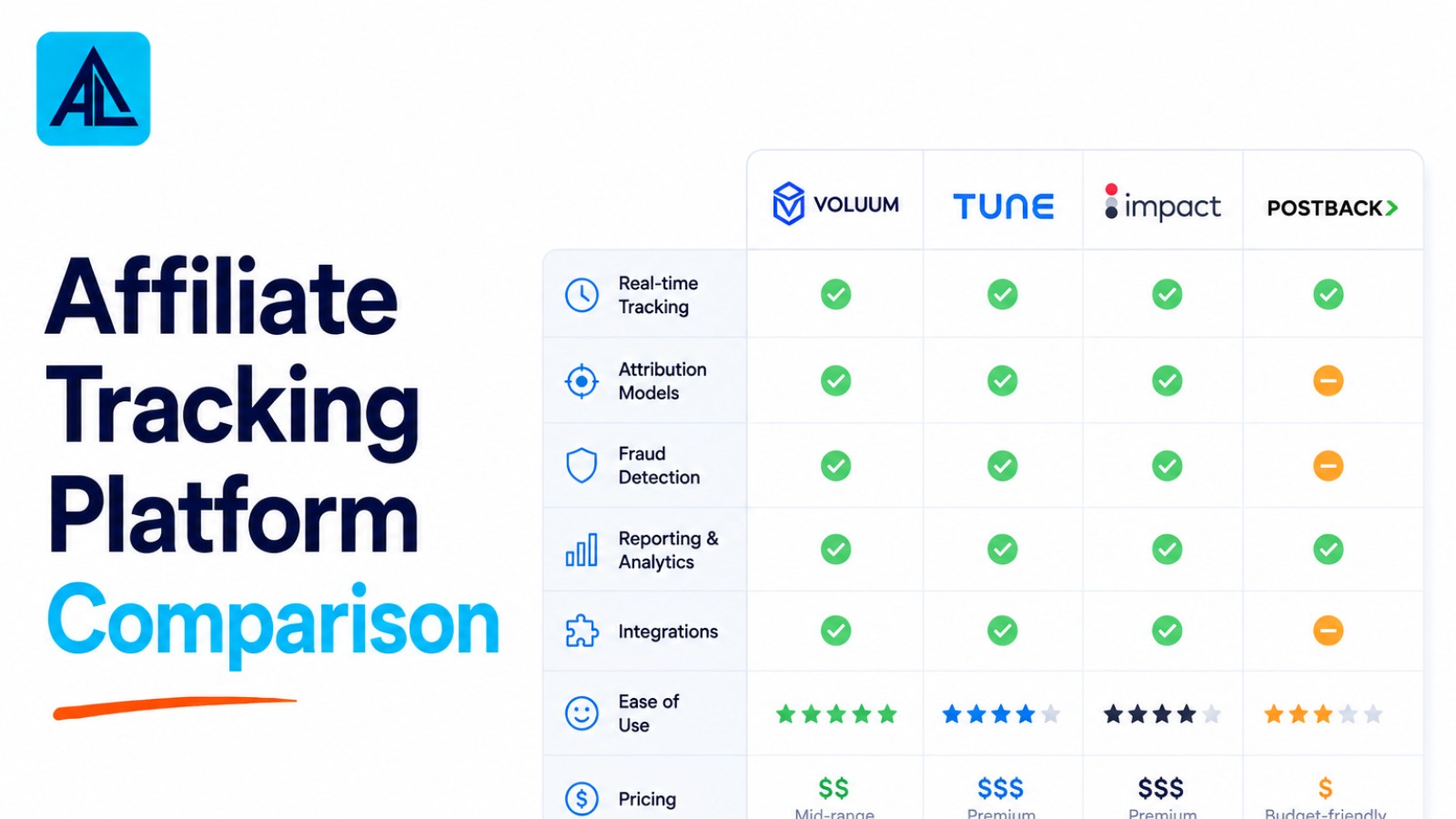
Affiliate Tracking Platform Comparison: Complete Guide
Compare affiliate tracking platforms on attribution accuracy, pricing at scale, fraud detection, and compliance. Find the right tool for your program stage
Last updated: 26 June 2026
Choosing an affiliate tracking platform shapes your program's accuracy, cost structure, and legal exposure in ways that a feature grid rarely shows. This comparison works through four variables that predict outcomes: how the platform assigns credit, what it charges as volume grows, how deeply it connects to your existing stack, and what the contract locks you into. Most programs discover the gaps after signing, not before.
No single platform wins across all four dimensions. The right choice depends on your program size, tech stack, and how much attribution complexity your affiliate mix requires.
What Separates One Affiliate Tracking Platform from Another
Affiliate tracking platforms sit between a publisher's click and a merchant's confirmed sale. They record every step in that chain and assign credit based on rules you configure. Meaningful differences show up in four places: credit assignment, pricing as you scale, integration depth with your existing stack, and contract terms.
Affiliates who use tracking data to personalize their content see a 31% higher click-through rate on affiliate links compared to generic placements. That lift only materializes if the underlying attribution is accurate enough to tell affiliates what is actually working.
Four Things to Know Before You Compare Platforms
Tracking method shapes accuracy more than any other variable
Cookie-based tracking drops attribution whenever a user clears cookies, switches browsers, or uses Safari's Intelligent Tracking Prevention. Server-side tracking routes conversion data through your own server before passing it to the platform, making it far more resilient to browser restrictions. Track360's 2026 comparison framework scores platforms specifically on tracking method as a primary criterion.
Pricing models compound differently at scale
A flat SaaS fee of $500/month looks expensive against a 2% revenue-share model at $20,000 in monthly affiliate-driven revenue. At $200,000/month, that math reverses. Map your projected volume before you benchmark costs.
Data ownership is inconsistent across vendors
Some platforms retain your publisher relationships and conversion data inside their ecosystem. If you migrate, you may lose historical attribution records or find that affiliates are contractually tied to the network, not to you. Closed ecosystems often offer better publisher discovery, but you are building on rented ground.
No platform wins every category
A tool with precise server-side tracking may have a weaker publisher marketplace. One with a large affiliate network may charge percentage-of-revenue fees that hurt at scale. The comparison only works if you weight categories against your actual program stage.
How Affiliate Tracking Platforms Work Under the Hood
Most platforms support three core tracking methods: pixel-based (a snippet fires on the confirmation page), postback URLs (a server-to-server call from your system to the platform), and hybrid setups that use both as a fallback.
The Click-to-Conversion Chain
When a visitor clicks an affiliate link, the platform stamps a unique identifier, typically stored as a cookie or passed as a URL parameter, then waits for a matching signal on the conversion side. Pixel tracking fires a small image or JavaScript tag on the order confirmation page. Server-to-server (S2S) postbacks skip the browser entirely: your cart system sends an HTTP request directly to the tracking platform once a sale confirms. S2S is more reliable because it does not depend on the buyer's browser loading the pixel correctly.
Digitalapplied's 2026 affiliate marketing benchmarks show S2S postback adoption rising steadily as programs move away from cookie-dependent methods, a direct response to browser-level privacy changes.
Attribution Windows and Multi-Touch Credit
Attribution windows define how long after a click a conversion can still be credited to that affiliate. Thirty days is a common default, but platforms handle multi-touch scenarios very differently. Last-click attribution gives 100% of the commission to the final affiliate link before purchase. First-click rewards the affiliate who introduced the customer. Linear models split credit across every touchpoint.
Last-click systematically over-rewards coupon and loyalty sites that appear at checkout, while first-click can under-reward the content publisher who drove initial awareness. Choosing one without understanding your funnel will distort your payout data and eventually your publisher mix.
Where Tracking Breaks
Three failure points show up consistently: Apple's Intelligent Tracking Prevention (ITP) caps first-party cookie lifespans at seven days and blocks third-party cookies entirely. Ad blockers strip tracking pixels before they fire. Cross-device gaps occur when a user clicks on mobile but converts on desktop, and the platform has no way to stitch those sessions together without a logged-in user ID.
S2S postbacks solve the ad-blocker problem because the call never touches the buyer's browser. They do not solve cross-device attribution unless your platform integrates with a customer identity layer.
When Platform Choice Actually Changes Program Performance
Platform choice has measurable impact in three specific situations: when transaction volume is high enough that tracking latency translates directly into lost commissions, when fraud exposure exceeds what entry-level tooling can catch, and when your markets require GDPR or CCPA compliance that some platforms handle poorly.
Tracking Latency at High Volume
At low transaction volumes, a 200-millisecond delay in a tracking pixel barely registers. At 50,000 conversions a month, the same latency compounds. Postback-based server-side tracking fires faster and more reliably than pixel-based setups. PSM Track's platform evaluation guide notes that server-side tracking is one of the primary differentiators between entry-level and mid-market platforms, particularly for programs running high-frequency flash sales or subscription billing cycles.
Server-side tracking requires developer time to implement correctly. Smaller teams often default to pixel tracking because it ships faster, but this is worth revisiting once monthly conversions clear a few thousand.
Fraud Detection Tiers
Entry-level platforms typically flag obvious patterns: duplicate click IDs, mismatched IP geolocation, and statistically impossible conversion rates. Enterprise tiers run behavioral scoring across sessions, device fingerprinting, and real-time traffic quality analysis. The practical difference shows up in programs running paid traffic affiliates, where click injection and cookie stuffing are common enough to move the budget needle.
A 2024 study from the Association of National Advertisers estimated that invalid traffic cost U.S. advertisers $8.2 billion in digital ad spend that year. Platforms that catch fraud earliest are the ones with layered detection rather than rule-based filters alone.
Compliance: GDPR, CCPA, and Consent Mode
This is where platform choice can create legal exposure. Programs operating in the EU need tracking that respects consent signals from CMPs (consent management platforms). Google's Consent Mode v2, which became mandatory for EU advertisers using Google tags in March 2024, requires platforms to handle modeled conversions when users decline cookies. Not every affiliate platform has built compatibility with that framework.
CCPA adds a parallel requirement for California residents, specifically around data sale opt-outs. Before signing any contract, confirm where conversion data is stored, how long it is retained, and whether the platform's DPA covers your specific use case.
A Side-by-Side Comparison of Five Leading Platforms
Impact, PartnerStack, Tune, Refersion, and Post Affiliate Pro cover most of the affiliate tracking market, but they are built for different program types.
Impact
Impact uses server-side and cookieless tracking, which holds up better under browser privacy restrictions. Pricing starts around $500/month for smaller programs and scales into enterprise contracts. Its marketplace lists over 300,000 partners. The API is comprehensive, covering contract creation, reporting, and payment automation.
The trade-off: that marketplace size creates noise. A program in a narrow vertical may find most partners irrelevant.
PartnerStack
PartnerStack targets B2B SaaS specifically. Tracking is JavaScript-based with referral link fallback. Pricing runs roughly $500-$800/month depending on partner volume. Its network skews toward software affiliates and resellers, not content publishers.
If your program lives outside the SaaS vertical, PartnerStack's publisher pool will feel thin.
Tune
Tune (formerly HasOffers) is infrastructure-first: it gives you a white-label tracking platform with pixel, postback, and server-to-server options. There is no built-in publisher marketplace. Pricing starts near $279/month. Cpvlab's platform review positions Tune as the preferred choice for performance networks and agencies that need to run tracking for multiple advertisers under one roof.
Because Tune provides infrastructure rather than a managed network, you are responsible for recruiting and vetting your own publishers.
Refersion
Refersion is built for e-commerce brands, with native integrations for Shopify, WooCommerce, and BigCommerce. Tracking is primarily pixel and postback-based. Pricing starts around $99/month on the entry tier, scaling to $299/month and above for larger programs.
Refersion works well up to a few hundred active affiliates, but programs with complex commission structures or high fraud exposure tend to outgrow it.
Post Affiliate Pro
Post Affiliate Pro is one of the older platforms in this space, with a self-hosted option that gives you full data ownership. Pricing starts at $129/month for the cloud version. Tracking supports pixel, postback, and direct link methods. The platform supports over 170 commission types, split commissions, and lifetime commissions out of the box.
The self-hosted option is the clearest differentiator. If data residency requirements or contractual data ownership matter to your program, Post Affiliate Pro is one of the few platforms where that is genuinely possible.
How to Run Your Own Affiliate Tracking Platform Comparison
Step 1: Audit your current tracking gaps
Document where your current setup loses attribution. Check your conversion rate against actual order volume. If the gap is more than 5-10%, you likely have pixel failures, ITP-related cookie drops, or cross-device mismatches.
Step 2: Map your volume trajectory
Pull your last 12 months of affiliate-driven conversions and project forward 18 months. Then price each platform at your projected volume, not your current volume.
Step 3: Test the API before you commit
Most platforms offer a trial or sandbox environment. Test whether the platform can receive a postback from your cart system, pass conversion data back to your reporting layer, and handle a refund or reversal correctly.
Step 4: Ask three contract questions directly
- Who owns the publisher relationships if you leave?
- Can you export your full conversion history in a portable format?
- What is the notice period and data retention policy after cancellation?
Step 5: Run a parallel tracking period
If you are migrating from an existing platform, run both systems simultaneously for 30 days before cutting over. Compare attributed conversions side by side. Discrepancies above 3-5% warrant investigation.
Frequently Asked Questions
What is the difference between affiliate tracking and affiliate network?
An affiliate network is a marketplace that connects merchants with publishers and handles tracking, payments, and compliance under one roof. An affiliate tracking platform is the software layer only: it records clicks and conversions but does not supply publishers. Networks like CJ Affiliate or ShareASale bundle both functions. Platforms like Tune or Post Affiliate Pro give you the tracking infrastructure and leave publisher recruitment to you. Networks charge higher fees (often a percentage of commissions paid) in exchange for publisher access, while standalone platforms charge flat SaaS fees but require you to build your own publisher relationships.
How accurate is affiliate tracking in 2026?
Accuracy depends almost entirely on the tracking method. Pixel-based tracking running on a modern browser with ad blocking enabled can miss 15-30% of conversions, based on ad blocker adoption rates that now exceed 40% in some demographics. Server-to-server postback tracking, when implemented correctly, approaches 98-99% accuracy because it bypasses the browser entirely.
Can you run affiliate tracking without cookies?
Yes. Server-to-server postbacks do not use cookies at all. Some platforms also support fingerprinting-based attribution and first-party data matching through logged-in user IDs. Cookieless tracking is more complex to implement but is now the standard recommendation for programs that operate in Safari-heavy markets or EU jurisdictions where cookie consent rates are low.
What should you look for in an affiliate tracking platform's fraud detection?
At minimum, look for duplicate click filtering, IP geolocation validation, and conversion rate anomaly alerts. For programs spending more than $50,000/month on affiliate commissions, also evaluate whether the platform offers device fingerprinting, behavioral scoring, and real-time traffic quality scoring. Ask the vendor specifically how their system handles click injection, since that is the fraud type most likely to go undetected on entry-level platforms.
How do you migrate from one affiliate tracking platform to another without losing data?
Start by exporting your full conversion history, publisher contact list, and commission structure documentation before you give notice. Run both platforms in parallel for at least 30 days to validate that the new setup is attributing correctly before you decommission the old one. Notify your top 20% of affiliates directly, since they generate the majority of your volume. Confirm with the new platform that your postback URLs are live and returning 200 responses before you redirect any traffic.
Is a percentage-of-revenue pricing model ever better than a flat fee?
For very early-stage programs with low and unpredictable volume, a percentage-of-revenue model can be lower risk because you only pay when the program generates revenue. The problem is that the model does not scale. At $500,000/month in affiliate-driven revenue, a 2% fee is $10,000/month, which is more than most enterprise flat-fee contracts. If you expect your program to grow, negotiate a flat fee or a capped percentage from the start.
AffiliateLandscape Weekly
Enjoyed this? Get the weekly briefing.
Once a week: new affiliate programmes, industry news, upcoming events and hiring moves, curated for people working in performance marketing.
Ready to explore the affiliate landscape?
Discover networks, tools, and opportunities in our directory.
Explore Directory